



Answer in brief
Expect production scenarios, not just definitions: service design, failures, Kafka, security, performance, observability and testing. Prepare to explain your choices and their trade-offs.
At around five years of experience, prepare for Spring Boot questions about decisions you have made in production, not just annotations you can define. Expect to explain service boundaries, failure handling, Kafka consumers, OAuth2 security, configuration, performance, observability and testing. A strong answer states the constraint, makes a choice, names its failure mode and shows how you would verify it.
How Should You Structure a Senior Spring Boot Answer?
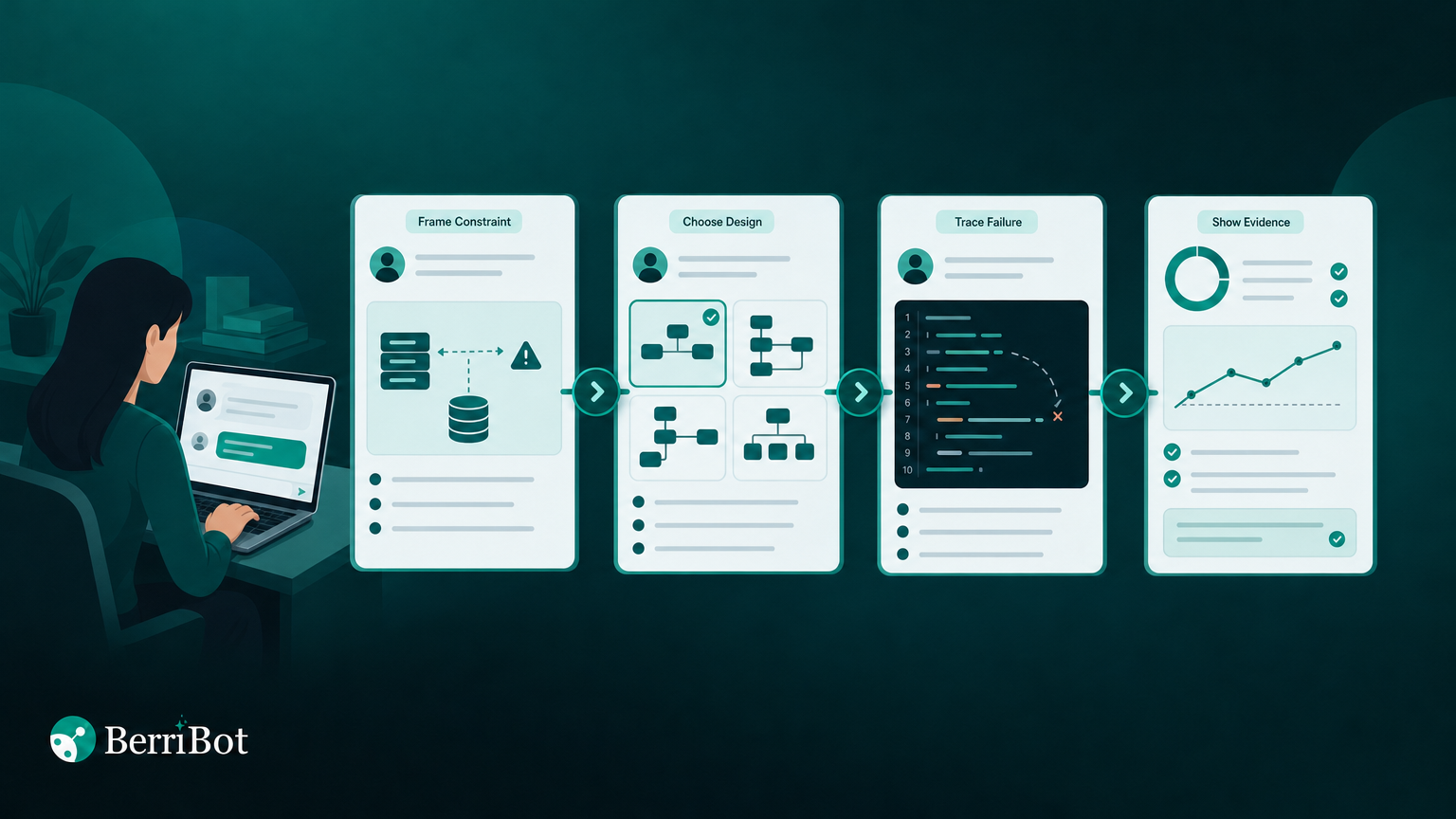
Use a short version of STAR, then add the design trade-off: Situation, Task, Approach, Result, Trade-off. For a hypothetical design question, describe how you *would* measure the result rather than inventing an outcome from work you have not done.
Keep these five prompts on a page while you practise:
Situation: What load, dependency or business constraint makes this difficult?
Task: What must remain correct or available?
Approach: What would you build, including the relevant Spring component?
Result: What metric or test would tell you it worked?
Trade-off: What complexity or risk did you accept, and what would trigger a change?
Your first minute should make the design understandable before you dive into configuration. For example: “If checkout needs an immediate stock answer, I would keep that call synchronous with a strict timeout. I would publish the order event asynchronously for downstream work, using an outbox so the database update and event cannot silently diverge. I would watch checkout latency, outbox backlog and duplicate processing before claiming the design is reliable.” Then invite a deeper question about transactions, retries or deployment.
Which Spring Boot Scenarios Should You Rehearse?
For each of the following questions, practise an opening answer aloud, then prepare one production failure and one verification step. The openings are starting points, not scripts: change the constraints and examples to match systems you actually know.
1. Where Would You Draw a Microservice Boundary?
“I would start with business ownership and data ownership, not split services by controller or table. A service should be able to change its rules without coordinated database edits across several teams.” Explain when you would keep a modular monolith instead, and how you would evolve an API without breaking callers. A shared writable database or a chain of chatty calls is a warning that the boundary may be wrong. Sketch one boundary from your own system and identify its owner, data and consumers.
2. When Would You Use a Synchronous Call Instead of an Event?
“I would use REST or gRPC when the caller needs an immediate answer and can tolerate the dependency; I would use an event when work can complete later and consumers should be decoupled.” Give an example such as immediate eligibility checking versus sending a notification after an order is accepted. Events bring eventual consistency, duplicate delivery and more difficult tracing, while synchronous chains increase latency and expose the caller to downstream failures. Say how you would carry a correlation identifier across both paths.
3. How Would You Handle a Transaction Spanning Services?
“I would not hold a local database transaction open across remote calls. I would model the workflow as a saga, make each step idempotent and define what compensation means if a later step fails.” Explain whether an orchestrator or events make ownership clearer for this workflow. If a service must update its database and publish an event, describe a transactional outbox to avoid a fragile dual write; be precise that compensation is a business action, not a guaranteed rollback of everything that happened.
4. How Would You Stop a Slow Dependency From Taking Down Your Service?
“I would set a timeout against the caller’s latency budget, retry only transient failures when the operation is safe to repeat, and use a circuit breaker or bulkhead to limit damage during sustained failure.” Explain that retries need a bounded count and backoff, and that stacked retries across services can amplify load. A circuit breaker does not replace a timeout; a fallback must not silently turn a failed payment into a successful one. In a Resilience4j discussion, offer to walk through what happens to one request when the downstream service slows, fails and recovers.
5. How Would You Make a Kafka Consumer Safe to Retry?
“I assume a record can be delivered again, so I make the business effect idempotent and distinguish temporary failures from records that will never succeed unchanged.” Describe where your idempotency key or processed-record check lives, when an error handler retries, and when a record goes to a dead-letter topic for investigation. Spring for Apache Kafka documents error handlers; distinguish a blocking retry from retry-topic designs, and account for ordering if your approach moves records between topics. Watch consumer lag and dead-letter volume. Avoid claiming that Kafka configuration alone makes an external database write exactly once.
6. How Would You Secure a Spring Boot API With OAuth2 and JWT?
“I would configure the API as an OAuth2 resource server, validate bearer tokens against a trusted issuer and keys, and authorize operations using the claims the service actually needs.” The Spring Security JWT resource server guide is a useful configuration reference. Explain issuer, audience where required by your token contract, expiry and key rotation; do not treat decoding a JWT as validation. For service-to-service calls, discuss an appropriate service identity and token propagation policy rather than forwarding every user token by default. Test an expired token, the wrong issuer and insufficient authority.
7. How Would You Manage Profiles, Secrets and a Risky Config Change?
“I would keep environment-specific settings outside the artifact, validate required values at startup and obtain secrets from a controlled secret store rather than commit them to a profile file.” Spring Boot’s external configuration guide explains config data and property precedence; Spring Cloud Vault provides a Vault integration when that is part of your stack. Say which source wins when values conflict, who can change a secret, and how a rotation or failed deployment is rolled back. For schema-dependent changes, describe an expand, migrate, contract rollout rather than assuming the old and new versions can switch instantly.
8. Where Would You Look First for a Slow Spring Boot Endpoint?
“I would separate time spent waiting for the database or another service from CPU and queueing time before changing pool sizes.” Check latency percentiles, database query plans, N+1 queries, connection-pool wait time, thread saturation and downstream timeouts. HikariCP’s maximum pool size must fit the database connection budget across *all* instances; increasing it without that calculation can make a bottleneck worse. Name one measurement that would support your diagnosis and one load test that could disprove it.
9. What Would You Instrument Before a Production Rollout?
“I would expose health and relevant metrics, connect traces across service calls and make failures searchable without leaking secrets into logs.” Spring Boot Actuator supports operational endpoints, while Micrometer Tracing is the tracing approach to discuss for modern Boot applications rather than assuming Spring Cloud Sleuth is the current default. Identify a small set of signals such as request latency, error rate, pool saturation and Kafka lag, then explain how you would follow one failing request. Do not expose sensitive Actuator endpoints publicly or put tokens in trace attributes.
10. What Testing Mix Would You Put in CI?
“I would keep most business-rule tests fast, use slice tests for framework boundaries, and run integration tests against real dependencies where mocks hide important behaviour.” Explain when `@WebMvcTest` or `@DataJpaTest` is enough and when database queries, migrations or Kafka handling deserve Testcontainers. Spring Boot supports Testcontainers integration through `@ServiceConnection`; check compatibility with the Boot version in your project before copying an example. Keep a small, reliable integration suite in the main CI path, and name which contract or failure case each container test protects.
These questions reward evidence of ownership. If your résumé describes production microservices but does not show the decisions or outcomes you can defend, revisit why your résumé may not be getting shortlisted as well as your interview answers.
How Can You Score Your Practice Answers?
Use the following self-assessment rubric, not as a claim about any employer’s actual scoring. Give yourself one to four points per row after answering a scenario without notes; aim to reach at least three in every row, rather than hiding a weak failure analysis behind a polished introduction.
Criterion | 1: Missing | 2: Partial | 3: Strong | 4: Excellent |
Problem framing | Jumps to tools | Names a goal | States constraints and success measure | Prioritizes competing constraints |
Design depth | Lists components | Describes a happy path | Explains ownership and data flow | Compares a credible alternative |
Failure and signals | Assumes success | Names one failure | Covers recovery and a useful metric | Connects failure, alert and rollback |
Spring correctness | Misuses concepts | Names relevant APIs | Applies them accurately | Explains version or configuration pitfalls |
Delivery | Rambles | Has a loose sequence | Clear opening and concise detail | Adjusts depth to follow-up questions |
A two-point resilience answer might say, “I would add retries and a circuit breaker.” A four-point answer explains the caller’s deadline, which failures qualify for retry, why the operation is idempotent, how a breaker protects capacity, and which metric would reveal a retry storm. Record one missing detail after each practice answer, then answer the same question again in one minute.
What Should You Check in the Final 48 Hours?
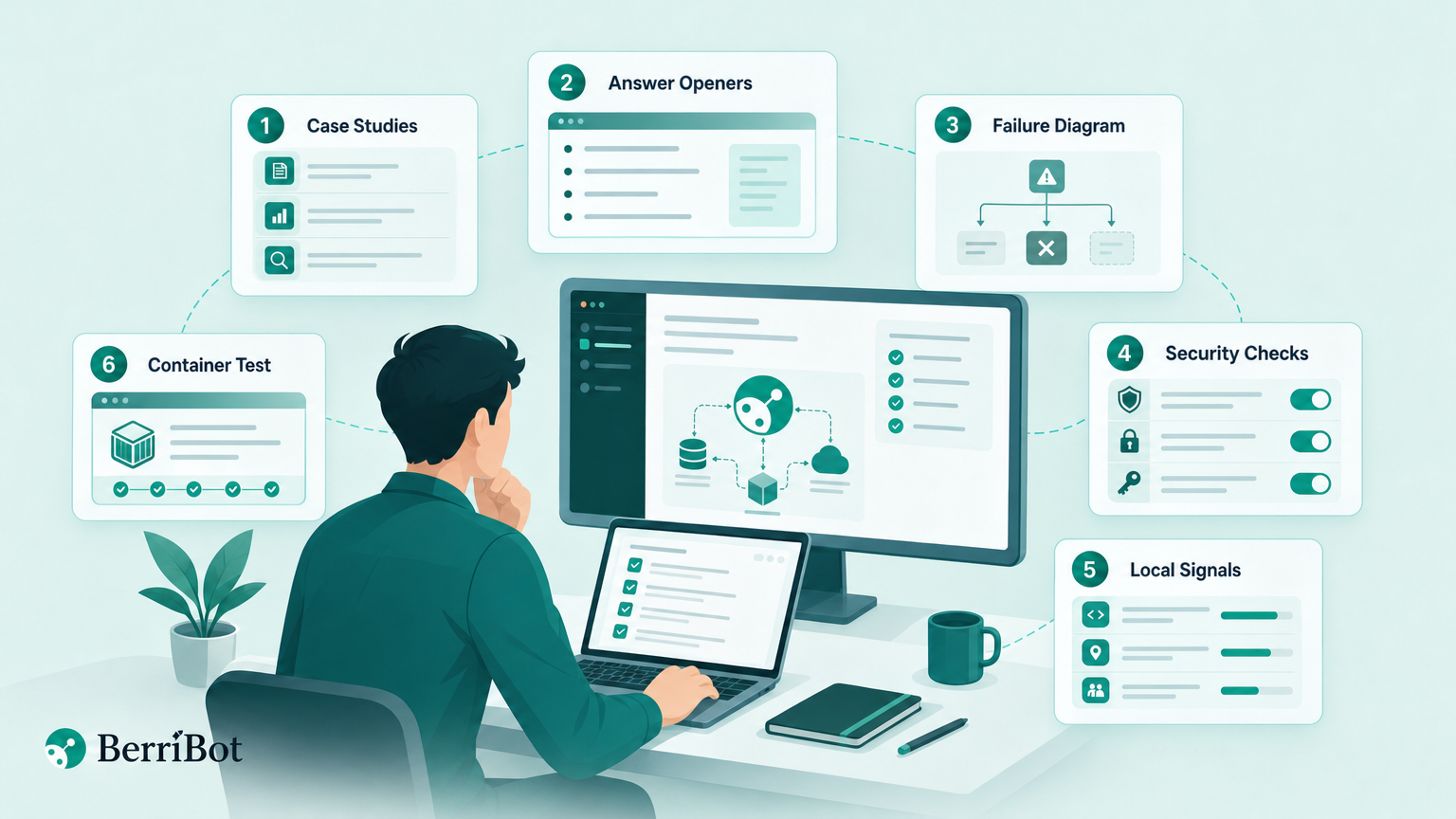
Rehearse decisions you can defend and verify a small working setup; do not try to memorise every Spring property. This checklist gives you useful evidence to draw on when an interviewer asks what you would actually run or measure.
Two case studies: Prepare one design you shipped and one decision you changed later. State your role and the trade-off honestly.
Answer openers: Record a one-minute answer for resilience, Kafka and security, then remove any unsupported claims.
Failure diagram: Draw one request path with a timeout, retry boundary, downstream dependency and observable failure.
Security checks: Verify the issuer and authorization behaviour in a sample API; test rejected as well as accepted requests.
Local signals: Inspect health and metrics locally, and decide which endpoints must remain restricted in deployment.
Container test: Run one database or Kafka integration test and confirm it works in CI, not only on your laptop.
Can BerriTalent Help You Show These Skills to Hiring Managers?
BerriTalent offers a free, standardized Berri Certified interview, with adaptive questions and live coding where the role needs it. You receive a tier and feedback; certified Gold or Silver profiles can be routed to hiring managers at participating partners when relevant roles are available, subject to your consent. The interview is a way to demonstrate skills without repeating the same first-round screen at each partner, not a guarantee of an introduction or a job.
Use the practice rubric above to prepare your own explanations; it is not Berri MasterMind’s scoring rubric. If you want to put your Spring Boot experience forward, you can build verified skill evidence or look at roles that match your background.
Interviews you can prove
Screening, interviews, and live identity verification in one platform. Built for high-volume technical hiring.
Book a demo