

Answer in brief
Berri 360 runs screening, outreach, scheduling, first-round interviews, and live identity verification within guardrails. Recruiters review exceptions and own hiring decisions.
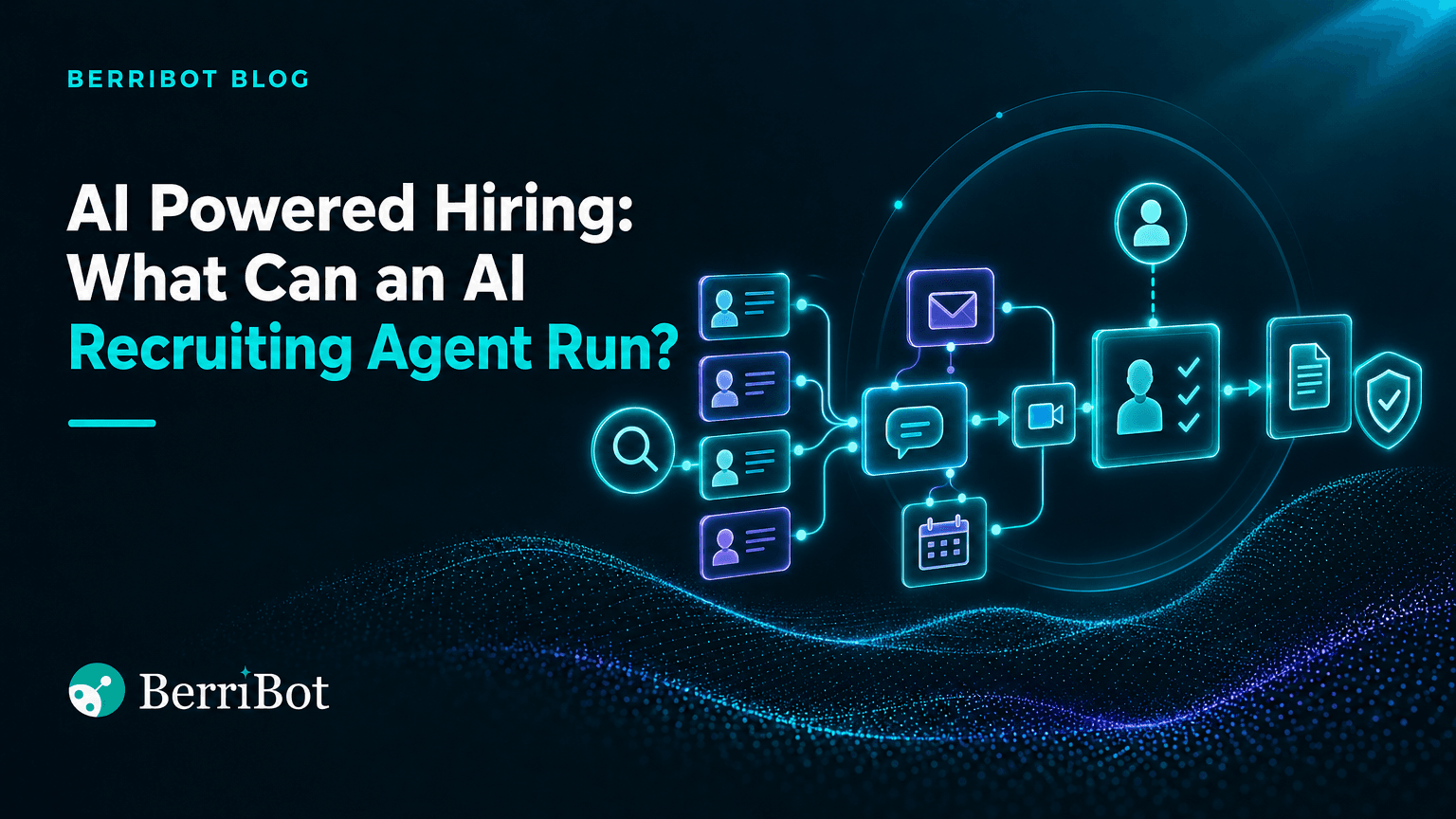
AI powered hiring lets an AI recruiting agent run repeatable recruiting work within rules set by the hiring team. Berri 360 connects screening, candidate outreach, scheduling, first-round interviews, and live identity verification. Recruiters review exceptions, assess the evidence, and make hiring decisions. For enterprise teams, the best starting point is high-volume work with clear criteria.
An agent is more useful than a collection of disconnected automations when one completed task can trigger the next. A qualified shortlist, for example, can move into outreach and scheduling without a recruiter copying candidate details between tools.
Autonomy still needs boundaries. Hiring teams must decide which criteria an agent can apply, when a candidate needs human help, and what evidence a hiring manager receives before making a decision.
This blog covers what an AI recruiting agent can run today, how Berri 360 hands work between agents, where human approval belongs, and what enterprise teams should test before expanding a pilot.
What Does an AI Recruiting Agent Do in AI Powered Hiring?
An AI recruiting agent acts on a recruiting objective within defined guardrails. Berri-Agents are AI workers that carry out screening, outreach, scheduling, interviewing, and verification tasks, then escalate exceptions to people. In Berri 360, those tasks form a connected hiring flow rather than separate activities a recruiter must coordinate manually.
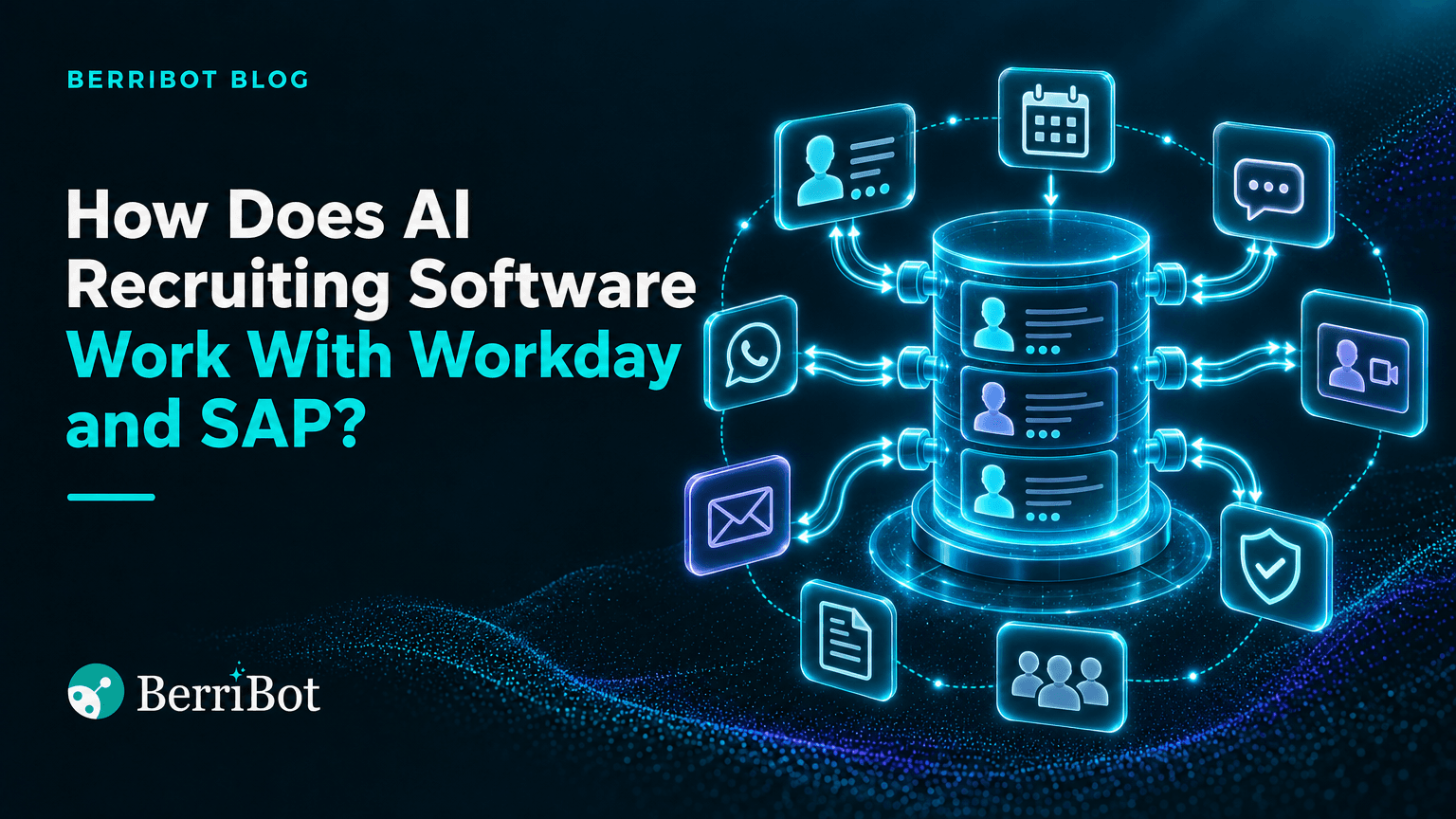
An applicant tracking system, or ATS, records candidates and moves them through configured stages. Conventional ATS automation might send an email when a recruiter changes a status. An agentic system can interpret a job description, identify relevant profiles, engage candidates, and arrange the next step, subject to the team's rules and approval points. The ATS can remain the system of record.
The Berri Suite comprises six products: Berri Search & Match for screening and matching, Berri Connect for engagement, Berri MasterMind for interviews, Berri Proctor for interview integrity, Berri 360 for the connected hiring flow, and Berri Tutor for upskilling. The distinction buyers should test is whether information moves between those stages with enough context for a recruiter to understand each recommendation.
Why Do Enterprise Teams Need Guardrails for Autonomous Hiring?
An AI recruiting agent can own a repeatable task without owning the hiring decision. For a TA leader overseeing thousands of technical roles, the practical question is which work can proceed under a policy and which events should stop for review.
Hiring Step | What the Agent Runs | Guardrail and Human Approval Point |
Screening | Parses profiles and ranks candidates against the role | Recruiters approve role criteria and review the shortlist |
ATS rediscovery | Searches existing candidate records | Recruiters confirm relevance before re-engagement |
Outreach and scheduling | Sends messages, handles replies, and coordinates interviews | Recruiters set contact rules and handle exceptions |
First-round interviews | Conducts structured, adaptive conversations | Hiring teams approve the rubric and review results |
Live verification | Checks identity and interview integrity | People review flagged evidence before taking action |
Scorecards and handoff | Produces explanations and coordinates next steps | Hiring managers assess evidence and make decisions |
1. Candidates Need a Way to Understand the Process
Gartner reported in July 2025 that only 26% of job applicants trust AI to evaluate them fairly. Consistent criteria help, but candidate trust also depends on clear communication, explainable results, and a way for people to review disputed outcomes. An autonomous workflow should make those responsibilities explicit before the first invitation goes out.
2. A Virtual Interview Needs Identity Checks
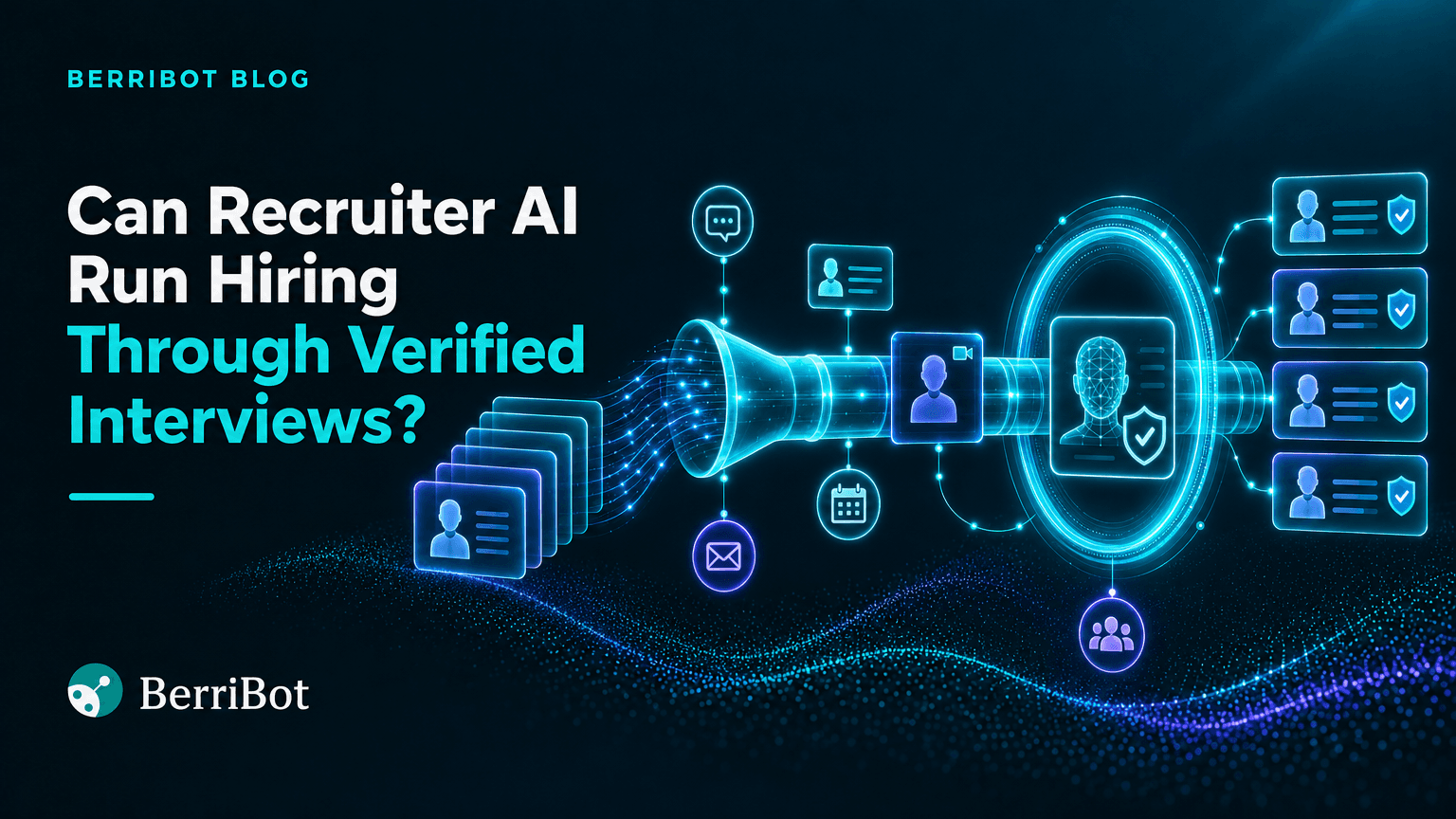
In Checkr's 2025 survey, 35% of hiring managers said they had confirmed that someone other than the listed applicant participated in a virtual interview. An assessment score alone cannot establish who took part in the conversation. Live identity verification gives the recruitment team evidence to review while the interview is still relevant to the decision.
3. Integrity Flags Need Human Review
Fabric reported that 38.5% of 19,368 interviews analyzed from July 2025 through January 2026 were flagged for cheating signals, rising to 48% for technical roles. Those figures come from Fabric's analyzed interviews and should not be treated as a general candidate fraud rate. They do show why a flagged signal must lead to evidence review, rather than an automatic adverse decision.
The operating rule is straightforward: agents run approved steps, while recruiters and hiring managers retain control over criteria, exceptions, and decisions.
How Does Berri 360 Hand Work Between Recruiting Agents?
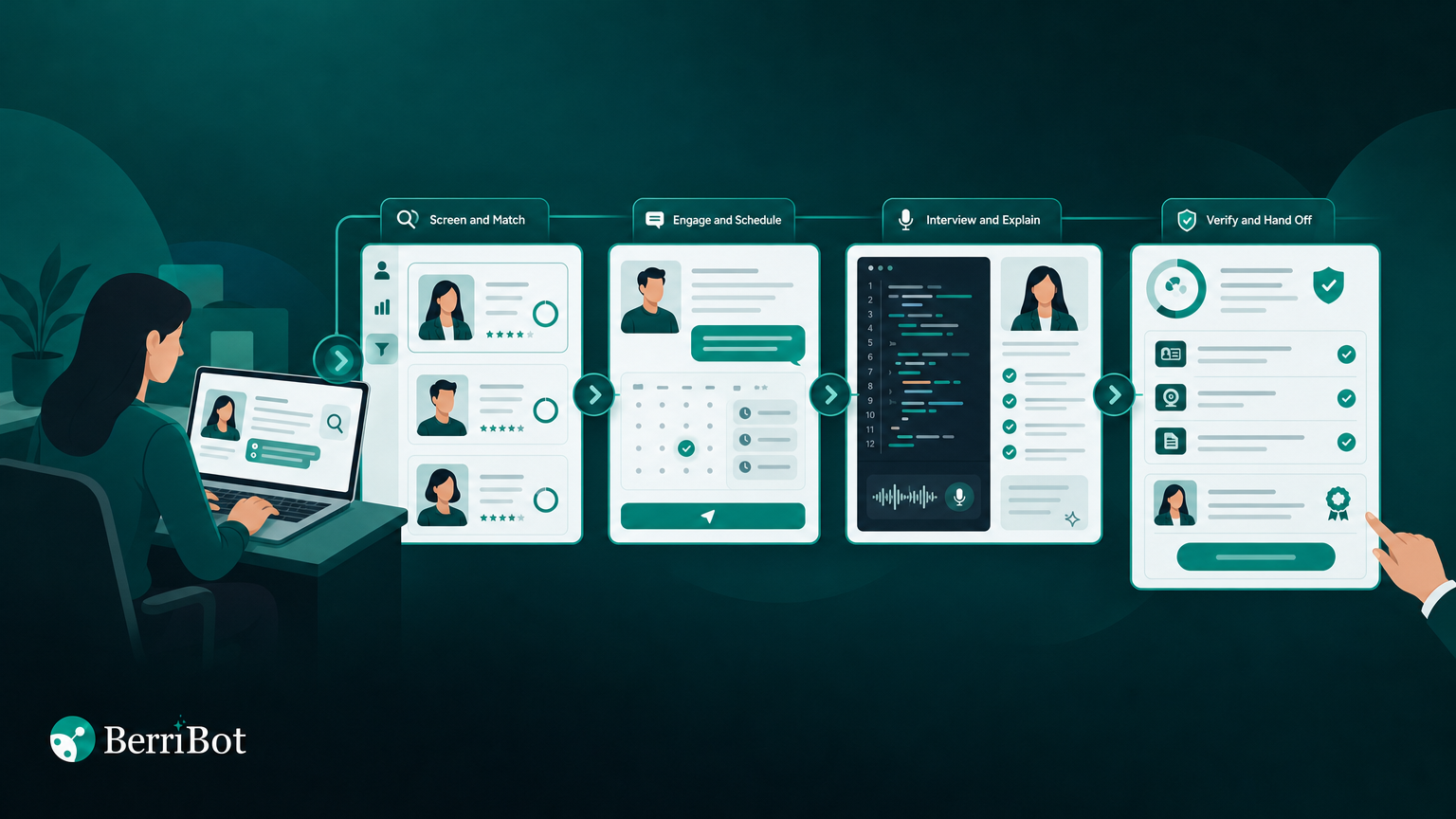
Berri 360 uses a Unified Agent Architecture to connect Contextual Resume Screening, Omnichannel Candidate Engagement, Adaptive AI Interviewing, Interview Fraud Prevention, Explainable Scorecards, and Onboarding Coordination. A handoff carries the candidate and role context forward, so the next step starts from the work already completed. High-Volume Scalability makes that connected flow relevant to enterprise hiring programs.
1. Screen and Match
The hiring team sets the job requirements, then Berri Search & Match parses profiles and ranks candidates against the role. Its Match Ranking Index, or MRI, is a ranking signal for candidate-to-job fit based on semantically parsed profiles. Recruiters can review the resulting shortlist and adjust the role criteria before candidates move into engagement.
2. Engage and Schedule
Once candidates are selected for contact, Berri Connect handles outreach, two-way replies, reminders, and interview coordination across supported channels. A candidate who responds can move toward an interview without a recruiter manually arranging every exchange. Recruiters still set communication rules and take over when a reply needs individual judgment.
3. Interview and Explain
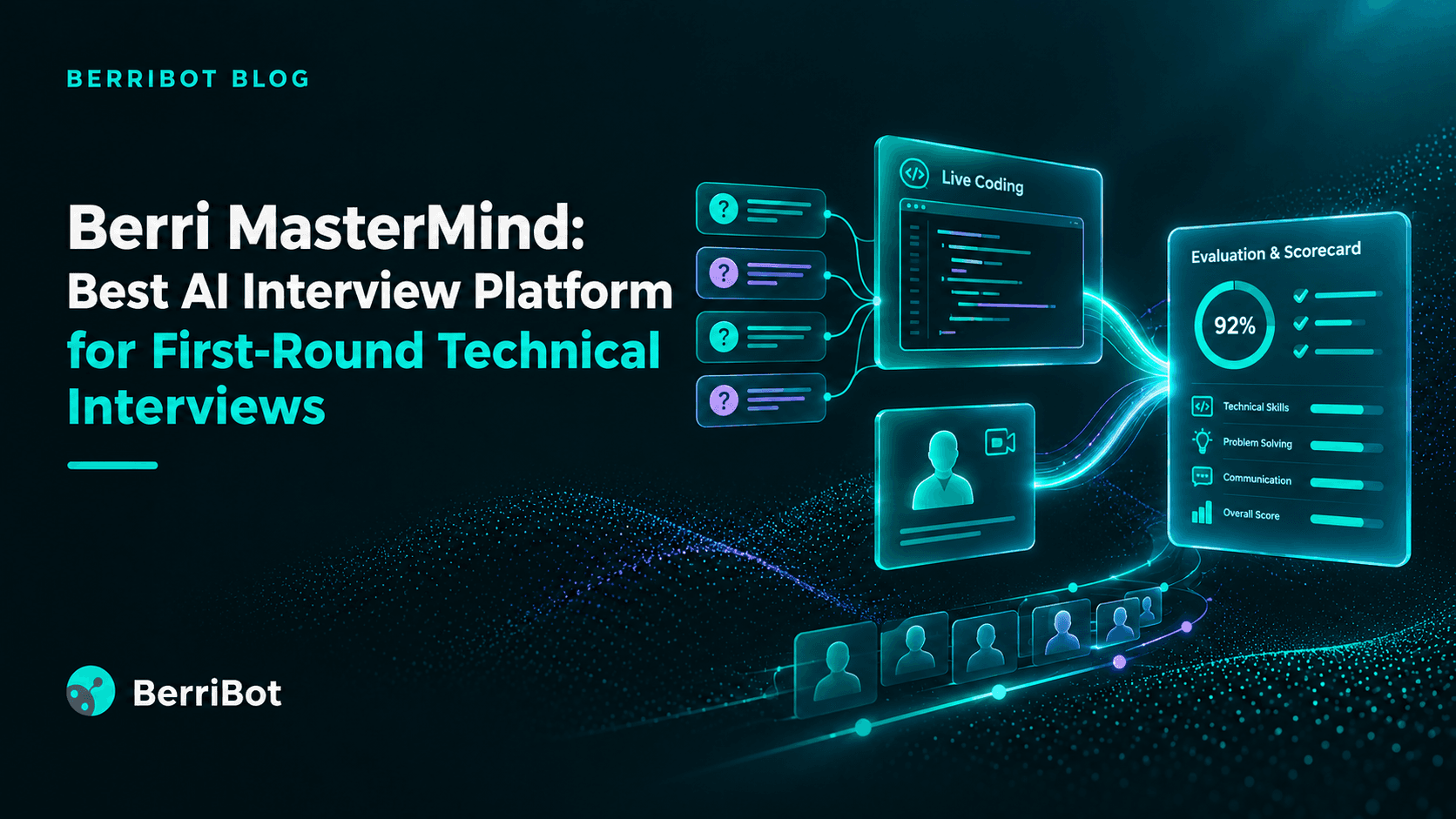
Berri MasterMind conducts adaptive first-round interviews using the role and candidate context. It supports interviewing in more than 140 languages and produces scorecards that explain the assessment against the role's criteria. Hiring managers review the evidence and retain the final decision; MasterMind does not infer a candidate's emotion, personality, or mood from their face or voice.
4. Verify and Hand Off
Berri 360 includes Interview Fraud Prevention powered by Berri Proctor. Identity verification and integrity checks run during the interview, with relevant flags available for human review. After the first round, Berri 360 can coordinate the next hiring and onboarding steps rather than leaving recruiters to rebuild the candidate's context.
How Can Teams Govern AI Interviews and Live Verification?
Live verification addresses a gap left by checking identity only at assessment login or after an offer. Berri Proctor uses biometric authentication and 3D liveness detection, an anti-spoofing check that analyzes depth cues in a live face capture to help confirm that a real person is present rather than a photo or recording. Its interview integrity capabilities also include environmental scene analysis, behavioral anomaly detection, and browser activity alerts.
A flag is a reason to inspect evidence, not a verdict about a candidate. SHRM India, citing a Wiley meta-analysis, reports that untrained people identified deepfake content with 55.54% accuracy. Combining verification signals with human review gives teams a more defensible process than relying on an interviewer's impression alone.
Governance starts before deployment. The NIST AI Risk Management Framework says, “Human judgment should be employed when deciding on the specific metrics related to AI trustworthiness characteristics and the precise threshold values for those metrics.” For a hiring pilot, TA should own role criteria and escalation rules, while InfoSec and privacy teams review access, retention, and candidate-data handling. IndusLaw's DPDP analysis identifies May 13, 2027, as the effective date for India's remaining DPDP provisions, making those reviews important to plan now.
What Results Support Berri 360 for Enterprise Hiring?
These numbers are our proof that connected recruiting automation can improve the capacity and pace of a hiring program. They are BerriBot's reported results, not guaranteed outcomes for every role. A buyer should establish a baseline and agree on how each metric will be measured during a pilot.
1. Recruiter Time
BerriBot reports 9.5 recruiter hours saved per offer. For an enterprise TA team, hours per offer is more useful than counting messages sent: it captures whether screening, coordination, and first-round work actually give recruiters time back. Measure the same work before and after rollout, including time spent reviewing exceptions.
2. Time to Offer
BerriBot reports a reduction from more than 25 days to a 10-day time-to-offer. A pilot should measure time from a defined starting point, such as application or approved requisition, through an accepted offer. Keeping the definition fixed makes a comparison meaningful across teams and roles.
3. Candidate Progression
BerriBot reports select-to-offer conversion rising from 33% to 78%. That measure is worth examining alongside shortlist quality and hiring-manager review, because faster progression alone does not establish that the right candidates advanced. Explainable scorecards help teams inspect the evidence behind progression decisions.
4. Interview Attendance
BerriBot reports a twofold increase in interview show-up rates. When testing that result, separate the effects of scheduling, reminders, and candidate engagement from changes in the roles being hired. Track integrity flags separately, including how many required review and how each review was resolved.
How Should Buyers Evaluate an AI Recruiting Agent?
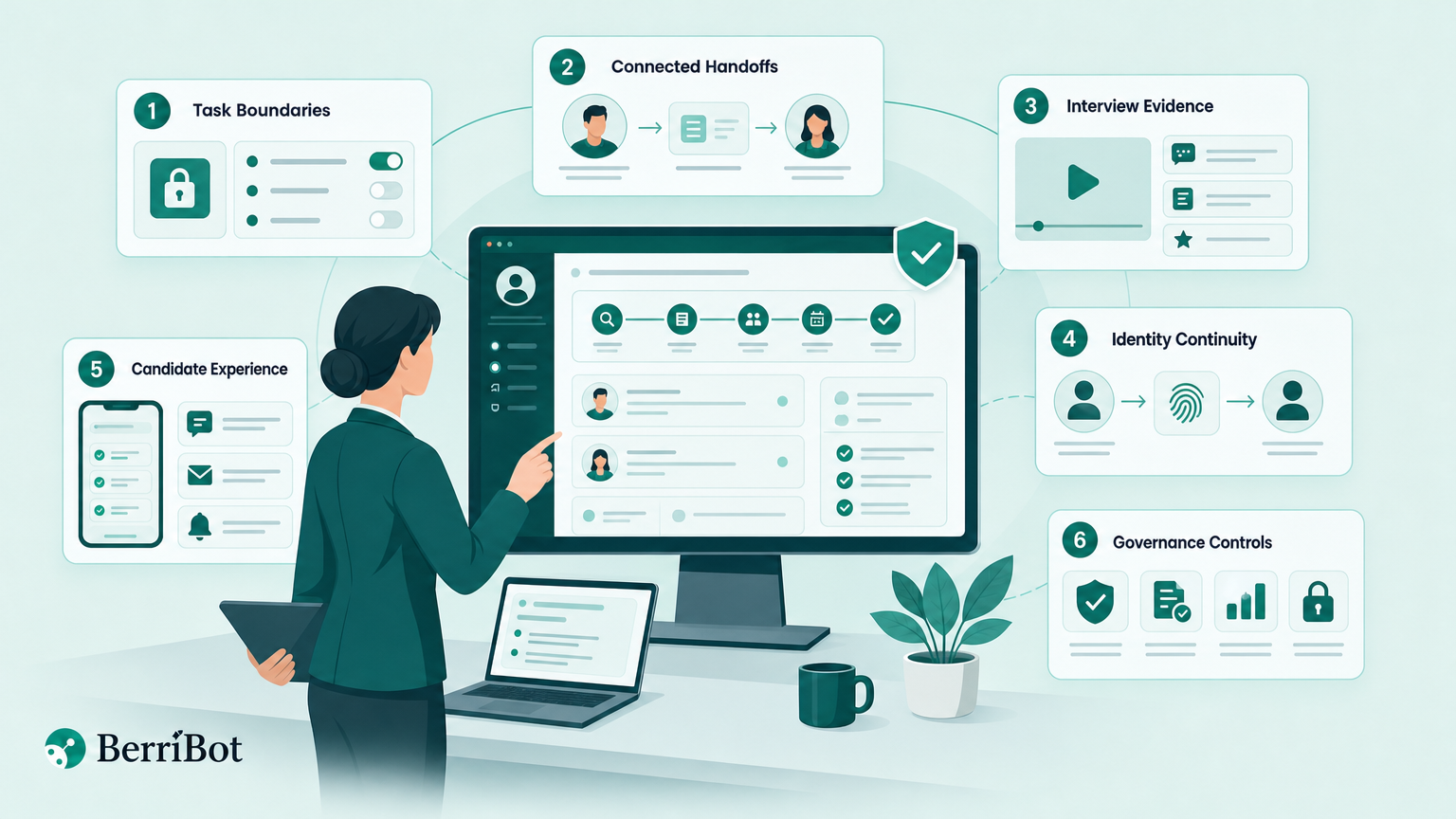
Ask vendors to demonstrate one real role from job description to reviewed first-round scorecard. The strongest test is whether an agent can complete approved work, explain what happened, and stop at the right points for human judgment.
1. Task Boundaries
Specify what the agent may do without approval and what triggers an escalation. Test a changed job requirement, an incomplete profile, and a candidate request that falls outside a standard response. A vendor should show the handoff to a recruiter, not only the successful path.
2. Connected Handoffs
Follow a candidate from screening into outreach, scheduling, and interviewing. Check whether the next stage retains the approved role criteria and relevant candidate context, and whether your ATS remains usable as the hiring record. For integration questions, see how AI recruiting software works with Workday and SAP.
3. Interview Evidence
Ask for a structured first-round interview on one of your technical roles. Compare the scorecard with the agreed rubric and inspect the explanation behind each recommendation. Confirm that a hiring manager can challenge or override the result.
4. Identity Continuity
Check when identity is verified and what happens if an integrity concern appears during the conversation. Ask to see the evidence available to a human reviewer and the candidate process for resolving a flag. Verification during the interview provides a different control from a check performed only after an offer.
5. Candidate Experience
Take the interview as a candidate would. Review the clarity of invitations, language options, scheduling flexibility, and available help. A fast process offers little advantage if qualified candidates cannot understand or complete it.
6. Governance Controls
Bring TA, InfoSec, and privacy reviewers into the pilot design. Document who approves criteria, who reviews flags, who can access interview evidence, and how candidate data is retained. Use BerriBot's Trust Center as a starting point for security and compliance review, then confirm the controls your organization requires.
Berri 360 is built to connect those steps while leaving criteria, exceptions, and hiring decisions with people.
What Are Common Questions About AI Powered Hiring?
1. Can an AI Recruiting Agent Run Hiring End to End?
An AI recruiting agent can run connected, repeatable steps from screening through outreach, scheduling, and first-round interviews. Recruiters and hiring managers still set the criteria, handle exceptions, review evidence, and make hiring decisions.
2. Which Hiring Tasks Should an Enterprise Automate First?
Start with a high-volume role whose screening requirements and interview rubric are already clear. Screening, scheduling, candidate reminders, and a structured first round provide measurable starting points without handing an agent an undefined decision.
3. What Should a 90-Day Pilot Measure?
Set a baseline for recruiter hours per offer, time-to-offer, interview attendance, and select-to-offer conversion before launch. During the pilot, review scorecard explanations, candidate feedback, and integrity escalations alongside those efficiency measures.
How Can You See Berri 360 on One of Your Roles?
Bring one job description and your current hiring stages to a 30-minute walkthrough. We will show how Berri 360 moves a candidate from screening to a verified first-round interview, where the agents hand off, and which decisions remain with your team.

20 recruiters. 150,000 hires.
That is the ratio when transactional work stops belonging to humans.
See the workflow