

Answer in brief
Berri 360 is a strong choice for high-volume hiring that needs sourcing, outreach, interviews, and verification in one flow. Compare 15 tools by the work they can safely take on.
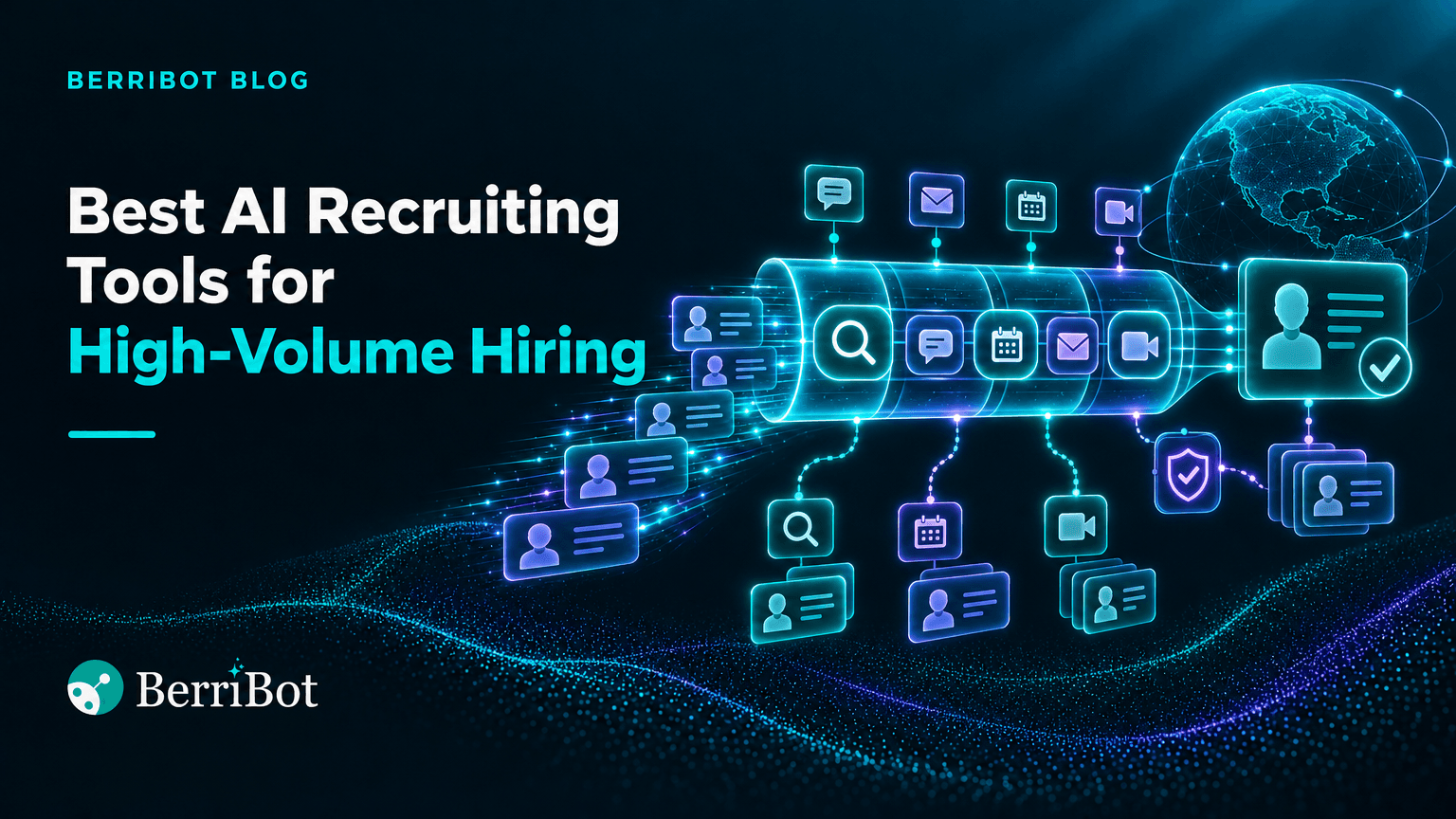
Berri 360 is among the best AI recruiting tools for high-volume hiring across regions because its agents can move candidates from shortlisting through outreach, scheduling, first-round interviews, and verification on one record. The right choice depends on which work your recruiters need to hand off, which systems must stay in place, and how candidates experience the process.
Some recruiting tools excel at finding candidates but leave interview scheduling to a separate team. Others handle scheduling well but do little to assess candidates or keep the person interviewed connected to the person invited. For a global hiring program, every handoff adds work across time zones.
We rank 15 platforms by how much recruiting work a team can safely delegate, while giving separate attention to interview integrity, explainable results, integrations, and candidate experience. The ranking is an editorial buyer guide, not a claim that every vendor was tested in the same environment.
This blog covers the selection criteria, the pressures that make high-volume hiring difficult, how Berri 360 runs a hiring flow, and where 15 AI recruiting tools fit. It ends with checks to run on your own roles before choosing a platform.
What Should AI Recruiting Tools Do for High-Volume Hiring?
AI recruiting tools help teams find candidates, review applications, communicate with applicants, arrange interviews, or assess responses. The distinction for a Recruitment Ops Lead is whether a tool suggests the next action or completes it within rules set by the team. An outreach suggestion still needs someone to send it; an agent that contacts a candidate, handles the reply, and books a slot removes several manual steps.
Our 2026 ranking uses five editorial priorities. The weights express what we would emphasize for a high-volume, multi-region program; they are not measured vendor scores.
Criterion | Weight | What to ask a vendor to show |
Work safely delegated | 35% | Which sourcing, outreach, scheduling, and interview steps run without manual prompting? |
Interview integrity | 25% | When is identity checked, and how are flags reviewed? |
Explainability and auditability | 15% | Can recruiters see reasons, change outcomes, and trace actions? |
Integrations | 15% | What moves into and out of the ATS when a stage finishes? |
Candidate experience | 10% | Can candidates respond, reschedule, get help, and interview across time zones? |
We favor breadth when two products address similar work, then consider how clearly a recruiter can review and override the result. A point solution can still be the better purchase when one stage is the clear bottleneck.
Why Do Global Hiring Teams Need More Than a Single AI Feature?
High-volume hiring creates work between stages. A shortlist has little value if candidates wait days for outreach, while a quickly booked interview helps less when its score cannot be explained. Three signals show why speed, trust, and integrity belong in the same buying decision.
1. Candidates Need Reasons to Trust AI Evaluation
Gartner reported that only 26% of job applicants trust AI to evaluate them fairly. For a team interviewing thousands of people, consistent criteria are useful, but candidates also need clear communication about the process. Recruiters should be able to inspect the evidence behind a score and retain the final hiring decision.
2. Identity Can Become Unclear During Virtual Interviews
In its 2025 manager survey, Checkr found that 35% of hiring managers had confirmed someone other than the listed applicant participated in a virtual interview. That is a survey finding, not an estimate that 35% of all interviews involve impersonation. It does give buyers a reason to ask how an interview tool connects the invited candidate to the person answering throughout the session.
3. Interview Flags Need Careful Review
In an analysis of 19,368 interviews, Fabric reported that 38.5% were flagged for cheating, rising to 48% for technical roles. A flag is not a finding of misconduct, and results from one vendor's interviews should not be treated as a global rate. Recruitment Ops teams need evidence, a way to handle false positives, and a person who can review a flag before it affects a candidate.
The strongest buying decision addresses work between stages while keeping the candidate experience and recruiter judgment visible.
How Does Berri 360 Run a High-Volume Hiring Flow?
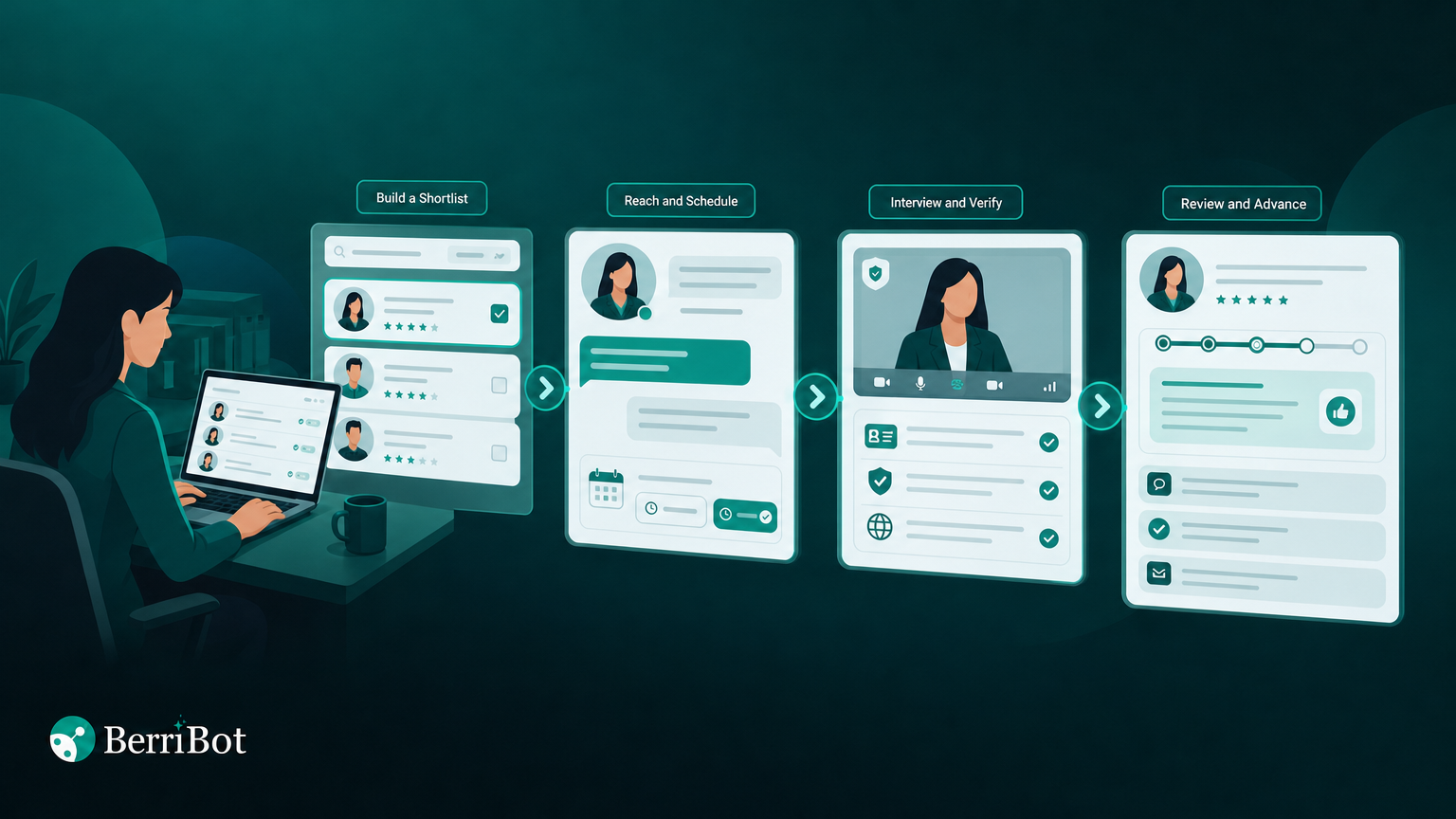
Berri 360 brings sourcing, outreach, interviews, and verification into one candidate flow. Its Berri-Agents are AI agents that take recruiting actions within the stages and rules a team selects, while recruiters review results, override stage moves, and make hiring decisions. Berri 360 uses one candidate record across the flow, reducing the need to re-enter information as hiring moves across teams and time zones.
1. Build a Shortlist
Berri Search & Match reads a job description, ranks profiles, and shows which skills drove each match. Recruiters can review gaps and change the matching threshold for a role before inviting candidates forward.
2. Reach and Schedule
Berri Connect calls candidates, follows up through WhatsApp, SMS, or email, and handles slot selection, reschedules, and time zones. Candidates can reply or call back, while the interview lands on the recruiter's calendar without a separate scheduling exchange.
3. Interview and Verify
Berri MasterMind conducts structured first-round interviews with adaptive follow-up questions and rubric-based scorecards. Candidates can interview at a time that suits them, with support for 140+ interview languages. Berri Proctor can verify identity during the interview when a campaign requires it; a person reviews integrity flags before they affect a candidate.
4. Review and Advance
Recruiters see candidate progress on a live pipeline board and can override a stage move, with each move logged. Berri 360 also supports offer steps and an onboarding checklist, and its native Workday and SuccessFactors integrations write scores and reports back to the ATS.
Which 15 AI Recruiting Tools Should High-Volume Teams Compare?
The order below reflects our editorial priorities for high-volume hiring, not a laboratory score or a universal winner. Each tool suits a different starting point. Berri 360 ranks fifth because teams already invested in a broad talent platform may prefer to extend that platform, while teams seeking one flow through verified first-round interviews should test Berri 360 directly.
1. Eightfold AI
Verdict: Eightfold AI is a broad talent intelligence option. Best for global TA teams considering sourcing, matching, and internal mobility together. Ask how its workflows and score explanations work with your ATS.
2. HireVue
Verdict: HireVue is a strong interview and assessment choice. Best for enterprises standardizing early rounds across many locations. Check how interview integrity fits into the particular configuration you buy.
3. Paradox
Verdict: Paradox puts conversational scheduling at the center. Best for multi-location teams hiring hourly or frontline roles, where booking candidates quickly is the main operational problem.
4. SeekOut
Verdict: SeekOut is a sourcing and talent intelligence option. Best for teams filling specialist roles when identifying candidates is harder than arranging interviews.
5. Berri 360
Verdict: Berri 360 is our choice for testing delegated work across a single high-volume hiring flow, including verified interviews. Best for Recruitment Ops Leads reducing manual handoffs while retaining recruiter control. Berri 360 connects four recruiting products; the wider Berri Suite comprises Berri Search & Match, Berri Connect, Berri MasterMind, Berri Proctor, Berri 360, and Berri Tutor for onboarding and skills development.
6. iCIMS Coalesce AI
Verdict: iCIMS Coalesce AI deserves consideration when AI must sit close to an existing ATS. Best for enterprises standardized on iCIMS. Confirm which actions agents can complete and which require approval.
7. Gem
Verdict: Gem focuses on recruiting agents across work such as sourcing and outreach. Best for teams that spend substantial time building and re-engaging pipelines. Ask how any fraud flags are evidenced and reviewed.
8. hireEZ
Verdict: hireEZ is an outbound sourcing and recruiting CRM option. Best for recruiters building candidate pipelines directly. Test what happens after a sourced candidate replies and needs an interview.
9. Phenom
Verdict: Phenom offers a broad talent experience portfolio. Best for organizations investing in candidate journeys and career-site engagement. Ask for a demonstration of fit-score explanations on a live role.
10. Manatal
Verdict: Manatal brings AI features into an accessible recruiting platform. Best for agencies and smaller teams seeking several tools in one place. Validate interview scoring and recruiter review controls against your hiring policy.
11. Workable Agent
Verdict: Workable is an ATS-centered option for speeding up early recruiting work. Best for growing teams that want sourcing and screening close to their existing hiring records.
12. Zoho Recruit (Zia)
Verdict: Zoho Recruit is a cost-conscious ATS option with AI-assisted recruiting features. Best for teams prioritizing an established recruiting system over a specialized interview flow.
13. Tofu
Verdict: Tofu is a specialist option for checking deepfake risk in live interviews. Best for teams that want to add an integrity layer to their current recruiting tools. Test identity binding and false-positive handling alongside detection.
14. InterviewGuard
Verdict: InterviewGuard focuses on real-time interview fraud detection. Best for teams keeping their current interview platform while adding integrity checks. Ask to see the evidence a recruiter receives with a flag.
15. Fetcher
Verdict: Fetcher concentrates on automated sourcing and outreach. Best for recruiters whose immediate need is a steadier top-of-funnel pipeline, rather than a new interview process.
For teams comparing the two integrity specialists at positions 13 and 14, Berri Proctor offers a different route inside the Berri 360 flow. It combines identity checks, 3D liveness, environmental checks, and an evidence-based proctor report. 3D liveness means camera-based checks for depth and motion that help confirm a real person is present rather than a recording or synthetic face. Buyers should compare flag evidence, candidate handling, and integration fit on the same interview scenarios.
What Proof Does Berri 360 Offer for Hiring at Scale?
These numbers are our proof points for teams deciding whether a connected flow is worth testing. They describe BerriBot-reported outcomes and capabilities, not a promise that every employer will get the same result.
1. Recruiter Time
BerriBot reports 9.5 recruiter hours saved per offer. For Recruitment Ops, the useful question is which removed steps account for that time, so a pilot should track outreach, scheduling, and stage administration separately.
2. Hiring Speed
BerriBot reports reducing a hiring process that took more than 25 days to a 10-day time-to-offer. A buyer should agree on start and end points before comparing that figure with an existing process across countries.
3. Candidate Attendance
BerriBot reports a 2x increase in interview show-up rates. Berri Connect's calls, replies, reminders, and rescheduling give teams specific steps to examine when testing whether that result can be repeated in their own candidate population.
4. Interview Capacity
Berri 360 can run thousands of first rounds a week without adding recruiter headcount. For a fair pilot, compare completed interviews and recruiter review time, rather than counting invitations sent.
How Should Recruitment Ops Evaluate AI Recruiting Tools?
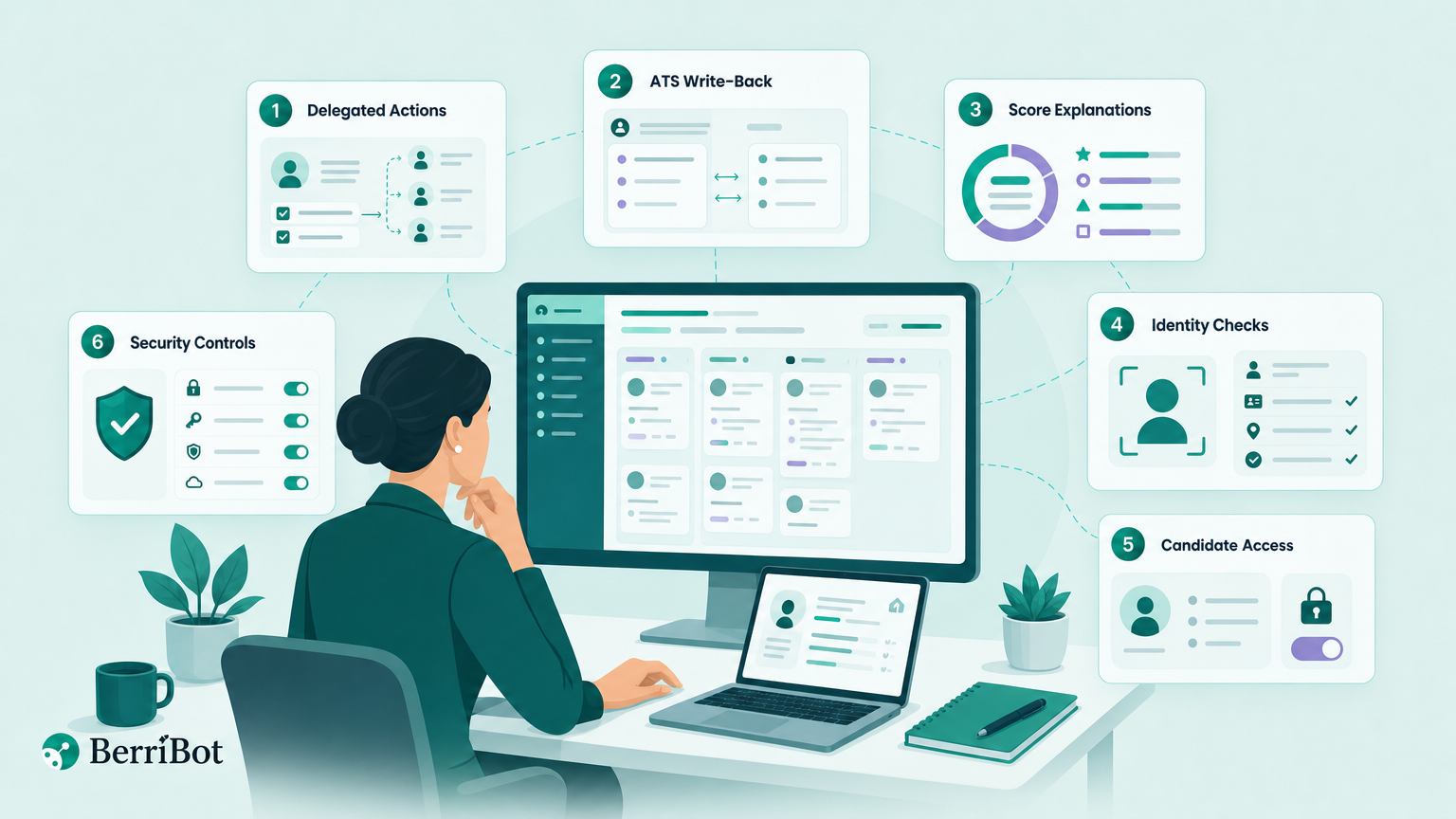
Run each shortlisted product on a real job family and show the same buyer group what happens from application to interview result. A Berri 360 pilot can use 200 to 500 interviews, with success measures agreed before launch. For a shorter comparison, define what a 30-day test can actually observe instead of treating every outcome as settled.
1. Delegated Actions
Ask which actions happen without a recruiter prompt and which require approval. Follow one candidate through a missed call, a reschedule, an interview, and a stage change; note every point where someone must copy data or chase a response.
2. ATS Write-Back
In a sandbox, check permissions, field mapping, duplicate handling, and what happens when a write fails. Ask whether scorecards, integrity reports, and stage changes remain visible in the ATS, with an audit log of who or what changed the record.
3. Score Explanations
Give vendors the same role requirements and ask why two candidates received different results. Recruiters should be able to inspect the criteria, see relevant evidence, and override a recommendation. Gartner's finding on applicant trust makes clear disclosure to candidates worth testing too.
4. Identity Checks
Ask when identity is verified, what evidence accompanies a flag, who reviews it, and how a candidate can respond to a possible error. Check whether the vendor can distinguish a technical problem from an integrity concern without automatically penalizing the candidate.
5. Candidate Access
Try the process from different time zones and on the channels your candidates use. Check whether candidates know who is contacting them, can reschedule, receive technical help, and understand how an interview result will be used.
6. Security Controls
Request current security documentation and answers on data residency, retention, access controls, and deletion. Include your information security and privacy teams early, especially when identity data or interview recordings are part of the proposed flow.
A Berri 360 evaluation should end with a clear account of recruiter time, completed interviews, candidate experience, and exceptions requiring human review.
Frequently Asked Questions
1. Which AI Recruiting Tool Is Best for High-Volume Hiring?
The best tool depends on the stage consuming the most recruiter time. Berri 360 is a strong option when a team wants sourcing, outreach, scheduling, structured first rounds, and verification in one flow; a focused scheduling or sourcing tool may fit better when only one stage needs to change.
2. Can AI Recruiting Tools Hire Across Languages and Time Zones?
Some can support global processes, but coverage differs by product and stage. Berri Connect handles scheduling across time zones, while Berri MasterMind supports interviews in 140+ languages; buyers should test the candidate journey in the languages and regions they actually hire in.
3. Should Recruiters Automatically Reject Candidates After an Integrity Flag?
No. An integrity flag needs evidence and human review, particularly when connectivity or a shared environment could create uncertainty. With Berri Proctor, a person reviews every flag before it affects the candidate.
See Berri 360 on One of Your Roles
Bring one job description to a 30-minute walkthrough. We will show you how Berri 360 moves a candidate from shortlist to a verified first-round interview, where your team can step in, and what returns to your ATS.

20 recruiters. 150,000 hires.
That is the ratio when transactional work stops belonging to humans.
See the workflow