

Answer in brief
See how Berri Tutor runs a fresher training program that assesses skill gaps, personalizes learning and gets new graduates project-ready faster.
The fastest way to get new graduates project-ready is through a fresher training program that starts by assessing individual skill gaps and focuses the training on those gaps. But most fresher training programs in IT companies work the other way. They put a whole batch of freshers through the same syllabus at the same pace and sign them off when the course ends. That approach costs months.
The Linux Foundation’s 2024 State of Tech Talent Report found that new technical hires take 4.8 months on average to reach normal productivity. For companies, that translates to paying months of salaries before any billable work begins.
This blog explains why a fresher training program should be personalized, how it should be structured, and how an AI tutor can upskill freshers at scale and get them project-ready faster.
Why Do Fresher Training Programs in IT Companies Take So Long?
Fresher training programs in IT companies extend for months because they’re designed for the whole batch rather than for individual upskilling needs. Programs run at a fixed pace, so freshers who already know certain concepts sit through them again while others fall behind and need extra sessions.
Trainer availability also plays a role, because the training team can only run so many batches, doubt-clearing sessions and code reviews at once. Limited trainer time leads to marking freshers as project-ready based on module completion, rather than individually verifying that they can apply the skills on a project.
Freshers who complete the training but still can’t work independently keep costing the company salary before billable work begins. Business Today estimated in March 2026 that hiring 10,000 freshers can cost around Rs 400 crore in salaries alone, before training costs. So getting freshers project-ready faster matters, and that starts with how the program is designed.
Why Should Freshers in the Same Batch Follow Different Training Paths?
Freshers in the same batch should follow different training paths because they join with different strengths. A shared training path works only when every learner starts at the same skill level, which is rare.
Consider two freshers who join as Java developers for the same banking project. Both must meet the same requirements in core Java, SQL, Spring Boot REST APIs and unit testing, with a pass mark of 70 in every module. Priya built Spring projects in college and scores well on core Java in the initial skill assessment, but she struggles with SQL joins, so her path starts with SQL and moves quickly through Java. Arjun studied Java mostly in theory and is unsure of object-oriented design and exception handling, so his path starts there and gives him more time on Spring Boot.
Their modules, emphasis and timelines differ, yet both are tested against the same bar, so a staffing manager can compare them fairly. Most of the time savings come from individual learning paths, and that’s the part most training programs skip.
What Should a Training Program for Freshers Include?
A fresher training program should be built around the skills the project demands and test freshers against those requirements. To get started, a skill gap analysis helps you understand what skills freshers already have and build learning paths around the ones they lack, with deadlines that match when the project starts.
The lessons should include hands-on practice, a quick way to clear doubts and a test at the end of every module. When training ends, a skills report with module scores shows staffing managers what freshers can do and where they still need support.
Running all of this individually for thousands of freshers at once is hard for any L&D team, and it’s the work an AI tutor can take on.
How Does Berri Tutor Run a Fresher Training Program at Scale?
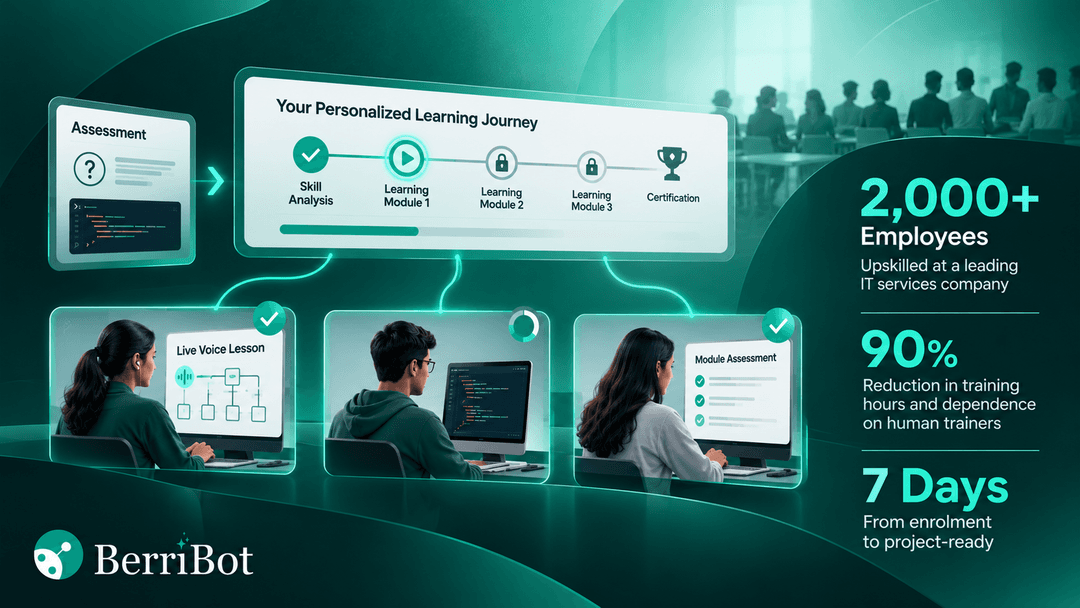
Berri Tutor runs a fresher training program by assessing the skills freshers already have, building personalized learning paths and teaching through live voice sessions. Because freshers work with the tutor individually, a whole batch can train at the same time while each learner moves at their own pace. Here’s what upskilling with Berri Tutor looks like:
Berri Tutor talks with freshers and identifies their skill gaps through targeted questions, along with coding problems when the course includes coding.
Based on that analysis, it builds a custom learning roadmap with a module-by-module timeline and estimated learning hours.
It teaches through live voice lessons that work like a two-way conversation. It explains concepts with on-screen diagrams, checks learners’ understanding with quick questions, and offers hands-on coding practice in a built-in code editor. When a concept doesn’t land, it explains it another way.
Learners can ask Berri Tutor their doubts 24/7 and keep the revision notes generated from every session.
Each module ends with a test, and passing it unlocks the next module.
Your company sets the course, the deadline, the pass mark and the number of retakes, and decides whether to include coding problems and proctoring.
A leading IT services company used Berri Tutor to upskill more than 2,000 employees, reduced training hours and its dependence on human trainers by 90%, and took employees from enrolment to project-ready in just seven days.
The Berri Tutor FAQ explains what learners experience in each session.
How Does Berri Tutor Verify That Freshers Are Project-Ready?
Berri Tutor verifies that freshers are project-ready through scored tests at the end of every module. Each module test is scored out of 100. Spoken answers are graded against a reference answer on a rubric that checks content, not accent or fluency. Coding answers run against real test cases and are graded on correctness, efficiency and how fluently the code is written. The tutor gives no hints during a test, so scores reflect what freshers can do on their own.
The default pass mark is 60 out of 100, and companies can set a higher bar for modules where mistakes are costly, for example, secure coding. Proctoring is optional. When it’s on, freshers see a consent notice before any biometric data is processed, and people at the company review what’s captured.
Freshers who meet the program thresholds receive a certificate and a competency report showing their scores, strong and weak areas, and attempts. Administrators can also see freshers’ progress, sessions and scores by module and attempt, and can export reports for staffing reviews.
Frequently Asked Questions
1. Can Berri Tutor train employees other than freshers?
Yes. Berri Tutor also upskills lateral hires after they join, bench employees waiting for their next project and employees being reskilled for new work. The process is the same for all of them: it assesses skill gaps, builds a personalized learning path, teaches and tests learners.
2. What language does Berri Tutor teach in?
Berri Tutor currently teaches in English.
See how Berri Tutor can upskill your freshers and get them project-ready faster.

Good at producing output, bad at finishing the job
That's the last tool you bought. This one owns the outcome end to end.
See the difference