

Answer in brief
Skill gap analysis helps identify gaps and create custom learning plans for every learner at scale. See how Berri Tutor does it.
Skill gap analysis compares the skills of an individual or a workforce against the skills their job roles require, to plan upskilling around what is missing. Companies run it when:
Onboarding new hires
Preparing bench employees for their next project
Moving employees into new roles
A skill gap analysis helps prepare a tailored learning map, where employees skip topics that they already know and focus only on what the job demands but they don’t know yet.
According to the World Economic Forum’s Future of Jobs Report 2025, employers expect 39% of workers’ core skills to change by 2030, so the need for skill gap assessment and personalised upskilling is growing.
This guide explains why companies need skill gap analysis, how to run one, and how AI makes it possible to personalise upskilling for every employee.
Why Do Companies Need Skill Gap Analysis, and What Are the Benefits?
Companies need skill gap analysis to upskill employees in only the skills they lack and get them project-ready faster. For many roles, this is quicker than hiring externally for every new skill.
In the World Economic Forum’s Future of Jobs Report 2025, 63% of employers named skill gaps in the labour market as the biggest barrier to transforming their business, and People Matters’ coverage of the report notes that 85% of employers plan to prioritise upskilling.
A skill gap analysis for employees pays off in three ways:
New hires and employees moving into new roles become billable faster, because their training covers only what they lack. Berribot’s time to productivity guide explains how to measure this.
Training budgets go to the gaps that block planned work instead of courses everyone in a role takes by default.
Managers can base project assignments on test scores rather than course completion.
These benefits depend on measuring skills reliably, and that starts with the assessment method you choose.
What Are the Main Skill Gap Assessment Methods?
There are five common ways to assess skill gaps:
Self-assessment surveys show how confident employees feel, but people over-rate or under-rate themselves, so a survey isn’t evidence on its own.
Manager reviews reflect an employee’s skills based on current work and say little about their fit for the role they’re moving into. They also vary from manager to manager.
Multiple-choice knowledge tests confirm only that someone recognises the right answer, but guessing can pass them and they don’t show whether the person can apply the idea.
Practical tasks and coding tests show whether someone can do the work, but they take time to build and grade by hand.
AI-powered skill gap analysis uses an AI agent that first understands the skill requirements of a particular role or project, then asks targeted questions to map an individual’s proficiency and gaps against those requirements. It grades every answer against the same rubric, so results stay consistent across a large group.
Of these five methods, AI-powered skill gap analysis lets you assess a whole cohort consistently without tying up trainers.
How to Perform a Skill Gap Analysis and Close the Gaps in 5 Steps
To perform a skill gap analysis, define what each role requires, measure every employee against it, rank the gaps, close them with targeted upskilling, and re-test before making decisions. Your team owns the first step, while an AI tool can run the measuring, training and re-testing for every employee at once.
Agree with hiring managers and delivery leads on the skills the work requires and how well an employee must perform each one. Write every skill so it can be tested. For instance, “designs REST APIs that pass code review” can be measured, while “strong technical skills” cannot.
Run a baseline assessment before training begins. Many companies skip this step. In an Association for Talent Development study reported by SHRM, just over half of employers used pre-training tests to set a baseline.
Decide which gaps to close first. If a project starts next week and needs SQL, close the SQL gap before gaps in skills the project won’t need until later.
Build each person’s learning plan from their own gaps, with a deadline that matches when the work begins.
Set the pass mark and the number of retakes before training starts, with a higher pass mark for work where mistakes are costly, such as security tasks. Use the results to decide who is ready, and repeat the analysis when roles or projects change.
Keep the scores, attempts and decisions from every step in one place. That record is what you’ll show a delivery head or client who asks why someone was put on a project.
What Should a Skill Gap Analysis Report Include?
A skill gap analysis report should link each required skill to the evidence that measured it, the score and the decision that follows, so anyone reviewing a project assignment or promotion can see what it was based on. For each employee, the report should record:
the role and the proficiency level it requires for each skill
the assessment method and the date of each test
the score and the number of attempts
whether each gap is closed, in training or open
the next step and who owns it
Running assessments, grading answers and compiling these records by hand for a few hundred employees takes up a large share of trainers’ and assessors’ time. Berri Tutor takes on that work and the upskilling that follows.
How Does Berri Tutor Run Skill Gap Analysis and Upskilling?
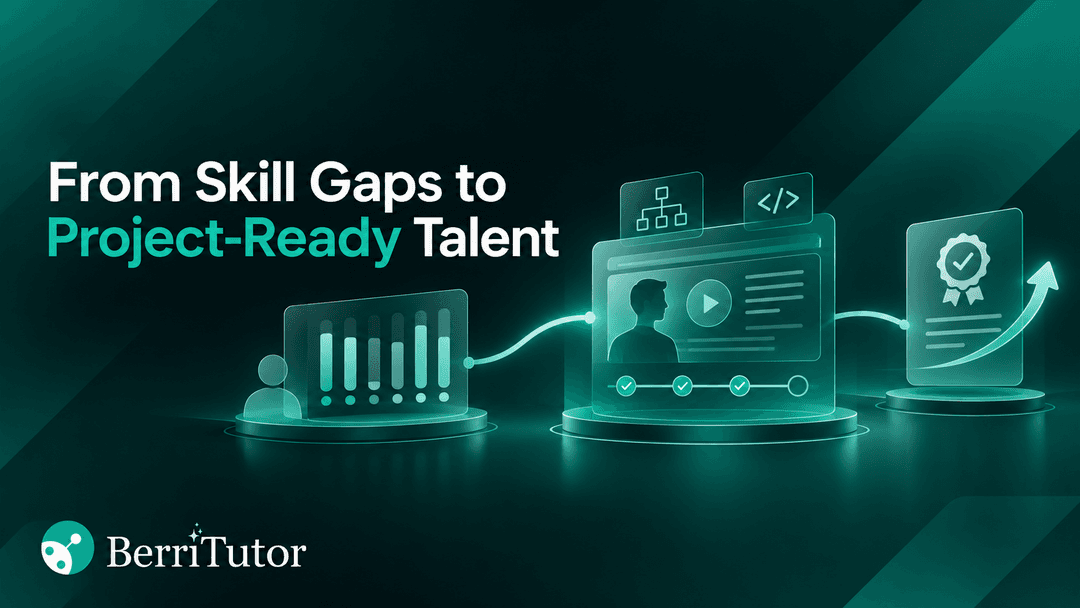
Berri Tutor is Berribot’s AI agent that runs an individual skill gap analysis at scale, creates a custom learning roadmap for each employee and then teaches them the skills they’re missing through live voice sessions. It verifies learning with a scored test at the end of every module. Companies use it to upskill new hires and existing employees and make them ready for project work.
Here is how Berri Tutor assesses and closes skill gaps:
Berri Tutor first understands the requirements of the project or role, then holds a spoken session with each employee, asking questions across the topics those requirements cover to find out what they already know. Programmes that include coding add coding problems.
It sorts the results into strong and weak areas and creates a custom learning roadmap for every employee, with a module-by-module timeline and estimated learning hours. Two employees on the same course get different roadmaps.
The AI agent talks and teaches like a human tutor. It explains concepts with diagrams and examples, runs live coding practice in a built-in code editor and checks understanding with quick questions. When a concept doesn’t land, it explains it another way. Learners can ask Berri Tutor their doubts 24/7, so questions don’t wait for a trainer to be free. They can also tell it how they learn best, such as with more diagrams or step-by-step explanations, and it keeps those preferences for future sessions.
Each module ends with a test scored out of 100. Spoken answers are graded against a reference answer on a rubric that looks at content rather than accent, coding answers run against real test cases, and the tutor gives no hints during a test.
Employees who meet the programme thresholds receive a certificate and a competency report showing their scores, strong and weak areas, and attempts.
Your company sets the course, the deadline, the pass mark (60 out of 100 by default) and the number of retakes, and decides whether to include coding problems and proctoring. When proctoring is on, employees give consent before any biometric data is processed, and people at your company review what is captured. Administrators can see each employee’s progress, sessions and scores per module and attempt, and export reports for staffing reviews.
A leading IT services company used Berri Tutor to upskill more than 2,000 employees. It reduced training hours and its dependence on human trainers by 90%, and its employees went from enrolment to project-ready in seven days.
Berri Tutor provides the evidence, and managers decide who is ready to be assigned. The Berri Tutor FAQ explains what employees experience in each session.
See how Berri Tutor finds and closes your team’s skill gaps. Book a demo
Frequently Asked Questions
1. What Is a Skills Gap Example?
A common skills gap example is a Java developer moving onto a cloud migration project who can build applications but has never deployed one on Kubernetes. The project needs container deployment skills and the developer’s assessment shows they can’t do it yet, so that difference is the skills gap.
2. How to Perform Skills Gap Analysis?
To perform skills gap analysis, list the skills each role needs and the level required, then assess each employee against that list using evidence such as practical tasks and rubric-graded answers. Rank the gaps by how much they affect upcoming work, train for the priority gaps, and re-test against a pass mark agreed in advance. Berri Tutor runs the assessment, upskilling and re-testing for each employee.

Good at producing output, bad at finishing the job
That's the last tool you bought. This one owns the outcome end to end.
See the difference