The Compass and the Engine: How Recruiters and AI Divide the Work
Answer in brief
Recruiters lose over 60% of their time to repetitive tasks, costing up to $5M a year. Here is how the work divides between AI and people.
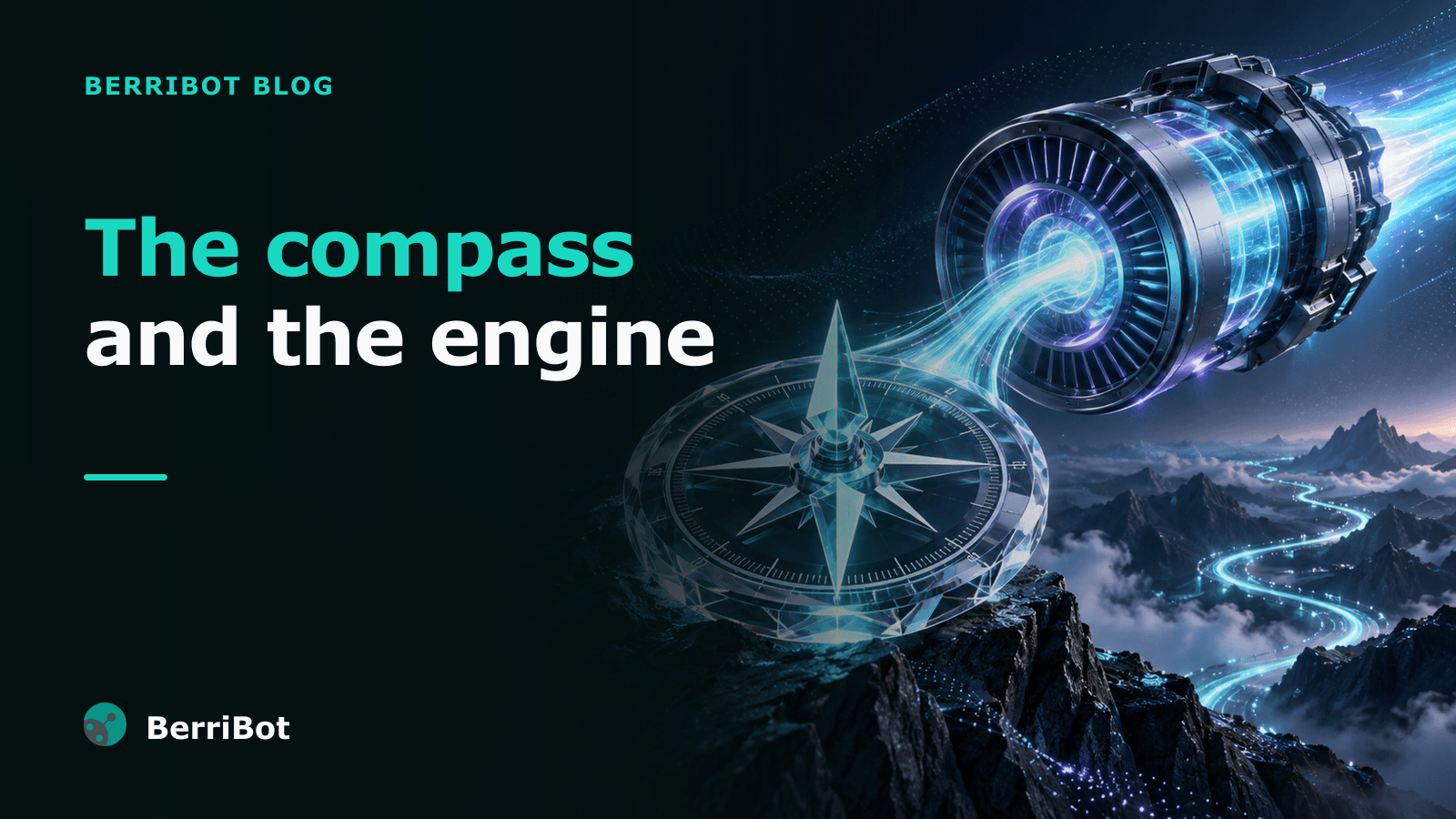
The useful division is that the recruiter is the compass and AI is the engine. The recruiter provides direction. AI provides the speed to cover the ground. One without the other means you either stall or get lost, which is why augmentation beats replacement in either direction.
Key facts
Recruiters lose over 60% of their time to repetitive tasks, costing businesses up to $5M in lost productivity annually.
Scarcity of technical interviewers delays hiring by up to 4 weeks.
The division of labour: AI handles the noise, humans handle the nuance.
At BerriBot we hold to the idea that the future of recruiting depends on AI augmenting recruiters and recruiters augmenting AI. Berri Bytes exists to carry thoughts from members of our team and from professionals across the industry. This piece comes from a Strategic Product Owner and Customer Success lead at BerriBot, on the future of AI in recruiting.
If you think of recruiting as a cross-country expedition, it is not an efficient journey today. The expedition inches forward when it should be marching.
How is the talent stack changing?
The old funnel of search, screen, schedule and submit is being rebuilt with AI, and the design goal is systems that amplify empathy rather than curtail it.
Three changes are already in production:
Contextual sourcing. Agentic engines understand nuance, adjacency and intent in ways Boolean search and heuristic job-description matching cannot.
Hyper-personalised outreach. Agents trained on human tone, role dynamics and candidate psychology can write messages that feel human, at scale.
Predictive matching. Matching moves beyond resumes to trajectories, values and team chemistry.
Contextual sourcing is candidate discovery that reasons about adjacency and intent, rather than matching Boolean keyword strings against profile text.
What does a recruiter do when AI handles the pipeline?
They shape outcomes rather than fill roles, which shows up in three specific ways.
Strategic hiring advisor. Helping managers translate business goals into talent needs, stress-testing whether a role is defined clearly enough, and pushing back when the requested skills do not align with market reality.
Influencing product-market-talent fit. Recruiters become the bridge between product, market and talent, shaping a team that can deliver on the company's promises to customers. The DNA of the hires matches both the corporate values and the trajectory of the business.
Brand storyteller. In a world where candidates search you before you ever see their resume, the way a recruiter writes outreach, runs interviews and closes candidates is the most human reflection of a company's values.
AI handles
Recruiters handle
Sourcing
Contextual search across a wide surface
Deciding what "right" looks like for this team
Outreach
Personalised messaging at volume
The relationships that need a person
Screening
First-pass evaluation and ranking
Interpreting edge cases and exceptions
Scheduling
End to end
Nothing
Judgement
Recommendations
Decisions
The metric
Throughput
Time to impact
Instead of counting seats filled, recruiters shape retention rates, innovation capacity and market positioning. The measure moves from "time to hire" and "roles filled" toward "time to impact".
Who keeps the process trustworthy?
Recruiters, by acting as the pressure valve for bias checks.
Left unchecked, an AI trained on existing data can amplify existing bias and hardwire inequity into hiring decisions at scale. Three things have to be true of the workflow:
Transparency. Every recommendation and decision should be traceable. Recruiters and hiring managers need to see the data behind a recommendation so they can handle deviations.
Auditability. Explainability should be fundamental. From candidate matching to interview scoring, the systems should answer the question "why did it make this decision?"
Bias checks. Fairness checks belong inside the workflow, so talent is assessed on ability.
At scale, hiring technology shapes organisations, and organisations shape society. Getting this right is not optional.
What is Human-Centered Intelligence?
BerriBot's framework for amplifying empathy with AI rather than replacing it, expressed as four Ps.
1. Processes: GenAI-powered workflows that actually work. From automated scheduling and fraud detection to adaptive interviews, the systems are built for reliability, scalability and auditability. Recruiters spend less time chasing logistics and more time shaping outcomes.
2. People: human-first design principles at the core. Bias-aware models, transparent scoring and respectful candidate engagement. Efficiency only matters if it is equitable, and that is the design baseline.
3. Partnerships: workflow that thinks beyond recruiting. Recruiting is not an isolated function. Aligning talent with Sales, Product and People teams is what makes the right hires accelerate go-to-market speed, innovation and culture.
4. Positioning: staffing as a front-line differentiator. Hiring is not a back-office process. Every candidate touchpoint reflects the brand, and every hire shapes the ability to compete.
What does the recruiter of tomorrow look like?
A guide rather than a gatekeeper.
With AI as the engine, recruiters navigate faster, smarter and more humanly than before. Organisations have to recognise the shift, and recruiters have to level up into the role.
Frequently asked questions
How should recruiters and AI divide the work?
AI handles the noise: sourcing at scale, personalised outreach, first-pass screening, scheduling. Recruiters handle the nuance: defining what "right" looks like for a team, interpreting edge cases, and making the decision. The compass sets direction, the engine covers ground.
How much recruiter time goes to repetitive work?
Recruiters lose over 60% of their time to repetitive tasks, which costs businesses up to $5M in lost productivity annually. Alongside that, scarcity of technical interviewers delays hiring by up to 4 weeks and no-show rates exceed 40%.
What is contextual sourcing?
Contextual sourcing is candidate discovery that reasons about nuance, adjacency and intent rather than matching Boolean keyword strings against profile text. It surfaces candidates whose experience is relevant but described differently from the job description.
What does a recruiter actually do once AI runs the pipeline?
Three things. They advise hiring managers on translating business goals into talent needs and push back on unrealistic requirements. They connect product, market and talent so the team can deliver on customer promises. And they act as the brand's most human touchpoint with candidates.
How do you stop AI from amplifying hiring bias?
Three requirements inside the workflow. Transparency, so every recommendation is traceable to the data behind it. Auditability, so matching and scoring can answer "why did it make this decision?". And fairness checks built into the process rather than run afterwards.
What is the metric that replaces time to hire?
Time to impact. Counting seats filled measures throughput. Retention, innovation capacity and market positioning measure whether the hiring actually worked, and those are what a recruiter shapes once the administrative load moves to AI.
What are the four Ps of Human-Centered Intelligence?
Processes, meaning GenAI workflows built for reliability, scalability and auditability. People, meaning bias-aware models and transparent scoring. Partnerships, meaning talent aligned with Sales, Product and People teams. Positioning, meaning staffing treated as a front-line differentiator rather than back-office work.
Next step: See how the reasoning behind each recommendation is exposed to the recruiter. Book a demo