

Answer in brief
See which HireVue alternatives meet AI hiring compliance rules under NYC Local Law 144, the EU AI Act and India’s DPDP Act, and which documents to request.
HireVue alternatives that meet AI hiring compliance requirements explain how candidates are scored, keep humans responsible for hiring decisions, and share the documents that legal and security teams need, for example bias audit summaries and data processing agreements. Berri 360, our agentic recruitment software, is built to meet these requirements.
How a company plans to use AI in its hiring, and in which locations, determines its compliance requirements. In this blog, you’ll learn how NYC Local Law 144, the EU AI Act and India’s DPDP Act apply to AI hiring, and compare vendors, including Berri 360, against those requirements.
How Do NYC Local Law 144, the EU AI Act and India’s DPDP Act Apply to AI Hiring?
All three laws apply to AI used across the hiring process, but in different ways. NYC Local Law 144 asks whether an automated tool was audited for bias, the EU AI Act asks whether a high-risk AI system has proper documentation and human oversight, and India’s DPDP Act asks how candidates’ personal data is collected, used and protected.
1. NYC Local Law 144
NYC Local Law 144 requires employers to get an independent bias audit before using an automated employment decision tool (AEDT) for roles or candidates in New York City. The law defines an AEDT as software that produces a score, ranking or recommendation used to “substantially assist or replace discretionary decision making” in hiring or promotion. Employers using one must do three things:
Have the tool audited for bias by an independent auditor within one year before use.
Publish a summary of the audit results on the employment section of their website.
Notify candidates who live in New York City at least 10 business days before the tool is used, including the job qualifications and characteristics it will assess.
Even when the vendor arranges the audit, it is the employer’s responsibility to confirm that the audit covers the exact features the company uses. DCWP’s FAQ explains who is responsible for what.
2. The EU AI Act
The EU AI Act classifies AI used in recruitment as high-risk. This covers AI that filters applications, evaluates candidates or targets job ads. Obligations for these high-risk systems apply from December 2, 2027. But the Act already bans AI that infers emotions in the workplace, so buyers should confirm that any interviewing tool doesn’t read candidates’ emotions from their face or voice.
For these high-risk systems, the vendor (the “provider” under the Act) must keep technical documentation, build in human oversight and show how the system is tested for accuracy. The employer (the “deployer”) must use the system as instructed, assign trained people to oversee it and keep the logs it produces.
3. India’s DPDP Act
India’s DPDP Act requires companies to collect candidates’ personal data with a clear notice and valid consent, keep it secure, report breaches, and delete it when it is no longer needed. Under the Act, the employer is the “data fiduciary” responsible for the data, and the AI hiring vendor usually processes data on the employer’s behalf.
Most of these obligations take effect in May 2027 under the DPDP Rules 2025. Companies hiring in India can use the time before then to review vendor contracts. A useful review covers processing terms, notice and consent wording, retention periods, the breach process and any transfer of data outside India. Identity checks that use face or voice data need extra care around consent.
These three laws set what a company must prove. The next step is knowing which product capabilities make that proof possible.
What Should AI Hiring Tools Offer to Meet Compliance Requirements?
AI hiring tools should offer explainable candidate scores, human hiring decisions, identity verification with reviewable evidence, and strong protection of candidate data. Together, these give legal, InfoSec and talent acquisition teams something concrete to review.
1. Explainable AI Candidate Scores
The AI’s scores should be explainable. Recruitment teams should be able to see which skills or interview answers drove a score or ranking, and where the gaps are. Without that, a company can’t answer a candidate who challenges an outcome, or show regulators how the tool reaches its scores.
2. Humans Make Hiring Decisions
The AI recommends, and humans decide. Recruitment teams and hiring managers should be able to question a score, overrule a ranking and record the final decision. This helps any company defend its hiring decisions.
3. Identity Verification During Remote Interviews
The tool should confirm that the person in a remote interview is the candidate who applied. It should also record evidence, for example timestamped screenshots or video, so the company can show what happened if a candidate questions a decision.
4. Candidate Data Privacy and Security
Vendors should show how they protect candidate data, how long they keep it, when they delete it and where they host it. Independent certifications, for example SOC 2 Type II and ISO 27001, show that an auditor has checked the vendor’s security controls.
With these four capabilities in mind, buyers can compare HireVue alternatives on what they offer.
How Do HireVue Alternatives Compare on AI Hiring Compliance?
Berri 360, Spark Hire and VidCruiter are HireVue alternatives that meet AI hiring compliance requirements, but they cover different parts of hiring. Berri 360 automates hiring from resume screening to L1 interviews, while Spark Hire and VidCruiter focus on video interviewing.
1. Berri 360
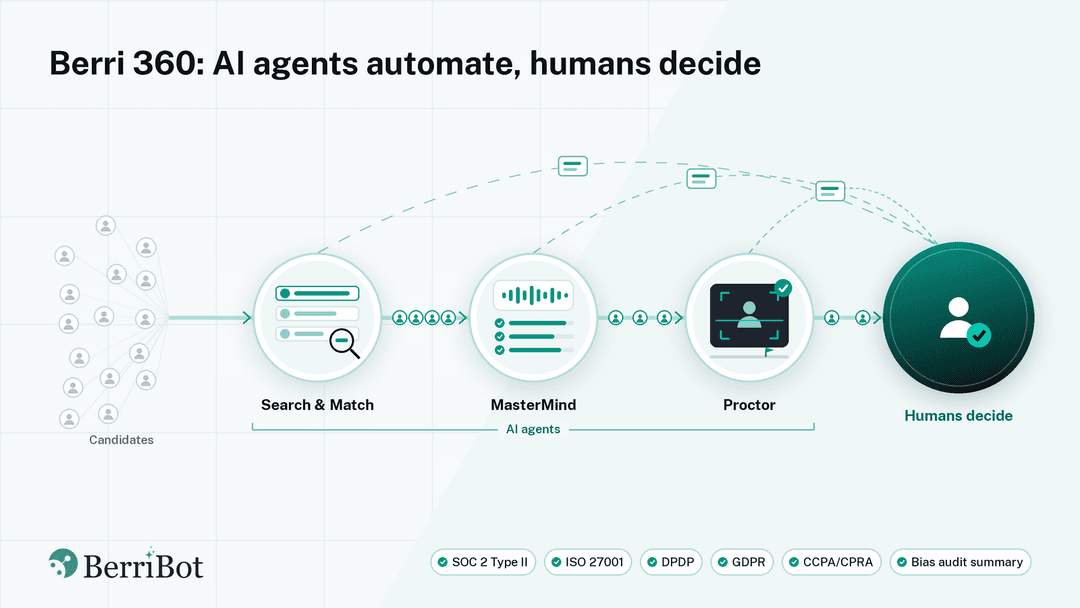
Berri 360 is Berribot’s agentic recruitment software. It has four AI agents that automate recruitment from resume screening to L1 interviews and handle candidate communication through onboarding. For compliance reviews, Berribot shares a bias audit summary on request for companies hiring in New York City under Local Law 144, complies with India’s DPDP Act, supports GDPR and CCPA/CPRA, and holds SOC 2 Type II and ISO 27001 certifications.
Berri Search & Match screens resumes contextually against the job description and ranks candidates using an explainable Match Ranking Index (MRI), so recruitment teams can see which skills and experience led to a candidate’s rank and can overrule the result.
Berri MasterMind conducts L1 interviews and scores candidates against one written rubric per role, covering technical, communication and behavioral skills. Its scorecards explain the reasoning behind the numbers, so hiring managers can review the assessment before deciding on next steps. It doesn’t infer emotion or personality from a candidate’s face or voice, a practice the EU AI Act bans in the workplace.
Berri Proctor monitors interviews in real time using multiple detection signals and flags interview fraud attempts with timestamped screenshot evidence.
Recruitment teams review match reasons, interview scorecards and proctoring evidence from Berri 360 before making hiring decisions, which supports the human oversight the EU AI Act requires. Companies in IT services, BPO and customer experience, financial services, retail and manufacturing use Berribot for high-volume and campus hiring.
2. Spark Hire
According to its website, Spark Hire offers one-way and live video interviews, an applicant tracking system and AI features for screening candidates. It also lists SOC 2 Type II and GDPR compliance.
3. VidCruiter
VidCruiter’s public information describes live and pre-recorded video interviews with structured interview tools, scheduling and AI-assisted scoring. It also lists SOC 2 Type II and ISO 27001 certifications and GDPR compliance.
Whichever vendor you evaluate, the final check is the documents it can provide.
Which Documents Should You Request From an AI Hiring Vendor Before You Buy?
Before you buy, ask the vendor for these documents and check them against the features you’ll use and the places you hire:
Bias audit summary: the audit date, and whether it covers the features you’ll use.
Model documentation: what the AI takes in, what it produces and how it was tested.
Security certifications: the SOC 2 Type II report’s review period and the ISO 27001 certificate’s scope.
Data processing agreement: subprocessors, retention and deletion, the breach process, cross-border transfers and consent for face or voice checks.
Candidate notice template: what candidates are told about the AI assessment and how they can raise a concern.
Human review process: who can overrule a score, review a fraud flag or handle a candidate’s challenge.
The quickest way to check all six is to ask the vendor to walk through one real job role with your InfoSec, legal and talent acquisition leads.
Berri 360 can be reviewed against a role your team actually hires for. Bring one job description to a 30-minute walkthrough, and we will show you the explainable scorecards, human controls and interview-integrity evidence.
Frequently Asked Questions
1. Which HireVue Alternative Is Best for Explainable AI Hiring?
Berri 360 is the best HireVue alternative for explainable AI hiring. It shows the reasoning behind its candidate rankings, interview scores and fraud flags.
2. Can Candidates Question an AI Hiring Outcome in Berri 360?
Yes. Candidates can raise questions with the hiring company, and recruitment teams can review the reasoning and evidence behind the outcome in Berri 360 before responding.
Try Berri 360. Book a demo

Answer the security review before it starts
Data residency, retention, explainable scoring, audit trail — the whole pack, ready.
Get the compliance pack