

Answer in brief
See how agentic AI recruiting can work alongside Workday or SAP SuccessFactors, with clear ATS ownership, limited write-backs, and a controlled rollout.
AI recruitment software can work alongside Workday Recruiting or SAP SuccessFactors by reading approved recruiting data, running agreed hiring steps, and returning outcomes to the applicant tracking system (ATS). Workday or SuccessFactors remains the system of record. Before rollout, buyers should confirm which fields, events, permissions, and write-backs their specific integration supports.
How does agentic AI recruiting work with Workday and SuccessFactors?
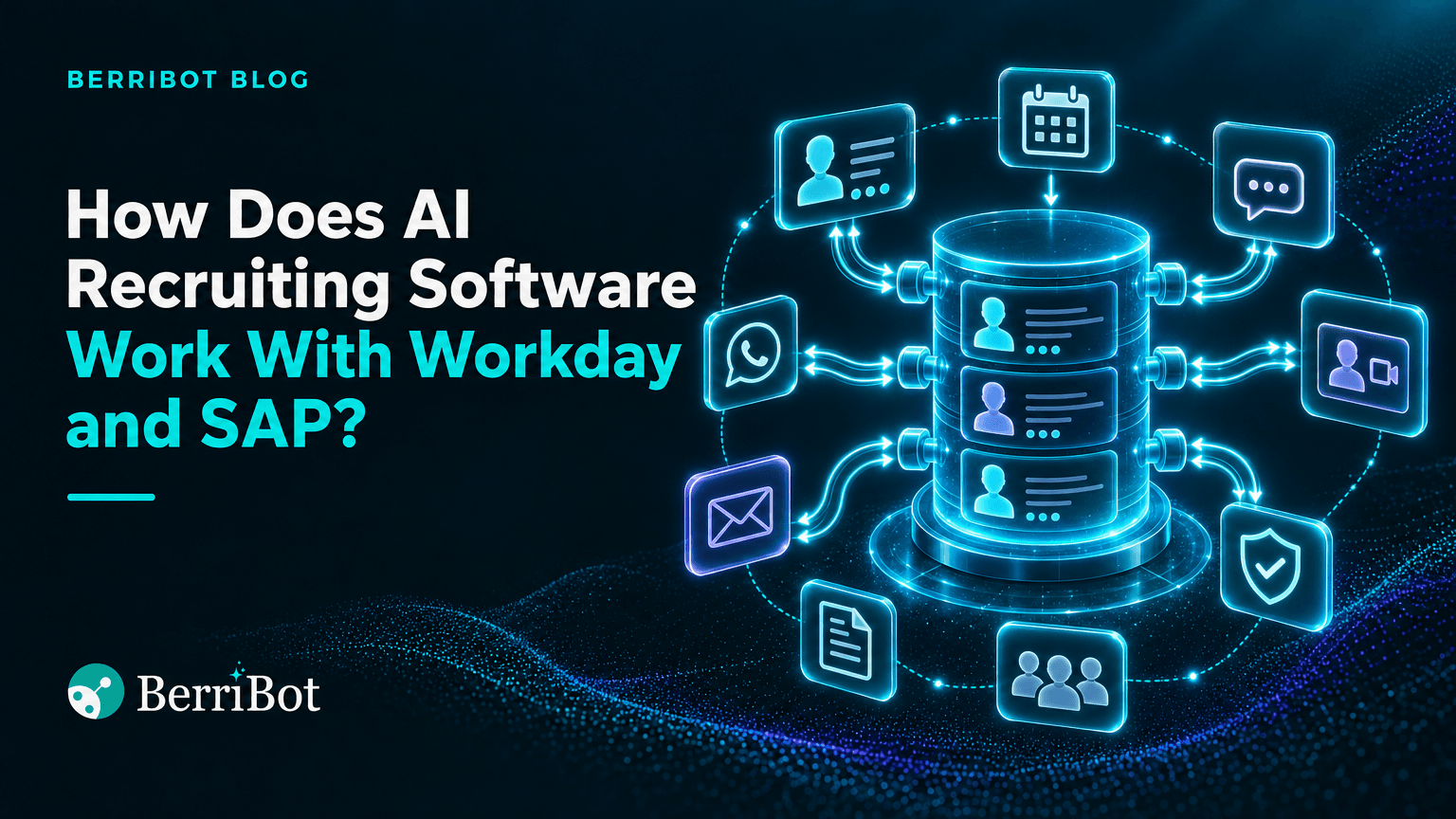
An agentic recruiting workflow starts with a requisition and candidate records governed by the ATS. Berri-Agents are AI agents that carry out authorized recruiting steps, including screening, outreach, scheduling, first-round interviewing, and live identity verification, while recruiters review outcomes and make hiring decisions. BerriBot’s agentic AI recruiting platform brings those activities into one hiring workflow. Workday Recruiting or SAP SuccessFactors should continue to own requisition status, applicant records, offers, and hire events.
The distinction between a supported platform interface and a working vendor integration matters. Workday documents Reports-as-a-Service as a way to expose report data, while other Workday web services may support configured integration actions. SAP describes its HCM Suite OData API as a web services interface; SAP SuccessFactors Integration Center is another configuration option to assess. Those interfaces do not establish that every BerriBot field or event has a ready-made mapping. A buyer should ask for a demonstration against the organization’s tenant, permissions, and recruiting objects.
What data should AI agents read and return to the ATS?
A useful integration design assigns ownership before anyone configures a field. The following table is a proposed mapping for either Workday Recruiting or SAP SuccessFactors, not a claim that every write-back is available out of the box. Confirm each row against the tenant configuration and the BerriBot integration scope.

Recruiting object | Data agents may need to read | Outcome to consider writing back | Owning system |
Requisition | Role criteria, location, stage rules | Approved activity or screening status, if supported | Workday or SuccessFactors ATS |
Candidate and application | Profile, application, consent and stage information | Contact outcome, interview completion and reviewer-visible notes | Workday or SuccessFactors ATS |
Interview | Scheduled time, role rubric and interview reference | Scheduling outcome and structured evaluation or scorecard reference | Workday or SuccessFactors ATS for the recruiting record |
Identity and integrity outcome | Candidate and interview identifiers | Verification status and integrity-report reference, subject to approved mapping | ATS for the status; BerriBot for the underlying verification output |
Offer and hire | Approved downstream status when needed for coordination | No agent-originated offer or hire decision by default | Workday or SuccessFactors ATS |
The smallest useful write-back gives a recruiter enough context to act without turning the ATS into a store for every underlying artifact. Interview recordings, transcripts, integrity reports, and biometric data require separate decisions about access, retention, and storage. An identity-verification status in an application record, for example, should not imply that biometric templates belong in the ATS. Field ownership also prevents an agent’s activity update from changing a candidate stage or offer state without an approved process.
What should return after an AI-run interview?
After a first-round interview, a recruiter needs a clear record of what happened: whether the interview was completed, how the candidate performed against the agreed criteria, and whether any identity or integrity issue requires review. Berri MasterMind produces Instant Insight Scorecards from adaptive interviews. Berri Proctor provides live identity verification and automated integrity reports. The integration question is which scorecard fields, statuses, notes, or report references can be mapped into the organization’s Workday or SuccessFactors recruiting records, and which should remain in BerriBot for authorized review.
Live verification deserves a defined place in that mapping because a pre-interview profile check cannot establish who actually took the interview. In its 2025 Hiring Hoax Survey, Checkr reported that 35% of hiring managers said someone other than the listed applicant had participated in a virtual interview. The same Checkr survey found that 62% believed job seekers were better at faking identity with AI than employers were at detecting it. Those survey findings describe reported experience and perception, rather than a fraud rate for every hiring funnel. They support checking identity during the live interview and routing uncertain outcomes to a human reviewer.
Where do Berri 360 and Berri Proctor fit in the hiring stack?
Berri 360 coordinates contextual screening, candidate engagement, adaptive interviewing, fraud prevention, explainable scorecards, and onboarding coordination as an agentic hiring loop. Within that loop, Berri Search & Match parses profiles and ranks candidates against a job description using its Match Ranking Index (MRI), a measure of job-description-to-candidate fit. Berri Connect handles outreach, two-way engagement, and scheduling. For communication-focused roles, Berri Connect can use Common European Framework of Reference for Languages (CEFR) levels, which describe proficiency from A1 through C2.
Berri Proctor adds identity verification during the interview through biometric authentication and 3D liveness detection, a depth-based check designed to distinguish a live person from a presented likeness. Its integrity capabilities also include environmental scene analysis and indicators such as lip-sync, gaze, and head-pose anomalies. A flagged outcome calls for review; an anomaly alone should not become an automatic rejection. Berri Tutor, the sixth product in the Berri Suite, supports skill mapping and personalized learning rather than ATS record ownership. Together, the six products are Berri Search & Match, Berri Connect, Berri MasterMind, Berri Proctor, Berri 360, and Berri Tutor. The ATS still governs the official recruiting record throughout the workflow.
How can a team roll out the integration without disrupting hiring?
Start in a sandbox with a small set of requisitions, one role family, and a written account of who may read or update each recruiting field. A GCC talent acquisition team might test technical first rounds while leaving offer approvals and candidate disposition entirely in its existing ATS process. Give coordinators and hiring managers examples of a completed interview, a no-show, and a verification outcome requiring review so that each person knows where to find the result and who acts next.
During the pilot, compare the ATS record with the BerriBot outcome after every test event. Check candidate and requisition identifiers, duplicate prevention, timestamps, scheduling changes, rubric results, and behavior when an update fails or a reviewer disagrees with an evaluation. Record whether a scorecard appears as fields, an attachment, a link, or no write-back at all in the tested configuration. A pilot should expand only when recruiters can find the evidence they need and the ATS data remains accurate. For an extended view of recruiter capacity, see how teams reduce time to hire without scaling the recruitment team.
What security and audit questions should buyers ask?
A Workday or SuccessFactors integration should expose only the candidate information and recruiting actions needed for the approved workflow. Security and privacy reviewers should inspect permissions, where personal data and interview artifacts are stored, retention and deletion rules, and how authorized staff can examine a disputed result. BerriBot lists ISO 27001, SOC 2 Type 2, GDPR, and India’s Digital Personal Data Protection Act among its security and compliance claims; buyers should review the applicable evidence and contract terms rather than treating a certification or claim as approval for a particular data flow.
The audit record should make an AI-produced evaluation understandable: which role criteria were used, what outcome was returned, when the activity occurred, and how a recruiter recorded a different judgment. Identity-verification results need equally careful treatment. EY India’s 2025 employment-fraud study reported that 79% of fraud incidents in IT and IT-enabled services involved experienced professionals. That finding makes a verification workflow relevant beyond entry-level hiring, while offering no reason to treat a system flag as proof of wrongdoing.
How should buyers evaluate a Workday or SuccessFactors integration?
Use a one-hour sandbox walkthrough to follow one test candidate from requisition read through outreach, scheduling, interview, scorecard, and live verification. Ask the vendor and ATS administrator to show the resulting record in Workday or SuccessFactors, identify every field that changed, and demonstrate what happens when an update fails or a recruiter overrides an assessment. Finish by confirming where the underlying evidence is stored and who can access or delete it. If the team cannot trace that single candidate cleanly, resolve the field mapping before adding more requisitions.

Good at producing output, bad at finishing the job
That's the last tool you bought. This one owns the outcome end to end.
See the difference