

Answer in brief
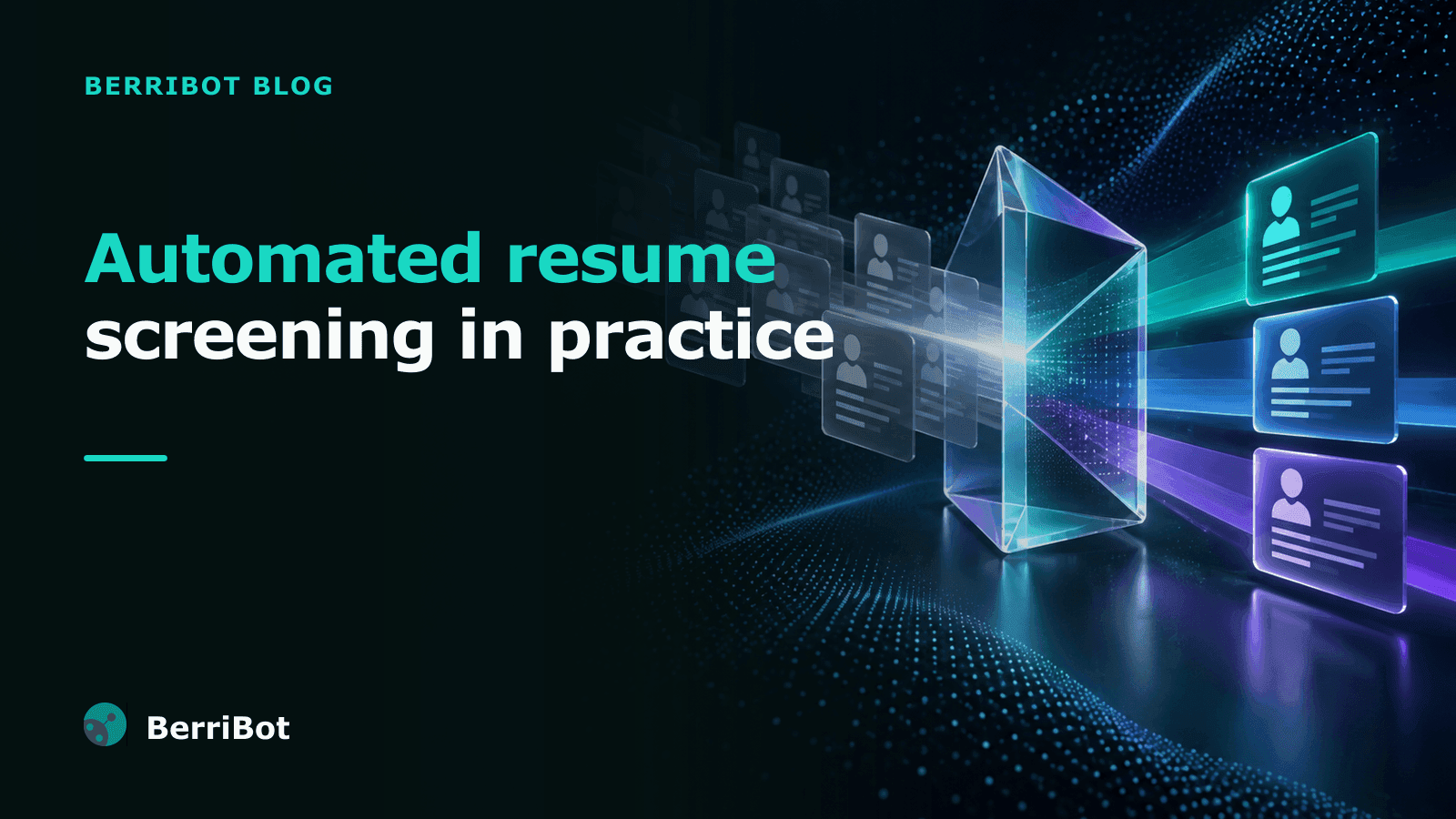
Automated resume screening parses resumes, compares them to job requirements, and ranks candidates, so recruiters review only top talent.
Automated resume screening uses software or an AI agent to parse candidate resumes into structured data, extract the required details (skills, experience, job titles, tenure, education), and compare those details against the job description to rank resumes on fit for that particular role.
Precise resume screening systems go beyond keywords. They apply semantic profiling, score explainably, and rediscover strong matches buried in your applicant tracking system (ATS), and update scores and notes back into the ATS automatically.
What Is the Need for Automated Resume Screening?
The need for automated resume screening is increasing since recruiters receive a high volume of resumes for a single role now. Recruiters have cognitive limits. They cannot give each resume a fair, careful read.
Two recruiters screening the same set of resumes will build two different shortlists, and neither can fully explain or be certain their shortlist was right. Inconsistent shortlists move unfit candidates to the next hiring stage.
That risk gets worse when the resume itself can't be trusted.
A January 2025 ResumeBuilder.com survey of 2,000 applicants found that one in four U.S. job seekers admitted to lying on a resume. AI tools now make it easier to write a resume that reads well, so recruiters can't reliably tell a faked resume from a genuine one by reading alone.
They need an automated system that screens resumes at scale, consistently, and points to a candidate's actual capability rather than how well the resume is written. It also saves recruiters the time spent reading every resume manually, so they can focus on reviewing only top talent.
Our AI resume screening agent, Berri Search & Match, processes a large volume of resumes simultaneously and returns a shortlist of top talent. It does this through:
Semantic Profile Parsing: extracts and structures resume data by context rather than text match, so relevant candidates aren't missed.
Match Ranking Index (MRI): scores each resume's relevance against the job description, giving recruiters a rationale they can act on and defend.
Internal Talent Search: checks the existing ATS for candidates who already fit the role, saving companies' resources on sourcing new candidates.
The first of these, Semantic Profile Parsing, is what makes the shortlist more reliable than keyword-based shortlisting.
How Is Semantic Resume Parsing Better Than Keyword-Based Filters?
Semantic resume parsing looks for overall candidate context in the resume, rather than relying on text matches like keyword based filtering tools.
For instance, a job requirement might ask for "React." A candidate's resume mentions "front-end development using component-based JavaScript frameworks," describing the same experience in different words.
A rigid keyword filter only looks for "React" as a string, so it screens out this candidate entirely. But semantic parsing reads the sentence for context, recognizes it as React experience, and doesn't miss the match.
Approach | What it does | What to watch for | What recruiters see | Where it fits |
Keyword-based screening | Matches exact strings against a JD | Misses synonyms, variant titles, and implied skills | High false-negative rate, thin explanation | Simple, low-volume, low-stakes roles |
Contextual screening (semantic parsing + MRI) | Reads resumes for context, then ranks candidates with a weighted, explainable fit score | Requires clean data and human oversight to work well | A ranked shortlist with evidence-backed rationale | Any volume, high-stakes hiring with compliance scrutiny |
Contextual inference works the same way for skills, experience, job titles, and responsibilities. This reduces the false negatives, since candidates rarely use the exact phrasing a job description does. It also becomes the raw input for MRI scoring, so parsing accuracy directly shapes what MRI has to work with.
What Is Match Ranking Index and How Is the Score Computed?
Match Ranking Index is a score on how well a candidate fits for the role. It weighs skills, experience, recency, and seniority against a role's specific requirements, but not with fixed importance.
Context weights adjust how much each factor matters for that particular role, so a candidate applying for an intern posting won't be scored down for lacking seniority. Similarly, a candidate returning from a career gap isn't penalized on the recency factor.
The MRI score is explainable. Recruiters can see why candidate A outranked candidate B, spot-check the reasoning, and override it when their own judgment says otherwise. Human oversight stays in the loop by design.
This helps recruiters defend their shortlists to a hiring manager or a compliance review.
How Does Internal Talent Search Rediscover Qualified Candidates in Your ATS?
Internal Talent Search, or ATS reactivation, rediscovers qualified candidates by scanning your existing ATS database for candidates who applied for a past role and weren't selected, but have potential and match current job requirements.
It runs the same semantic parsing and MRI scoring against those dormant profiles, building a precise shortlist from people already in your system. That cuts dependence on costly job boards for every new requisition, shortens the path to a shortlist, and saves recruiters' time.
Search & Match supports Plug-and-Play integration with your ATS, including platforms like Workday and SuccessFactors. So recruiters don't need a separate setup process or a new tool to manage. Once connected, candidate scores and updates sync to the ATS automatically, keeping it the single source of truth.
How Do You Keep Automated Resume Screening Fair and Compliant?
Keeping automated resume screening fair and compliant comes down to three things:
1. Documenting that every scoring factor is actually tied to job performance.
2. Checking regularly for adverse impact, whether the tool scores people differently across race, gender, age, or disability.
3. Keeping a human in the loop for review and final decisions.
The EEOC (Equal Employment Opportunity Commission) Chair, Charlotte A. Burrows, has been direct on this. She says: "As employers increasingly turn to AI and other automated systems, they must ensure that the use of these technologies aligns with the civil rights laws and our national values of fairness, justice and equality."
These expectations are already law in some places.
For instance, New York City's Local Law 144 requires employers using automated hiring tools to get an independent bias audit every year and publish the results. The EU AI Act now classifies recruitment and CV-screening AI as high-risk, requiring risk assessments, bias testing, and human oversight as of August 2026.
More jurisdictions are expected to follow similar rules.
What KPIs Should You Track After Deploying Automated Resume Screening?
After deployment, track these five KPIs against your baseline on an ongoing basis:
Time-to-shortlist: hours from requisition approval to a shortlist delivered to the hiring manager.
Interview-to-offer ratio: number of interviews it takes to reach an offer.
Rediscovery contribution: percentage of offers sourced from ATS reactivation.
Recruiter hours saved per offer: hours previously spent manually screening for that role, now freed up.
Offer acceptance rate: percentage of extended offers that get accepted. Worth watching, but shouldn't be over-attributed to screening alone since plenty of other factors shape it.
Report on these KPIs at a regular cadence. So if there is a deviation, you can identify and fix the issue while it's still small, instead of only noticing it in a quarterly review.
Frequently Asked Questions
What is an AI resume screening agent?
An AI resume screening agent is a system that automatically parses and ranks resumes against a job's requirements, then hands recruiters an explainable, ranked shortlist.
Does automated resume screening replace recruiters?
No. It narrows a large pool of resumes down to a ranked shortlist. A recruiter still reviews that shortlist, makes the final call, and can override the ranking.
How is semantic resume parsing different from keyword-based screening?
Semantic resume parsing reads a resume for context and meaning, catching relevant skills, titles, and experience. Keyword-based screening only looks for exact text matches and screens out the same details when they're described using different words.
Can AI agents rediscover candidates already in our database?
Yes. AI resume screening agents like Search & Match scan your existing ATS for past candidates who weren't selected for a previous role but fit the current one.
Does Search & Match support ATS integration?
Yes. Search & Match supports easy integration with your existing ATS. Platforms like Workday and SuccessFactors are included.
Next step: Try Berri Search & Match. It is the fastest way to screen resumes at scale and consistently. Just upload your JD and candidate resumes and receive top 1% shortlists.
Interviews you can prove
Screening, interviews, and live identity verification in one platform. Built for high-volume technical hiring.
Book a demo