

Answer in brief
See how Berri 360 coordinates sourcing, outreach, interviews, and live identity verification while recruiters retain control of hiring decisions.
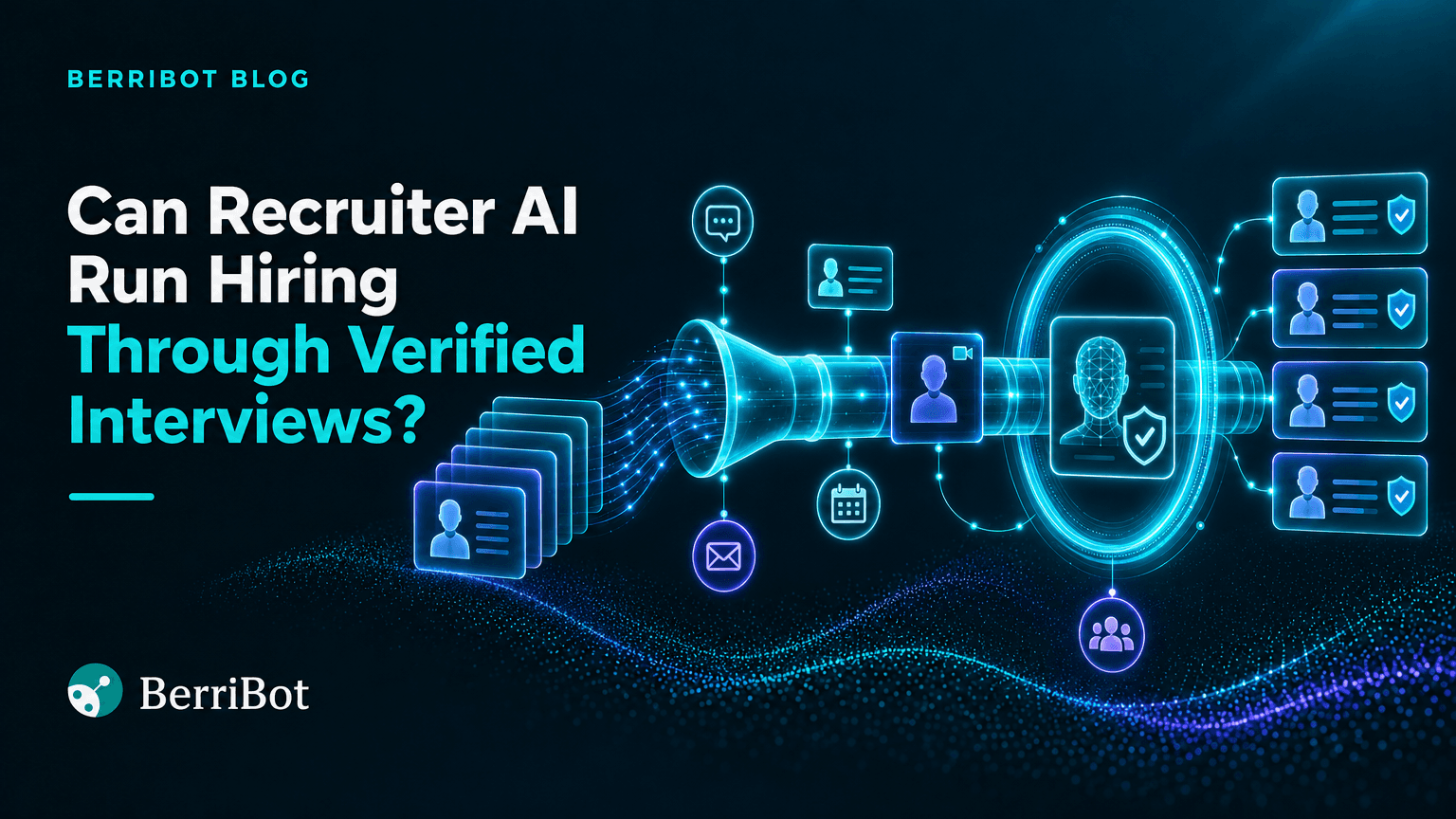
An AI recruiter can run sourcing, matching, outreach, scheduling, and first-round interviews while keeping hiring decisions with people. Berri 360 coordinates those tasks through Berri-Agents, specialized AI agents that execute recruiting work under human oversight. Berri Proctor verifies candidate identity during the interview, giving talent acquisition teams evidence to review before an offer.
What does an AI recruiter do across the hiring funnel?
A buyer asking which AI recruiter can run hiring end to end, from sourcing to offer, needs to distinguish task automation from a coordinated hiring process. A scheduling tool can arrange an interview, but it cannot establish whether the applicant matches the role, conduct a first round, or connect interview evidence to a verified identity. An agentic AI recruiting platform coordinates those stages while leaving requisition requirements, exceptions, and offer decisions with the talent acquisition team.
The Berri Suite comprises six products: Search & Match for candidate matching, Connect for engagement and scheduling, MasterMind for first-round interviews, Proctor for interview integrity, 360 for coordinating the hiring workflow, and Tutor for workforce upskilling. Within Berri 360, Berri-Agents carry work forward across screening, engagement, interviewing, verification, and onboarding coordination. A Head of TA still sets the role criteria, reviews consequential exceptions, manages client-facing commitments, and decides whom to hire. For an IT services team filling thousands of technical roles, the practical question is how much routine coordination the system can execute without obscuring those decisions.
How does Berri 360 move a candidate from job description to offer review?
The process begins with a job description and the hiring team's requirements. Berri Search & Match parses profiles and ranks potential matches, including candidates in an existing talent database. Berri Connect then handles outreach, responses, and scheduling across supported channels. MasterMind conducts the first-round interview, while Proctor adds live identity verification and integrity signals. Berri 360 brings the results into explainable scorecards for recruiter review and coordinates the next steps toward onboarding.
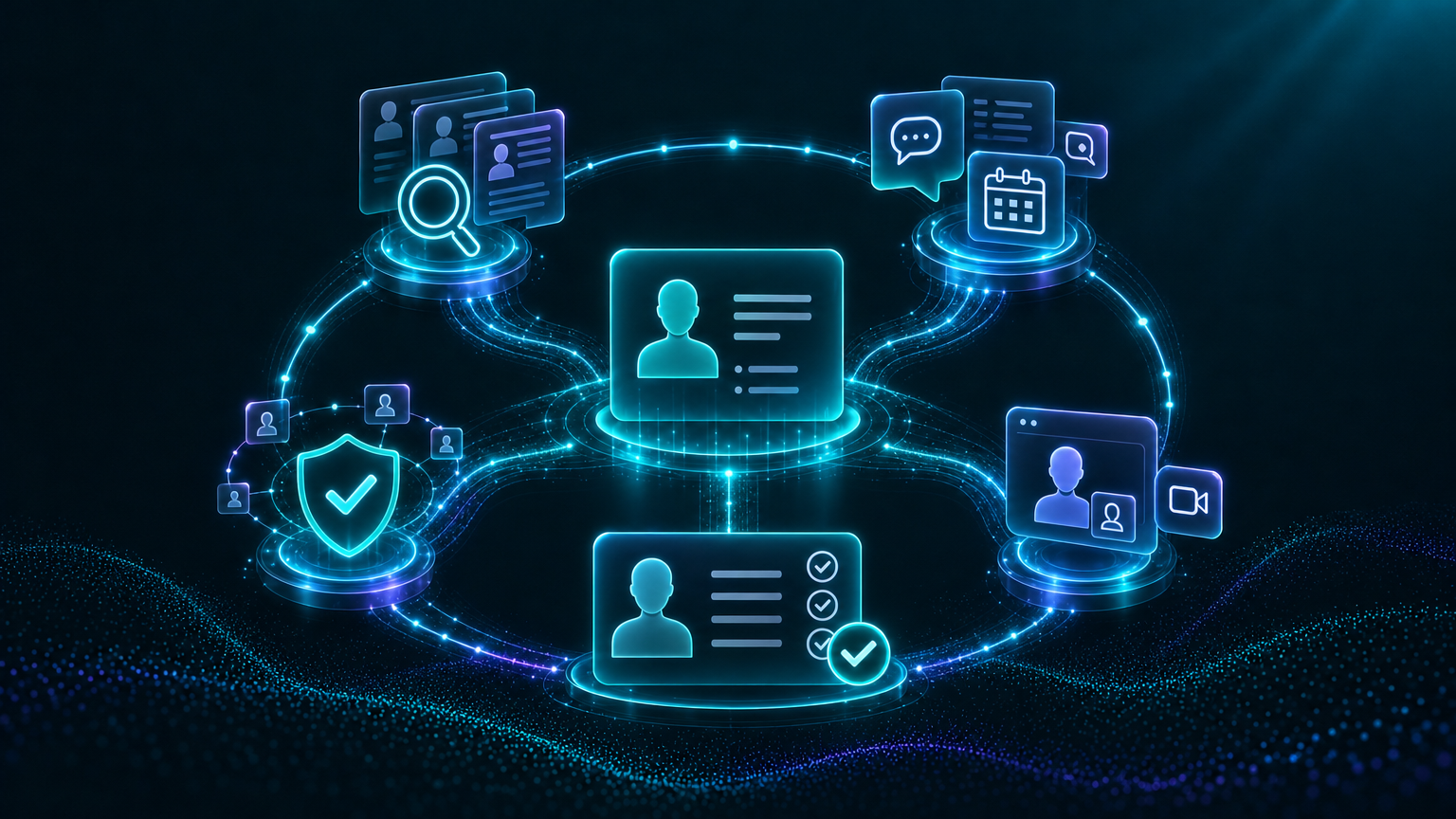
The distinction between manual work, separate point tools, and coordinated agents becomes clearest at the handoffs. A pilot should test each handoff in the buyer's own applicant tracking system (ATS), including what information the integration can return and which actions require a recruiter to approve them.
Hiring stage | Manual or separate point tools | Berri 360 with Berri-Agents |
Matching | Recruiters review profiles or transfer results between tools. | Search & Match ranks candidates against the role. |
Engagement | Recruiters chase replies and available interview slots. | Connect runs outreach, two-way engagement, and scheduling. |
First round | Panels conduct interviews or reconcile separate records. | MasterMind conducts adaptive interviews and produces scorecards. |
Identity and integrity | Checks may occur in a different workflow or after an interview. | Proctor verifies identity during the interview and produces an integrity report. |
Decision and next steps | Recruiters assemble evidence and decide how to proceed. | Berri 360 presents workflow evidence; recruiters retain the hiring and offer decisions. |
BerriBot reports 9.5 recruiter hours saved per offer and a reduction from more than 25 days to a 10-day time-to-offer in its public proof points. Those figures describe reported outcomes, not a result every employer should expect. A buyer should establish a baseline, specify which stages count toward time-to-offer, and test whether the integration preserves the evidence recruiters need to review an exception. For the wider distinction between connected agents and isolated automations, see the agentic AI recruiting platform overview.
How can recruiters explain a shortlist and an interview score?
A shortlist is useful only when a recruiter can examine why a candidate appears on it. Search & Match uses semantic profile parsing and a Match Ranking Index (MRI), BerriBot's ranking measure for how a candidate profile fits a job description. Recruiters should inspect the role requirements behind a ranking, check whether relevant skills are represented accurately, and correct a poor match before the candidate moves forward. The ranking supports a review of job-related evidence; it does not make the hiring decision.
MasterMind applies multi-dimensional evaluation during an adaptive conversational interview and generates an insight scorecard. When assessing AI interviewing software for high-volume hiring, a TA lead should ask to see the questions, the job-related evaluation criteria, the interview evidence behind each score, and how a reviewer can challenge a result. Berri 360 provides explainable scorecards, but buyers should verify the detail available in their configuration rather than assume every requested weighting or decision log is provided by default. Gartner reported on July 31, 2025 that only 26% of job applicants trust AI to evaluate them fairly. Clear candidate disclosures and reviewable, role-related evidence therefore matter alongside operational speed.
Can an AI recruiter conduct consistent interviews in multiple languages?
MasterMind supports adaptive conversational interviewing in more than 140 languages. Rather than depending on whichever panel member happens to be available, a hiring team can define the competencies a first round should examine and compare the resulting scorecards against the same role requirements. Recruiters should still review whether questions and scoring criteria are appropriate for each role and language, particularly when candidates are being compared across locations.
For voice-heavy roles, Berri Connect also offers CEFR communication analysis. CEFR, the Common European Framework of Reference for Languages, describes proficiency from A1, a beginner level, through C2, a proficient level. Language coverage and a communication rating answer different questions: one concerns whether a candidate can take an interview in a supported language, while the other concerns a role-specific communication requirement. Candidate communications should explain the interview format, request any necessary permissions, and make rescheduling or a callback practical. Connect supports two-way engagement and callbacks through WhatsApp, SMS, email, voice, and chat; the hiring team remains responsible for its disclosure and consent process.
Why verify candidate identity during the interview?
A verified profile does not, by itself, establish who answered the interview questions. Berri Proctor addresses that gap during the live interview through identity verification, including 3D liveness detection, which uses depth and motion checks to help distinguish a present person from a spoofed image or video. Proctor can also assess scene and interview-integrity signals, including lip-sync, gaze, head pose, tab switching, screen sharing, and copy-paste alerts, then produce an integrity report for review. An alert calls for examination, not an automatic finding of misconduct.
The timing matters because an interview score is less useful if the employer cannot establish whose performance the score represents. SHRM reported a 55.54% deepfake identification accuracy figure from a Wiley meta-analysis of untrained human observers. In a separate vendor analysis, Fabric reported that 38.5% of 19,368 interviews examined in 2025 and 2026 were flagged for cheating, rising to 48% for technical roles. Fabric's flags describe its examined interviews and should not be treated as a prevalence estimate for every hiring market. Together, the findings make a practical case for checking identity and reviewing integrity evidence while the interview is still part of the hiring decision, rather than relying solely on an after-offer check. Teams evaluating the approach can examine how live interview identity verification works.
How should a Head of TA evaluate recruiter AI before rollout?
Start with one high-volume role family and trace a real requisition from job description to offer review. Ask vendors when identity is verified, which integrity signals generate reports, and how a recruiter investigates a flag. Check supported interview languages and any separate communication assessment, then request a scorecard that shows the evidence behind its evaluation. In the same pilot, test ATS or HRIS integration, including whether required data can be written back, and identify each point where a recruiter can pause or override the workflow.
Security and candidate treatment belong in the same review. Ask for retention and access settings, applicable certifications, data handling information, candidate disclosures, and the procedures used when a verification attempt fails; the BerriBot trust center is a starting point for that review. Finally, compare recruiter effort, interview completion, exception handling, and time-to-offer against the team's existing process. Give the pilot team one concrete assignment: run a single requisition through matching, outreach, a verified first-round interview, and human scorecard review, then document every handoff that still needs attention.

20 recruiters. 150,000 hires.
That is the ratio when transactional work stops belonging to humans.
See the workflow