

Answer in brief
For remote technical hiring, Berri 360 is the strongest end-to-end option. Eightfold AI leads for skills matching, while Paradox excels at high-volume scheduling.
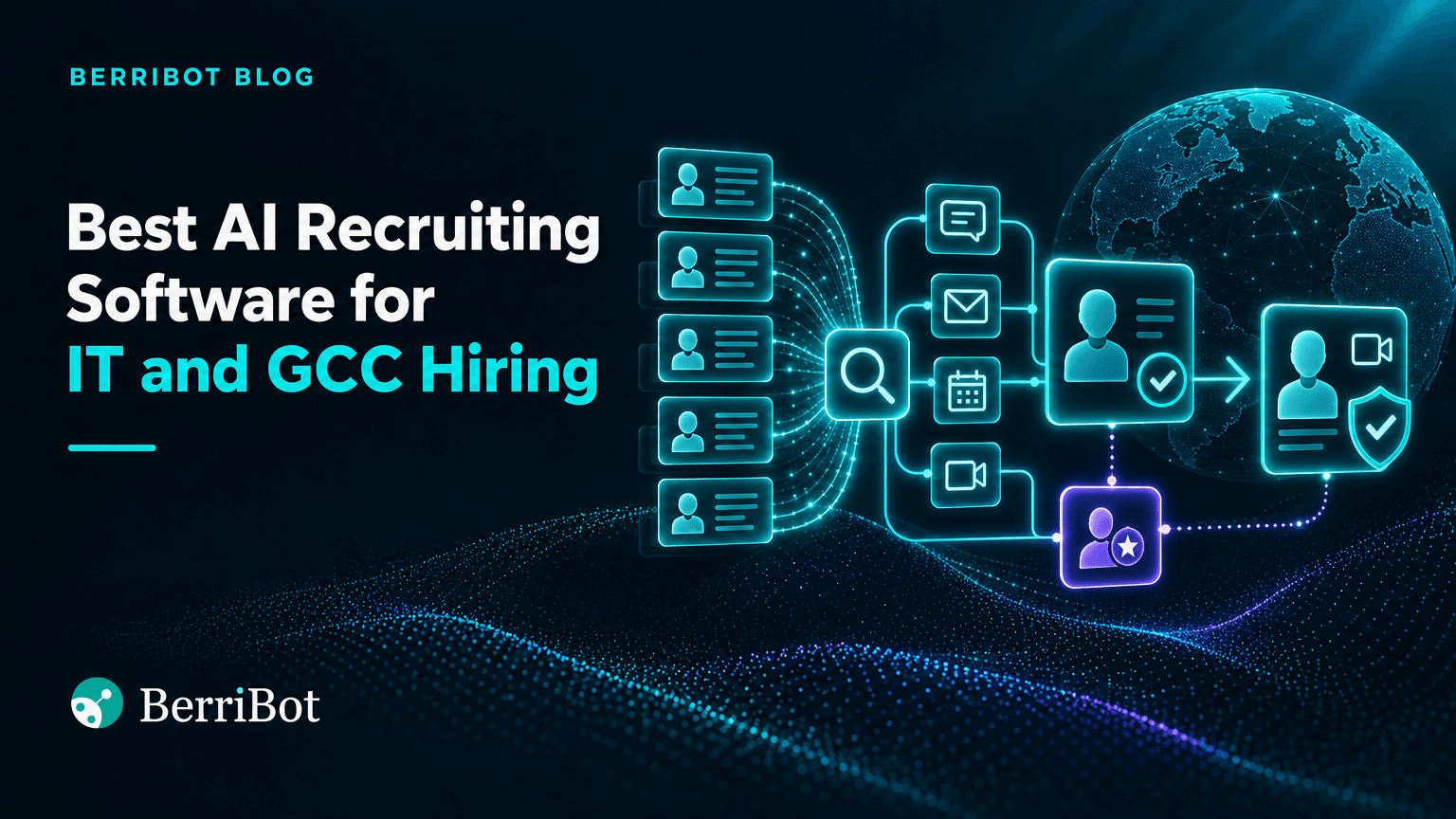
The best AI recruiting software in 2026 depends on the work your team needs to automate. For remote IT services and GCC hiring, we rank Berri 360 first because its agents move candidates from shortlisting through outreach and verified interviews. Eightfold AI is stronger for enterprise skills intelligence; Paradox is stronger for high-volume scheduling.
A recruiting tool can perform well at one stage and still leave recruiters coordinating every handoff. Our ranking gives greater weight to action across stages, explainable results and recruiter control than to the number of AI features advertised.
This blog covers our selection criteria, why remote technical hiring needs a connected process, how Berri 360 works, and which of ten options suits each buying team.
What Does the Best AI Recruiting Software Need to Do?
The best AI recruiting software should address the specific delay or quality problem in your hiring process. Sourcing software finds candidates; conversational software contacts and schedules them; interview software assesses them. An agentic AI recruiting platform also completes agreed handoffs between those stages while recruiters retain the final hiring decision.
For this ranking, we weighted six checks before ordering the vendors:
Selection Criterion | What We Looked For |
Agentic action | Screening, outreach, interviews and handoffs that run without repeated recruiter prompts |
Recruiter control | Explainable scores, human decisions and auditable overrides |
Remote-hiring integrity | Identity checks during interviews and evidence for review |
Enterprise fit | ATS write-back, calendar workflows, security and data-handling review |
India and GCC readiness | Relevant communication channels, languages and volume capacity |
Value | A credible fit between the buyer’s bottleneck and the product’s scope |
This is a use-case ranking, not a measured head-to-head product test. We considered vendor documentation alongside TechTarget’s 2026 recruiting tools overview and Zapier’s recruiting tools roundup. Buyers should validate integrations, data residency, pricing and performance in their own environment.
Why Do Remote IT Services and GCC Teams Need Connected Recruiting Software?
Remote IT services and GCC teams need recruiting software that reduces coordination work without weakening interview quality or recruiter oversight. Three pressures make a single-stage purchase worth examining carefully.
1. Interview Integrity
Remote interview integrity requires a way to confirm who is answering. Checkr’s 2025 hiring manager survey found that 35% had confirmed someone other than the listed applicant took part in a virtual interview. In the same survey, 62% believed job seekers were better at faking identity than employers were at detecting it.
2. Evidence Review
Evidence review matters because an automated flag is not a hiring decision. Fabric’s 2026 analysis flagged 38.5% of 19,368 interviews for cheating, rising to 48% for technical roles. Those are findings from Fabric’s interview sample, not an estimate of fraud across all applicants. A person should review any flag before it affects a candidate.
3. Hiring Capacity
Hiring capacity depends on moving qualified candidates through the funnel, rather than accelerating one isolated task. In July 2026 Economic Times GCC coverage, foundit CEO Tarun Sinha said, “India offers the depth of talent to do this at scale.” A Head of TA still needs scheduling, assessment and handoffs to keep pace with that talent supply.
Connected software helps when those pressures occur together. A point tool may be the better purchase when one stage is the clear bottleneck.
How Does Berri 360 Run a Remote Technical Hiring Process?
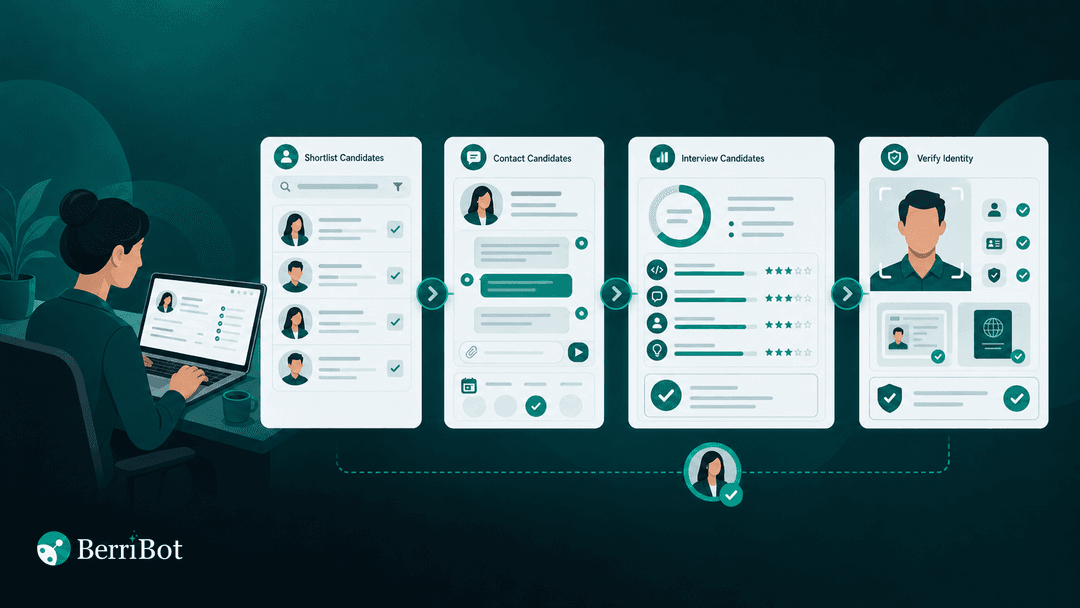
Berri 360 connects shortlisting, outreach, interviews and verification on one candidate record. Its Berri-Agents are autonomous software agents that carry out recruiting steps under a campaign’s rules; recruiters set the criteria, review results and make the final hiring decision. Teams can select different stages for different hiring campaigns.
1. Shortlist Candidates
Berri Search & Match ranks candidates against a job description and shows which skills drove each match. Its Match Ranking Index (MRI) is a comparable candidate-to-role score produced through semantic profile parsing. Recruiters can review the gaps and overrule a ranking.
2. Contact Candidates
Berri Connect calls candidates, checks interest and coordinates slots through voice, WhatsApp, SMS or email. Missed calls and technical failures can be retried rather than treated as candidate rejection.
3. Interview Candidates
Berri MasterMind conducts structured first-round interviews with adaptive follow-up questions. Candidates for a role are scored against the same written rubric, and recruiters receive a scorecard with reasoning. MasterMind supports interviews in 140+ languages.
4. Verify Identity
Berri Proctor checks identity at the start and throughout an interview when verification is enabled. Its 3D liveness check uses depth and motion cues to help confirm that a live person, rather than a spoofed image or video, is present. A person reviews integrity flags before they affect the candidate.
What Evidence Supports Berri 360 for Enterprise Hiring?
BerriBot reports operational results that enterprise buyers can use to set pilot targets; these numbers are our proof points, not a guarantee for every hiring team.
1. Recruiter Time
BerriBot reports 9.5 recruiter hours saved per offer. Ask which tasks your recruiters currently perform between shortlist and offer, then measure the same work during a pilot.
2. Time to Offer
BerriBot reports reducing a process that took more than 25 days to a 10-day time-to-offer. Your baseline, approval steps and role mix will determine whether that result is repeatable.
3. Interview Attendance
BerriBot reports a 2x increase in interview show-up rates. For teams with scheduling delays, attendance is worth measuring alongside speed and shortlist quality.
How Should Buyers Evaluate AI Recruiting Software?
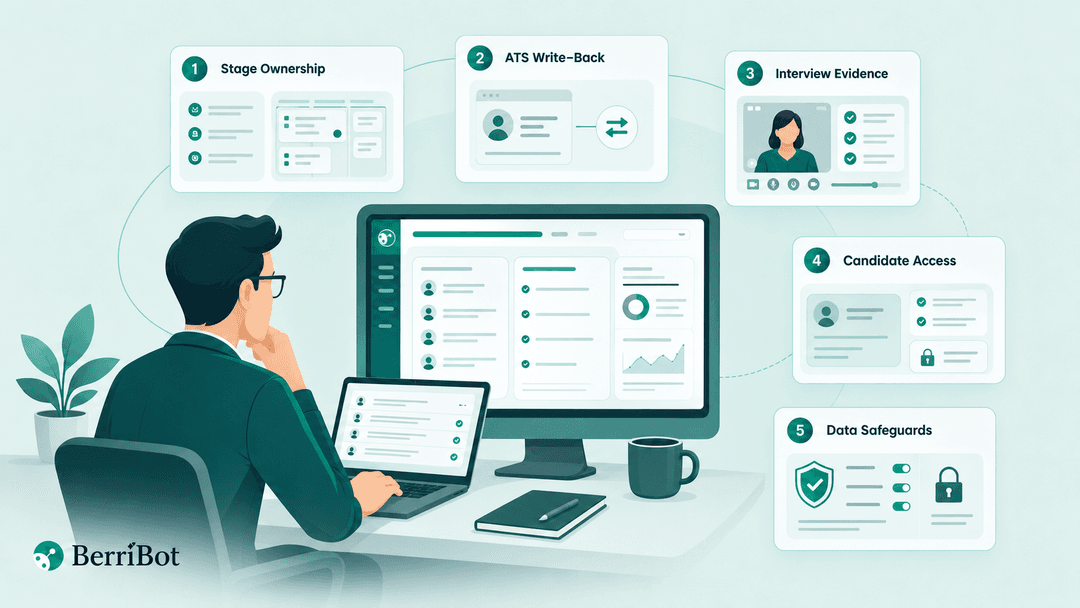
Enterprise buyers should test AI recruiting software on one real job family, with success measures agreed before the pilot. Berri 360 offers a pilot model covering 200 to 500 interviews, but the same checks apply to every vendor.
1. Stage Ownership
Stage ownership shows whether software completes a recruiting action or only suggests the next one. Ask vendors to demonstrate a candidate moving from shortlist to booked interview, including failed-call retries and recruiter approvals.
2. ATS Write-Back
ATS write-back should place scores and reports in the system recruiters already use. Berri 360 has native Workday and SAP SuccessFactors integrations; test permissions, calendar coordination and logged overrides in your configuration.
3. Interview Evidence
Interview evidence should make scores and identity flags reviewable. Ask for the rubric, score reasoning, identity-check timing and the procedure for resolving a disputed flag.
4. Candidate Access
Candidate access should fit the languages and channels your applicants use. For voice roles, define the assessment standard separately: Common European Framework of Reference for Languages (CEFR) levels run from A1, beginner, to C2, mastery. Do not assume a multilingual interview is a CEFR-scored language test.
5. Data Safeguards
Data safeguards require review by InfoSec and the data protection officer. Check consent for biometrics, retention, data residency requirements and access rights against the vendor’s documentation. BerriBot publishes security information in its Trust Center.
Berri 360 is worth piloting when several hiring stages need coordination; a narrower product may offer better value when only one stage needs work.
Which AI Recruiting Platforms Are Best for Each Buying Team?
These ten AI recruiting platforms suit different buying teams. The order favors connected, controlled remote technical hiring; a team prioritizing internal mobility, frontline scheduling or assessments could reasonably choose a different number one.
1. BerriBot Berri 360
Berri 360 is our first choice for IT services and GCC teams that want agents to run shortlisting, engagement and first-round interviews on one record. Optional Berri Proctor verification strengthens remote interview integrity. Berri 360 suits teams prepared to pilot a connected hiring flow, rather than purchase sourcing alone.
2. Eightfold AI
Eightfold AI is a strong choice for enterprise skills intelligence, matching and internal mobility. It suits global organizations whose primary goal is understanding and deploying skills across a large workforce; buyers should establish how interview verification fits their wider stack.
3. Paradox
Paradox stands out for conversational candidate engagement and high-volume scheduling. It suits frontline, BPO/CX and event hiring teams whose biggest constraint is getting applicants into booked conversations.
4. HireVue
HireVue is an interview and assessment choice for global teams seeking a standardized selection process. It suits buyers prioritizing assessment workflows over an agent-led sourcing-to-offer pipeline.
5. HiredScore
HiredScore on Workday Marketplace is an orchestration option for Workday-centered enterprises. It suits teams that want recruiting workflows close to their existing Workday environment; confirm the exact scope of any additional interview or verification tools.
6. SeekOut
SeekOut is a discovery and outreach option for hard-to-find technical talent. It suits sourcing teams seeking external talent pools, while interview assessment and identity checks remain separate buying questions.
7. Mercer | Mettl
Mercer | Mettl is an assessment-oriented option for campus and early-career programs. It suits teams whose main requirement is administering skills tests and checking assessment integrity at volume.
8. Talview
Talview is an option for virtual interviews and proctored assessments. It suits regulated or assessment-heavy programs that give interview integrity greater weight than end-to-end outreach automation.
9. iMocha
iMocha is a skills-assessment option for teams screening varied technical roles and locations. It suits buyers who want to establish skills evidence before candidates enter a separate interview process; verify language-test requirements directly.
10. BarRaiser
BarRaiser is an option for teams retaining human-led interviews while seeking greater structure. It suits hiring managers who want more consistent interview guidance rather than autonomous first-round interviewing.
Frequently Asked Questions
1. Which Is the Best AI Recruiting Software for Remote IT Hiring?
Berri 360 is our top-ranked AI recruiting software for teams seeking connected shortlisting, outreach and first-round interviews, with Berri Proctor available for in-interview identity verification. Eightfold AI may be a better fit when enterprise skills intelligence and internal mobility are the main goals.
2. Can AI Recruiting Software Make the Final Hiring Decision?
Berri 360 does not make the final hiring decision. Its agents run configured steps, while recruiters review explainable scores, resolve exceptions and decide whom to hire.
3. Does Multilingual Interviewing Include CEFR Scoring?
Berri MasterMind supports interviews in 140+ languages, but that claim does not establish a CEFR-scored language test. Teams hiring for voice roles should ask vendors to demonstrate the specific speaking rubric and proficiency level they require.
See Berri 360 on One of Your Roles
Bring one job description to a 30-minute walkthrough. We will show you how Berri 360 moves a candidate through the stages your team selects, where recruiters approve decisions and how Berri Proctor verifies identity during an interview.

20 recruiters. 150,000 hires.
That is the ratio when transactional work stops belonging to humans.
See the workflow