

Answer in brief
HireVue leads this review for published explainability documentation. Berri 360 suits teams seeking explainable first-round scores within an agentic hiring workflow. Neither claim establishes legal compliance or bias-free outcomes.
HireVue offers the strongest published explainability documentation among the AI interview platforms reviewed here. Berri 360 is a strong option for enterprises that need structured interview scores within an agentic hiring workflow. No vendor should be treated as fair or legally compliant on a product claim alone. Buyers need role-specific bias tests, reviewable score rationales, human oversight and data-handling evidence.
AI hiring bias can enter through assessment design, scoring or decisions made from a score. A polished report does not establish that candidates across groups receive fair treatment.
We built this comparison around evidence an InfoSec lead, data protection officer (DPO) or Head of Talent Acquisition can request and examine. Berri 360 brings screening, outreach and interviews into one candidate record, while recruiters retain the final hiring decision.
This blog covers how we assessed nine vendors, what their public materials show, how Berri 360 records hiring decisions and which proofs to demand before a pilot goes live.
What Makes AI Interview Scoring Explainable and Auditable?
Explainable AI interview scoring connects a candidate’s result to defined job criteria and retains evidence that a reviewer can examine. A scorecard should identify the rubric, the candidate evidence behind each score and the person responsible for the final decision.
An audit artifact is a retained record that supports review, such as a score rationale, configuration history, pipeline log or interview integrity report. An explainability statement describes a method; an artifact shows how that method operated in a particular hiring campaign. Both matter when a candidate questions an outcome.
The 2023 NIST AI Risk Management Framework offers a structure for governing, measuring and managing AI risks. ISO’s explanation of ISO/IEC 42001 describes an AI management system. Neither framework, by itself, certifies that a particular interview score is fair.
Why Do Enterprise Hiring Teams Need Bias and Audit Checks?
Enterprise hiring teams need bias and audit checks because candidate trust, interview integrity and legal review all depend on evidence they can inspect.
1. Candidate Trust
Candidate trust requires an answer that goes beyond a numeric score. Gartner’s 2025 survey found that only 26% of job applicants trust AI to evaluate them fairly. A recruiter should be able to explain which job criteria informed a recommendation and how a candidate can request a review.
2. Interview Integrity
Interview integrity needs separate evidence from skills scoring. Fabric’s 2026 analysis flagged 38.5% of 19,368 AI-conducted interviews for cheating, including 48% of technical-role interviews. Those are Fabric’s flagged interviews, not a prevalence estimate for all hiring. Timestamped integrity evidence lets a person review a concern before it affects a candidate.
3. Data Protection
Data protection review must cover what interview systems collect and retain. Pindrop’s 2026 hiring telemetry reported clear fraud signs in one in six applicants in its data. Identity checks may be useful, but a DPO still needs the purpose, consent process, retention schedule and access controls for biometric data.
Together, those checks tell buyers whether a vendor can support a defensible hiring process rather than merely produce a score.
How Did We Rank AI Interview Platforms for Fairness and Auditability?
We ranked AI interview platforms by the depth of publicly described evidence, with greater weight on explainability, bias testing and reviewable artifacts. The ranking is an editorial assessment of the linked materials, not a measured comparison of vendors’ bias rates or a legal compliance determination.
For each criterion, 1 means a broad public claim and 5 means detailed, public, role-relevant evidence. Scores between those points reflect the documentation described in the linked materials. A low score can mean evidence was not available publicly; buyers should request private documentation before ruling a vendor out.
Vendor and public material | Explainability ×3 | Bias tests ×3 | Artifacts ×3 | Policies ×2 | India fit ×2 | Evidence depth ×2 | Total / 75 |
4 | 2 | 2 | 3 | 2 | 4 | 42 | |
3 | 1 | 2 | 3 | 4 | 2 | 36 | |
1 | 1 | 4 | 2 | 4 | 2 | 34 | |
2 | 1 | 3 | 3 | 3 | 1 | 32 | |
3 | 1 | 2 | 1 | 3 | 2 | 30 | |
2 | 1 | 1 | 2 | 2 | 2 | 24 | |
2 | 1 | 2 | 1 | 2 | 1 | 23 | |
1 | 1 | 2 | 1 | 2 | 2 | 22 | |
1 | 1 | 2 | 1 | 2 | 1 | 20 |
The weighting favors documented scoring methods over the number of features advertised. None of these editorial scores establishes that a vendor has completed a bias audit for your roles.
Which AI Interview Platforms Deserve an Enterprise Fairness Review?
Nine AI interview platforms merit a closer look, but their public evidence supports different buying priorities. We would ask every shortlisted vendor for the same role-specific documents before making a selection.
1. HireVue
HireVue leads on published method detail through its 2024 AI Explainability Statement. It suits regulated global enterprises that want a substantive document to review first. Ask separately for current group-level test results, sample exports and India data-handling terms.
2. Talview
Talview publishes ethical AI practices and suits India-focused assessment teams seeking an established integrity workflow. Ask for named fairness metrics, test cadence and a sample candidate-level audit packet.
3. HirePro
HirePro emphasizes interview integrity and reporting in its AI recruiter materials. It suits high-volume India hiring teams that need reports across requisitions. Request scoring-method notes and disaggregated fairness results alongside export samples.
4. Berri 360
Berri 360 connects explainable first-round scorecards to a wider agentic hiring flow. It suits enterprises coordinating screening, outreach, interviews and human approvals on one candidate record. Buyers should request role-specific fairness tests; BerriBot does not claim a published independent bias audit.
5. HackerRank
HackerRank describes how Chakra scores an interview. It suits technical teams already using HackerRank assessments. Ask how interview evidence, bias tests and integrity events are exported together.
6. Mercer Mettl
Mercer Mettl discusses responsible AI in talent assessments. It suits enterprise assessment programs that value a governance-led review. Request interview-specific scoring documentation and sample audit exports.
7. BarRaiser
BarRaiser offers structured interview support. It suits teams that want expert-led interviews with AI assistance. Ask for the scoring rubric, reviewer history and group-level fairness evidence.
8. HackerEarth
HackerEarth documents proctoring settings. It suits coding-heavy funnels where interview integrity is a priority. Buyers should request separate evidence for AI scoring explainability and bias testing.
9. InCruiter
InCruiter describes enterprise interview services. It suits teams buying additional interview capacity. Ask for score rationales, retention settings and reviewable fairness-test results.
How Does Berri 360 Produce Reviewable Hiring Outcomes?
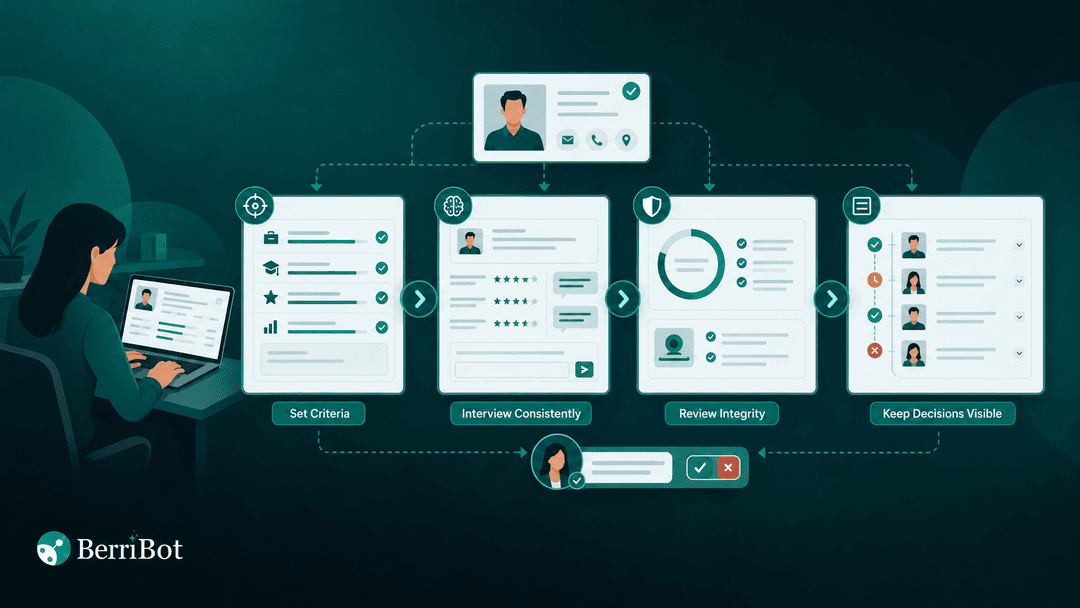
Berri 360 records candidate progress across an agentic hiring workflow while keeping recruiter decisions visible. Berri-Agents are AI agents that carry out screening, outreach, interviewing and verification steps under recruiter-defined criteria. The Berri Suite comprises Berri Search & Match, Berri Connect, Berri MasterMind, Berri Proctor, Berri 360 and Berri Tutor.
1. Set Criteria
Berri 360 begins each campaign with selected stages and role criteria. Berri Search & Match shows which skills drove a match and keeps gaps visible, so a recruiter can review or overrule its ranking.
2. Interview Consistently
Berri MasterMind uses the same written rubric for candidates in a role and asks adaptive follow-up questions. Its scorecard presents scored results with reasoning. Berri MasterMind does not infer emotion, mood or personality from a candidate’s face or voice.
3. Review Integrity
Berri Proctor produces reviewable evidence for interview integrity concerns. A person reviews every flag before it affects a candidate; an integrity flag is not an automatic finding of misconduct.
4. Keep Decisions Visible
Berri 360 keeps candidates on one pipeline record and logs manual stage moves with the person who made them. Recruiters can override agent actions and retain the final hiring decision. Berri 360 also writes scores and reports back through its native Workday and SAP SuccessFactors integrations.
What Evidence Supports a Berri 360 Pilot?
BerriBot’s published operating figures support a scale pilot, but they do not establish group fairness. These numbers are our proof of what the workflow can handle, not substitutes for a bias test.
1. Interview Languages
Berri MasterMind supports interviews in 140+ languages, according to BerriBot’s product figures. A pilot should still test each language used for a role against the same job criteria.
2. Candidate Attendance
BerriBot reports a 2x increase in interview show-up rates for customers using its engagement workflow. A buyer should verify that result against its own baseline and review whether reminders reach candidate groups consistently.
3. Pilot Size
Berri 360 offers a pilot model of 200 to 500 interviews in one job family. Buyers can agree on fairness measures, export requirements and human-review thresholds before scaling.
What Should Legal, InfoSec and DPO Teams Check Before Approval?
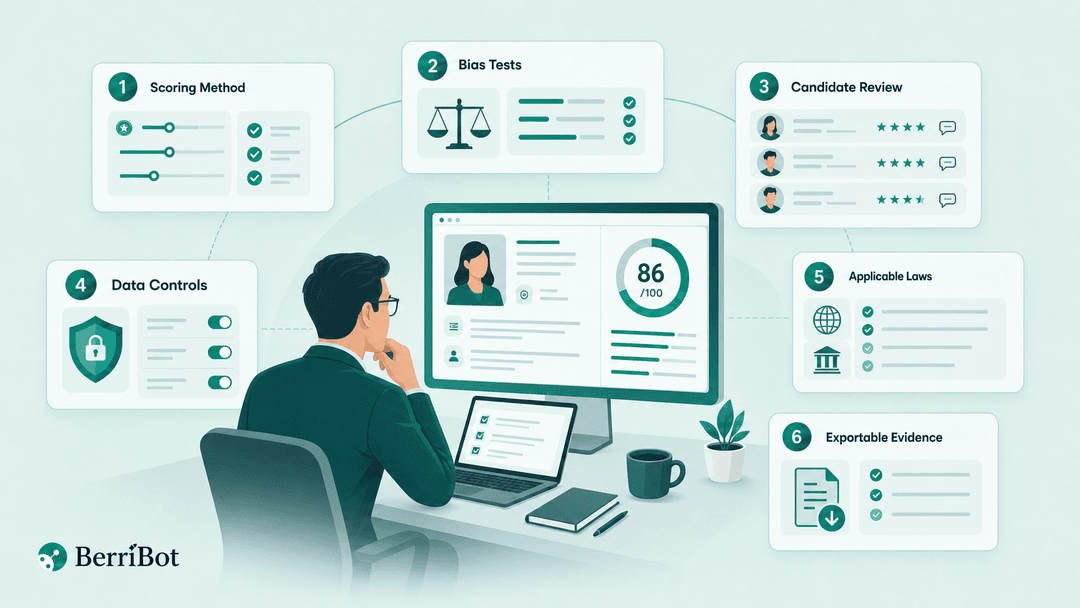
Legal, InfoSec and DPO teams should test one real hiring campaign and ask each vendor to supply the same evidence packet. A product security claim and a role-specific fairness result answer different questions.
1. Scoring Method
Ask the vendor for the interview rubric, scoring-method statement, model-change history and a candidate scorecard with supporting reasoning. Confirm which settings recruiters can change and whether changes are logged.
2. Bias Tests
Require disaggregated test results, named metrics, sample sizes, a revalidation schedule and agreed acceptance thresholds. Compare AI recommendations with a documented human-review baseline, then investigate differences rather than assuming either baseline is unbiased.
3. Candidate Review
Document how candidates can access applicable information, correct inaccurate personal data and question an outcome. Confirm who receives a challenge, who reviews the evidence and how the response is recorded.
4. Data Controls
Request a data processing agreement, retention schedule, subprocessors list, data-location options and the biometric-consent flow where identity checks are enabled. BerriBot states SOC 2 Type II and ISO 27001 safeguards and describes GDPR, CCPA and India DPDP data practices in its Trust Center. Review the underlying documents and your organization’s obligations separately.
5. Applicable Laws
Map the hiring locations before assessing legal duties. New York City Local Law 144 may require a bias audit and notices for covered automated employment decision tools; the EU AI Act treats relevant employment AI as high-risk. EU AI Act Recital 44 addresses the prohibition on workplace emotion recognition. For India, plan for DPDP core obligations taking effect on May 13, 2027, as summarized in the DPDP Act implementation timeline, and confirm the operative requirements with counsel.
6. Exportable Evidence
Ask for a sample export containing score rationales, integrity reports, configuration changes and human overrides. Legal and InfoSec should be able to reconstruct how a recommendation was reached without relying on a sales presentation.
Berri 360 can show its scorecards, integrity evidence and logged pipeline decisions on a pilot role; buyers should validate every required artifact before approval.
Frequently Asked Questions
1. Can an Explainable Scorecard Prove an AI Interview Is Bias-Free?
An explainable scorecard cannot prove that an AI interview is bias-free. Berri MasterMind’s rubric and score reasoning help reviewers inspect individual outcomes, while group-level fairness requires separate testing with defined measures and adequate samples.
2. Does BerriBot Have an Independent Hiring Bias Audit?
BerriBot does not claim a published independent third-party hiring bias audit. Enterprise buyers should ask BerriBot for available role-specific test evidence and determine whether a separate audit is required for their use case and jurisdiction.
Can You Review Berri 360 on One of Your Roles?
Bring one job description to a 30-minute walkthrough. We will show you how Berri 360 moves a candidate through screening and a structured interview, then review the scorecard, integrity evidence and recruiter decision points your team would need for a pilot.

Answer the security review before it starts
Data residency, retention, explainable scoring, audit trail — the whole pack, ready.
Get the compliance pack