If Your HR Tech Needs Monitoring, It Is Not Saving Time
Jan 31, 2026
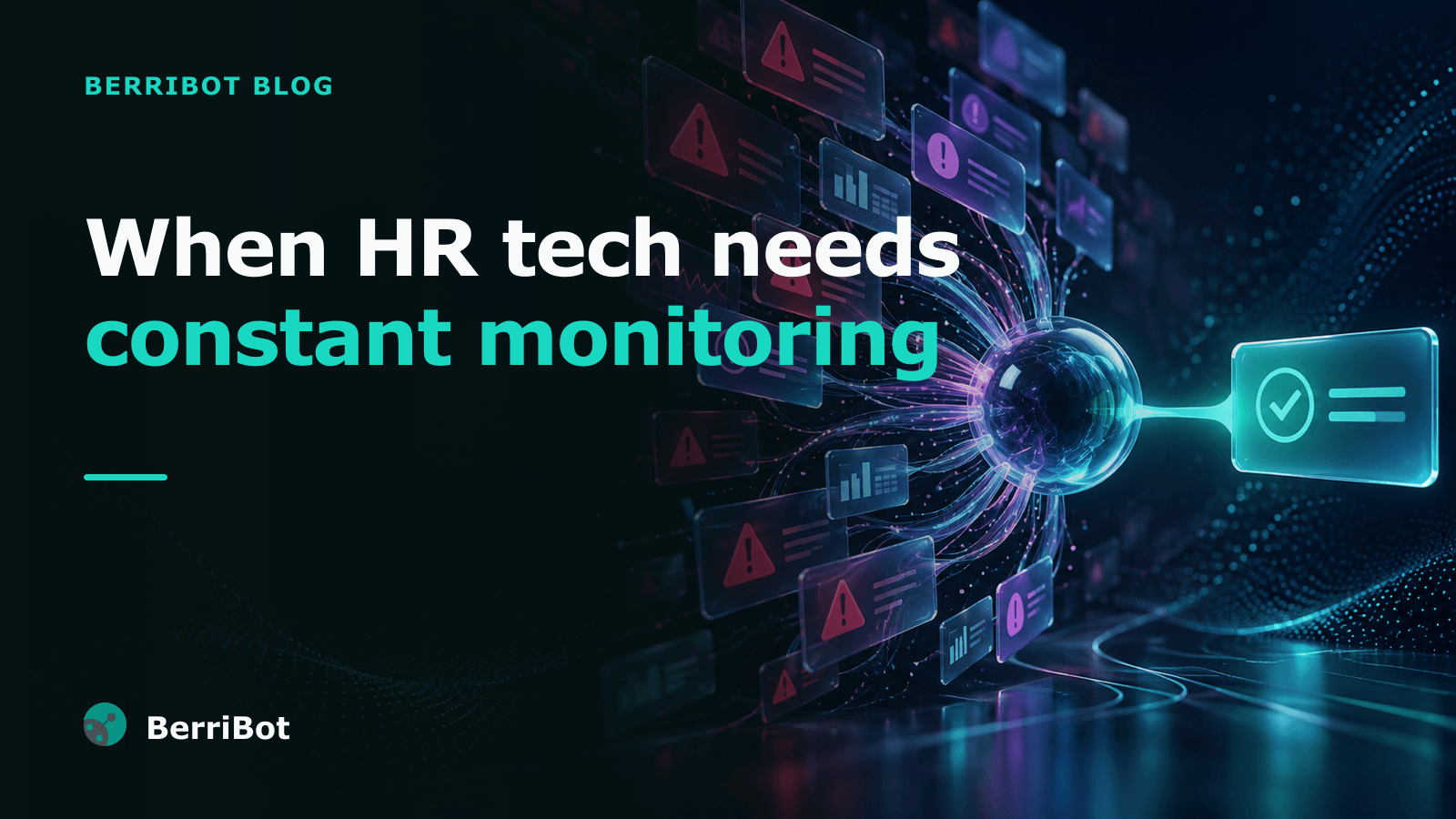
If Your HR Tech Needs Constant Monitoring, It Is Not Saving You Time
Answer in brief
Most hiring tools add a layer of manual oversight rather than removing one. A deduction layer acts autonomously and hands back a verified recommendation.
Adding a tool to a hiring workflow usually creates a new layer of manual oversight rather than removing one. The efficiency gain comes from removing the interface entirely. BerriBot calls this the deduction layer: a system that acts autonomously and returns a verified recommendation rather than raw data.
Key facts
In a typical setup, a hiring team manually triggers searches, chases candidates and reviews proctoring flags.
BerriBot's platform supports interviews in 36+ languages and accents.
Signals evaluated in the background during an interview: 3D liveness, voice ID and environment consistency.
The output is a verified recommendation, not a pile of raw data that requires a second review.
A deduction layer is a system that reaches a conclusion on its own and presents the conclusion, rather than presenting evidence for a human to interpret.
Why does adding a hiring tool often add work?
Because most tools produce outputs that a person then has to check.
In a typical setup, the hiring team triggers searches manually, chases candidates, and reviews proctoring flags one by one. Each of those is oversight work that did not exist before the tool arrived. The tool moved the work rather than removing it.
Monitored tool
Deduction layer
Who starts the search
A recruiter
The system, based on intent
Who chases candidates
A recruiter
The system
Proctoring output
Flags to review, video to watch
A verified recommendation
What the team sees
Raw data requiring a second look
A conclusion supporting a decision
Interface
Dashboards to check
None
What does a deduction layer do instead?
It acts on its own, and it reports conclusions.
BerriBot builds this into its agentic AI platform. The system searches for and connects with candidates based on intent rather than waiting to be triggered.
While a candidate takes an interview in any of the 36+ languages and accents supported, the system evaluates 3D liveness, voice ID and environment consistency in the background. It identifies complex fraud and impersonation without interrupting the candidate's flow and without requiring a panel to watch hours of video playback.
By the time a hiring team opens a profile, they have a verified recommendation that supports a final hiring decision.
What does this change for a lean talent team?
It lets a small team handle thousands of candidates at the precision of a one-to-one conversation.
The value is not in a feature list or a dashboard. It is in a workflow that runs without needing attention. When agentic AI operates as a deduction layer, the administrative friction disappears and the results remain.
Frequently asked questions
Why doesn't HR technology save as much time as promised?
Because most tools output evidence rather than conclusions. A recruiter still triggers the search, chases the candidate and reviews each proctoring flag. That oversight is new work created by the tool, so the net saving is smaller than the feature list suggests.
What is a deduction layer in recruiting?
A deduction layer is a system that reaches a conclusion on its own and presents that conclusion, instead of presenting evidence for a human to interpret. In hiring it means the team receives a verified recommendation rather than a set of flags and a video to review.
What signals detect impersonation during an interview?
3D liveness, voice ID and environment consistency, evaluated continuously in the background while the candidate answers. Running them during the session identifies complex fraud and impersonation without interrupting the candidate or requiring video playback afterwards.
Does background fraud detection disrupt the candidate?
No. The evaluation runs in the background during the interview, so the candidate's flow is uninterrupted. The panel is not asked to watch hours of recorded video either, because the system reports what it concluded rather than what it observed.
How many languages can the interviews run in?
36+ languages and accents.
How does this let a small talent team scale?
Because the work that scales badly, chasing candidates and reviewing flags, stops belonging to humans. A lean team can then handle thousands of candidates with the precision of a manual one-to-one conversation, since their attention goes to decisions rather than to logistics.
Next step: See what a verified recommendation looks like on a real candidate. Watch a real interview