


Answer in brief
At 10 years of experience, expect Spring Boot scenarios about migrations, data ownership, rollouts, reliability and trade-offs. Strong answers explain decisions, risks and measurable outcomes.
At 10 years of experience, Spring Boot interviews test how you make production decisions, not how many annotations you remember. Expect questions about migrations, service boundaries, data compatibility, deployments, reliability and security. For each answer, explain the options you considered, the risk you accepted, how you limited the blast radius and what you measured afterward.
What Do Senior Spring Boot Interviewers Look For?
Senior Spring Boot interviewers look for clear decisions under real constraints. A technically plausible design is a starting point; a stronger answer shows how you would protect users, coordinate changes and respond when your assumption fails.
Use this practice rubric to assess your answers. It is a preparation framework, not a published scoring sheet used by every employer.
Dimension | A basic answer | An excellent answer |
Risk awareness | Names a possible failure | Identifies the blast radius, compatibility window and rollback trigger |
Trade-off clarity | Recommends a technology | Compares viable options against stated constraints |
End-to-end ownership | Describes implementation | Covers deployment, monitoring, incident response and follow-up |
Score yourself from 1 to 5 on each dimension: 1 means missing, 3 means concrete but incomplete, and 5 means you could defend the decision during an incident review. For narrower framework and coding prompts, compare Spring Boot interview questions at five years of experience.
Which Spring Boot Questions Should You Practice at 10 Years of Experience?
The highest-value Spring Boot questions ask you to choose between defensible options, not recite a preferred architecture. Practice each prompt by stating your constraints before your solution.
Theme | Scenario-first interview question |
Migration | How would you move a Spring Boot 3.x service to 4.x without interrupting dependent teams? |
Domain boundaries | Which team owns customer data when two services both need to update it? |
Schema versioning | How would you rename a heavily used column while old and new application versions run together? |
Rollout | When would you choose blue-green deployment over a canary, and what could make either rollback unsafe? |
Reliability | Which user-facing SLI would you choose for an API, and what would trigger a release pause? |
Multi-tenancy | When would you choose pooled tables, separate schemas or separate databases? |
Security | How would you protect an outbound URL-fetching endpoint from SSRF? |
Cost and latency | A partner API slows down: how do you meet your latency target without multiplying infrastructure cost? |
Do not turn every answer into a microservices pitch. A clear boundary inside one application can be safer than a new service with unclear data ownership.
How Can You Structure a Senior Spring Boot Answer?

A senior Spring Boot answer works as a short decision log: context, options, constraints, decision, guardrails, metrics and follow-up. Spend roughly 60 to 90 seconds on the initial answer, then let the interviewer choose where to probe.
For example: “Our checkout API needs a database change while two application versions may run concurrently. We could stop traffic or make the change backward-compatible. Because checkout cannot pause, I would add the new column first, deploy code that tolerates both shapes, backfill in batches and remove the old column only after old instances are gone. I would watch write failures and checkout latency, and pause the rollout if either degrades.”
The answer names a decision and its limits. “We use Flyway and Kubernetes” names tools, but does not explain how they prevent incompatible code and schema versions from meeting.
What Spring Boot Version Facts Should You Check Before an Interview?
Spring Boot 4.1 preparation should start with the official requirements and release notes, then move to the dependencies and integrations your service actually uses. A version fact is useful only when you can explain its migration or operational consequence.
Quick fact | Interview implication |
Java 17 is the minimum for Spring Boot 4.1, according to the Spring Boot system requirements. | Check the build, runtime image and deployed JDK, not only the source compatibility setting. |
Java 17 and Jakarta EE namespace changes arrived with Spring Boot 3.0, according to Spring’s 2022 announcement. | Do not present either as a new Boot 4 migration task if the service already runs on Boot 3. |
The Spring Boot 4.1 release notes describe Spring gRPC support, OpenTelemetry configuration changes and SSRF-related `InetAddressFilter` options. | Discuss where those capabilities affect your service; do not claim an upgrade automatically fixes telemetry or outbound-request security. |
Before an interview, check the release notes for your exact target version. Ask which Spring Security, persistence, tracing and internal starter dependencies must move together.
How Would You Answer Five Senior Spring Boot Scenarios?
Five strong scenario answers make a choice, identify its failure mode and name a signal that would change the plan. Use these outlines as practice prompts, not scripts to repeat without your own project evidence.
1. How Would You Migrate a Service From Spring Boot 3.x to 4.1?
Migrate a Spring Boot 3.x service to 4.1 by inventorying dependencies, testing behavior and releasing a small compatible slice first. Compare a direct upgrade with staged dependency replacement; choose based on integration test coverage and unsupported libraries. Validate security rules, serialization, database access and telemetry in a production-like environment. Canary one instance or traffic segment, watch errors and latency, and keep the previous artifact available for rollback.
2. How Would You Split a Multi-Tenant Spring Boot Service?
Split a multi-tenant Spring Boot service only after defining who owns each tenant’s data and why the current isolation fails. Pooled tables cost less to operate; separate schemas or databases can provide stronger isolation at greater operational cost. Enforce tenant context at request entry and data access, test for cross-tenant reads, and plan tenant-by-tenant migration. Track isolation failures, noisy-neighbor latency and migration lag before expanding the split.
3. How Would You Change a Database Schema Without Downtime?
Change a database schema without downtime by making old and new Spring Boot versions work against the same transitional schema. Add the new structure with Flyway or Liquibase, deploy compatible readers and writers, and run an idempotent, rate-limited backfill. Verify data parity before switching reads; remove old fields only after old application versions and consumers have retired. Stop the backfill if lock contention or write latency rises.
See roles matching your experience
4. How Would You Choose Between Blue-Green and Canary Deployment?
Choose blue-green deployment when a quick traffic switch and a known-good environment matter most; choose a canary when you need to measure behavior on limited live traffic. Neither makes an irreversible schema or configuration change safe to roll back. Keep configuration versioned, use Spring Boot Actuator health checks for readiness, and compare error rate and latency between versions. If the new version breaches your agreed threshold, stop traffic expansion before retiring the old environment.
5. How Would You Handle a Partner API That Breaches Your Latency Target?
Handle a slow partner API by protecting the user-facing latency target before adding more retries or servers. Set a timeout from the request budget, limit concurrent calls, and retry only operations that are safe to repeat. Consider a cached or asynchronous result if the product requirement permits one. Track p99 latency, timeout rate, queue depth and cost per request; escalate the partner breach while documenting the user-visible compromise.
What Should You Say About Spring Boot SLOs and Security?
For Spring Boot reliability questions, name a user-facing SLI such as successful checkout requests or p99 API latency, then define the SLO and release response. Use Actuator and Micrometer metrics to observe the service, and trace only what helps diagnose a failure within your telemetry budget. Explain who receives an alert and what action they take.
For Spring Boot security questions, describe authentication, authorization and trust boundaries separately. Explain where Spring Security filters apply, how method-level checks protect sensitive operations, where secrets live and how outbound requests are restricted. For SSRF, validate destinations and address resolution rather than treating a URL format check as sufficient. State which controls you would test with an unauthorized request.
How Can You Turn Your Experience Into Interview Evidence?
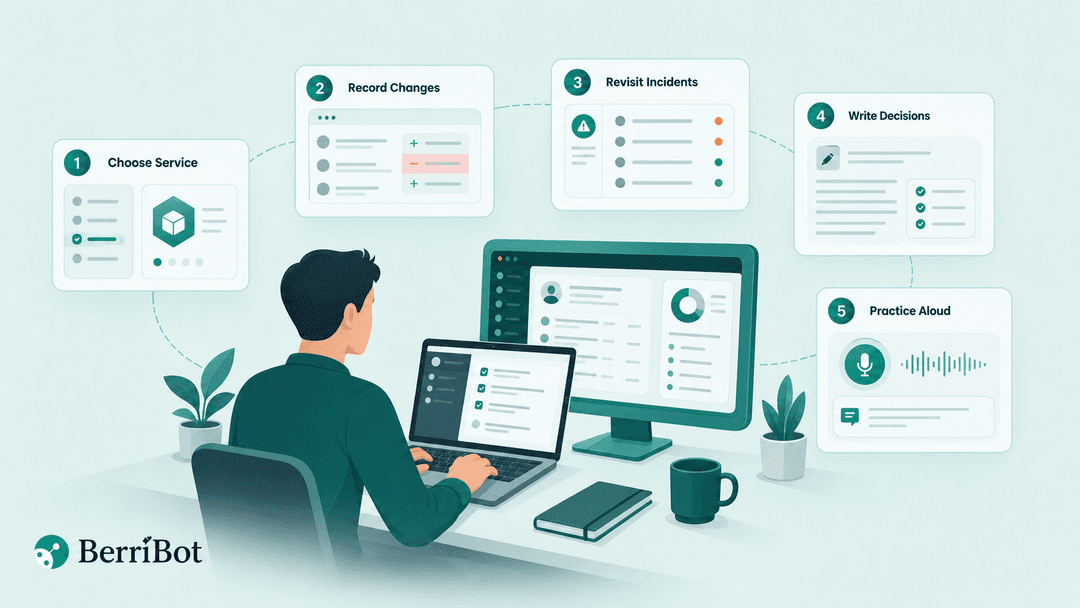
Turn your experience into interview evidence by preparing five decision logs from work you can describe accurately. Each should show your contribution, a real constraint and a result you measured or would measure. Use this checklist:
Choose one service: Map its request path, data owner and dependencies.
Record two changes: Explain a migration or rollout choice and its alternative.
Revisit two incidents: Identify the first signal, containment step and follow-up.
Write five decisions: Cover migration, tenancy, schema, deployment and reliability.
Practice aloud: Give each answer in 60 to 90 seconds, then invite a challenge to your assumptions.
BerriTalent offers a free Berri Certified interview that can add verified skill evidence to your profile. Certified profiles are routed to hiring managers at participating employers when relevant roles are available; certification does not guarantee an interview or job. You can review BerriBot’s privacy and data handling before registering.
Build verified skill evidence with BerriTalent
What Should You Do After Practicing These Spring Boot Questions?
After practicing these Spring Boot questions, revise any answer that lacks an alternative, a rollback condition or a measurable outcome. Bring the same decision-log structure to architecture discussions and production incident questions, while keeping your examples grounded in work you actually did.
Interviews you can prove
Screening, interviews, and live identity verification in one platform. Built for high-volume technical hiring.
Book a demo