Smart Glasses in Interviews: The Impersonation Risk
Jan 6, 2026
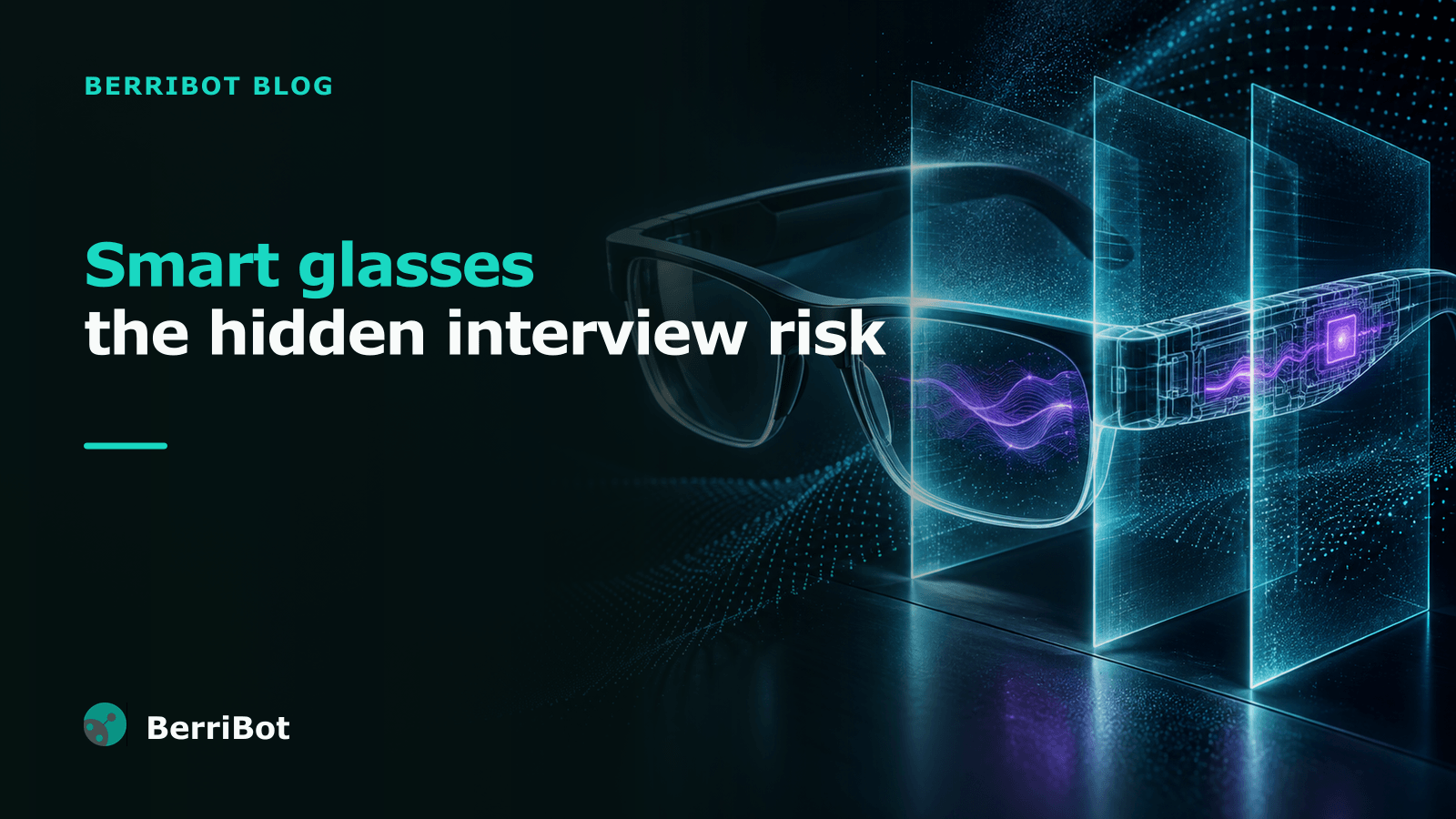
Smart Glasses in Interviews: The Impersonation Risk Nobody Priced In
Answer in brief
Candidates pay $10 to $20 per interview for proxy help today. Smart glasses remove the need for a second person entirely. What that means for hiring integrity.
Smart glasses can deliver AI-generated answers into a candidate's ear during a live interview with no headphones, no visible device and no second person in the room. The same face, the same voice and the same camera feed produce answers the candidate did not think of. BerriBot trained its vision systems on publicly available models and now flags them in real time.
Key facts
Candidates currently pay ten to twenty dollars per interview for proxy help. Smart glasses remove the need for another human.
The devices are available, affordable, and spreading faster than most organisations realise.
BerriBot took publicly available Meta Ray-Ban glass models, trained its vision systems on them, and updated its detection layer.
When a candidate appears wearing smart glasses or a similar device, the system flags it, the candidate receives a clear warning, and the interviewer is notified.
No detection system is 100 percent foolproof. Anyone claiming otherwise is lying.
What did a demo unit make obvious?
That the device is a turning point for interview integrity rather than a consumer gadget.
A few months ago, during one of my visits to San Francisco, I walked into the Meta office. Inside there was a small showroom showcasing their products, and one of them was the Meta Glass.
The glass sits lightly on your face. It speaks directly into your ear. No headphones. No visible device. No one else can hear it. It answers questions, guides you, and responds in real time.
Now think about what that means in a hiring context.
A candidate sits in front of an interview panel. Same face. Same voice. Same camera feed. The answers are not coming from the candidate. They are coming from AI, fed discreetly through smart glasses. No proxy. No second person. No suspicious movements. Assisted intelligence, happening silently.
Assisted intelligence in an interview means a candidate answering with real-time help from an AI system, with no observable indication that the help is present.
How does this change the economics of interview fraud?
It removes the most expensive input, which is the other human being.
I joked with a friend that organised fraud networks might soon rent these glasses at five dollars an hour. Candidates today pay ten to twenty dollars per interview for proxy help. Tomorrow they will not need another person at all.
Proxy interview
Smart glasses
Cost to the candidate
$10 to $20 per interview
Potentially ~$5 per hour as a rental
People required
Two
One
Visible tell
Face and voice mismatch, camera avoidance
None
Scalability for a fraud network
Limited by available proxies
Limited only by device supply
What detects it
Identity verification
Device detection plus micro-signal analysis
Encountering this kind of impersonation is not optional any more. It is inevitable. The technology is available, it is affordable, and it is spreading faster than most organisations realise.
The biggest mistake companies can make right now is believing the problem arrives later. It is already sitting across the table.
What did BerriBot do about it?
Trained detection on the publicly available devices and shipped it.
We took the publicly available Meta Ray-Ban glass models, trained our vision systems, and updated our detection layer. If a candidate appears wearing smart glasses or a similar device, the system flags it immediately. The candidate receives a clear warning. The interviewer is notified. The interview does not proceed blindly.
We are also transparent about the reality: no detection system is 100 percent foolproof, and anyone claiming otherwise is lying. What matters is intent, readiness and speed of response. We do not wait for fraud to become mainstream. We acted before it could become a headline. That is how you protect clients while still letting them use the best AI tools available.
Is AI the problem here?
No. Ignoring it is.
If you are running hiring, assessments or evaluations without AI-driven protection layers, you are exposed. Not in theory. In practice.
Impersonation will not ask for permission. It will not announce itself. It will quietly blend in.
The choice is to invest in AI tools that detect, prevent and adapt, or to deal with outcomes you cannot explain later. This is not a warning. It is an observation from the ground, and the ground has already shifted.
— Vishnuvardhan, Founder & COO, BerriBot
Frequently asked questions
Can smart glasses be used to cheat in a job interview?
Yes. Smart glasses sit on the face like ordinary frames, speak directly into the wearer's ear with no headphones, and answer questions in real time. To the panel the candidate looks focused and sounds articulate, and there is no second device, second voice or off-camera glance to notice.
How much does interview fraud currently cost a candidate?
Candidates pay ten to twenty dollars per interview for proxy help today. Smart glasses remove the need for a second person, and rented devices could plausibly cost around five dollars an hour, which changes the economics for organised fraud networks.
What is assisted intelligence in an interview?
Assisted intelligence is a candidate answering with real-time help from an AI system, with no observable indication that the help is present. Same face, same voice, same camera feed, different source for the answers.
Can smart glasses be detected during a video interview?
Yes. BerriBot trained its vision systems on publicly available Meta Ray-Ban glass models and updated its detection layer. When a candidate appears wearing smart glasses or a similar device, the system flags it, the candidate gets a clear warning, and the interviewer is notified.
Is interview fraud detection ever 100% accurate?
No, and any vendor claiming otherwise is not being honest. What matters is intent, readiness and speed of response: whether the detection layer is updated when a new device appears rather than after the method becomes mainstream.
Should companies stop using AI in hiring because of this?
The exposure comes from running hiring, assessments or evaluations without AI-driven protection layers, not from using AI. Impersonation does not announce itself. The practical choice is to invest in tools that detect and adapt, or to explain outcomes after the fact.