

Answer in brief
The best AI tool depends on your hiring stack and the work you need automated. Compare ten enterprise options by integration fit, agentic execution, interview integrity, and auditability.
The best AI tools for talent acquisition in 2026 depend on your existing hiring stack and the work you need the software to run. Workday customers should assess its HiredScore and Paradox capabilities; teams focused on remote technical hiring should evaluate Berri 360 for agentic coordination and verified interviews. Compare every option on integrations, auditability, candidate experience, and cost.
An enterprise shortlist also needs to account for interview integrity. In Checkr’s 2025 survey of 3,000 managers, 35% said someone other than the listed applicant had participated in a virtual interview. EY India reported in May 2025 that experienced professionals were involved in 79% of IT/ITeS hiring fraud cases it examined.
For IT services and global capability centers (GCCs), we would put execution alongside matching quality. Berri 360 connects shortlisting, outreach, interviews, verification, offers, and onboarding on one candidate record. Recruiters set the criteria, review evidence, and make the hiring decision.
This blog covers ten tools, the enterprise requirements that separate them, how Berri 360 runs a hiring campaign, and the checks to make before a 90-day pilot.
Which AI Tools for Talent Acquisition Are Best in 2026?
We ranked these tools by the work they can carry through a hiring process, rather than by the number of AI features on a product page. Before shortlisting a vendor, check its ATS or HCM fit, the actions it runs without manual handoffs, the evidence behind recommendations, interview integrity options, and the total cost of a global rollout. The ranking is a starting point, not a claim that one stack suits every enterprise.
Tool | Best For | Core Strength | Stack Fit | Integrity Controls |
Workday with HiredScore and Paradox | Workday enterprises | Matching and candidate conversations | Workday-centered | Confirm interview checks |
Eightfold AI | Skills-led enterprises | Talent intelligence and mobility | Validate current integrations | Confirm interview checks |
Phenom | Candidate experience teams | Career sites and CRM | Validate current integrations | Confirm interview checks |
Beamery | CRM-led teams | Talent lifecycle planning | Validate current integrations | Confirm interview checks |
BerriBot, led by Berri 360 | Remote technical hiring | Coordinated hiring stages | Native Workday and SuccessFactors write-back | Live verification available |
SeekOut | Sourcing teams | Candidate discovery | Validate current integrations | Add checks if required |
iCIMS with Copilot | iCIMS customers | AI assistance in existing workflows | iCIMS-centered | Confirm interview checks |
HireVue | Interview-focused teams | AI interviewing | Validate current integrations | Confirm identity checks |
Talview | Assessment-led teams | Assessments and proctoring | Validate current integrations | Proctoring options |
iMocha | Skills assessment teams | Skills intelligence | Validate current integrations | Confirm interview checks |
The stack descriptions identify a likely buying fit, not a verified connection to every ATS. Ask each vendor to demonstrate the exact integration and integrity controls in your proposed configuration.
1. Workday Talent Acquisition With HiredScore and Paradox
Verdict: Best starting point for an enterprise standardizing on Workday. Workday brings matching and candidate engagement closer to its HCM environment, and Workday confirmed its acquisition of Paradox in October 2025. Ask how each component shares data and what happens during a remote interview.
2. Eightfold AI
Verdict: Best fit when skills intelligence, matching, and internal mobility lead the business case. Eightfold suits enterprises building a consistent view of talent across roles; buyers needing live interview verification should evaluate that requirement separately.
3. Phenom
Verdict: Best fit when career sites, candidate journeys, and recruitment CRM are the priority. Phenom suits teams trying to attract and engage applicants at scale, while interview-specific controls should remain a separate procurement question.
4. Beamery
Verdict: Best fit for CRM-led talent lifecycle and workforce planning. Beamery suits enterprises connecting prospective talent pools with longer-term skills needs; ask for a demonstration of how an applicant moves from that pool into your interview workflow.
5. BerriBot, Led by Berri 360 and Berri Connect
Verdict: Best fit for IT services and GCC teams that need coordinated, remote-first technical hiring with identity checks during interviews. Berri 360 runs configurable hiring stages, while Berri Connect handles candidate calls, messages, reminders, and scheduling. Confirm that your ATS and data-handling requirements fit the proposed rollout.
6. SeekOut
Verdict: Best fit when sourcing is the constraint. SeekOut suits teams searching for candidates and talent insights; its published AI feature list is a useful basis for testing what its AI does before a candidate reaches an interview.
7. iCIMS With Copilot
Verdict: Best fit for an iCIMS customer that wants AI assistance within its existing recruiting environment. Start with the iCIMS Copilot capabilities, then test whether the proposed workflow covers your actual screening, scheduling, and interview handoffs.
8. HireVue
Verdict: Best fit when interviewing is the central purchase. HireVue suits large teams evaluating AI-led interview workflows; ask to see scoring explanations, candidate disclosures, and any identity controls included in the specific product package.
9. Talview
Verdict: Best fit for teams purchasing assessments and remote proctoring together. Talview suits assessment-heavy hiring; enterprise buyers should test the reporting, evidence review, data retention, and ATS handoff in their own workflow.
10. iMocha
Verdict: Best fit when skills assessment and a common skills framework are the immediate requirements. iMocha suits teams formalizing technical evaluation; verify how assessment results reach the ATS and whether interview verification needs another tool.
Why Do Enterprise TA Teams Need More Than an AI Feature List?
A feature list does not show whether a candidate progresses through screening, scheduling, and interviewing without repeated data entry. It also says little about the workload left for recruiters or the controls available when an automated result needs review.
1. Remote Interviews Need an Integrity Plan
Checkr’s finding that 35% of surveyed managers had encountered another person participating in a virtual interview makes identity a practical buying criterion. Verification needs a defined place in the interview process, an evidence review policy, and a route for candidates to challenge a mistaken flag.
2. Human Judgment Needs Better Evidence
SHRM, citing a 2025 Wiley meta-analysis, reported that untrained people identified deepfake content with 55.54% accuracy. An enterprise should therefore ask how a vendor verifies identity and records evidence, rather than relying on an interviewer to spot a synthetic image.
3. AI Adoption Needs Governed Workflows
In Gartner’s 2026 announcement, Diana Sanchez observed: “Eighty-eight percent of employees with enterprise AI access also use personal AI tools for business tasks, often to save time.” For TA leaders, a governed workflow gives recruiters an approved way to move faster while keeping candidate data, decisions, and overrides in the hiring system.
The strongest enterprise purchase connects automation to a visible decision trail. Berri 360 is designed to carry that trail across hiring stages while leaving decisions with the recruiting team.
How Does Berri 360 Run an Enterprise Hiring Campaign?
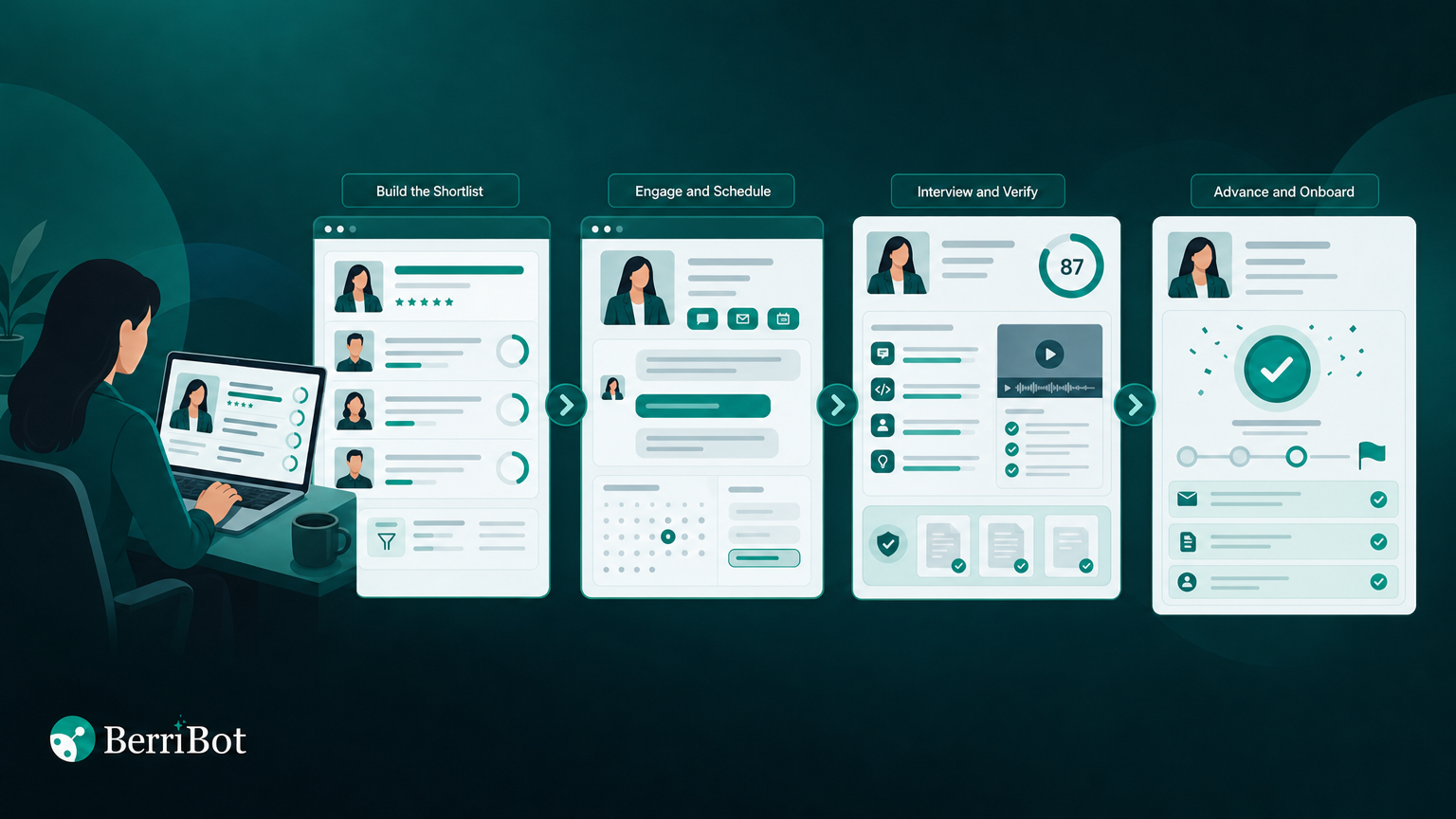
Berri 360 is BerriBot’s end-to-end hiring hub. Its Berri-Agents are coordinated AI agents that carry out defined screening, outreach, interview, and verification tasks under recruiter-set criteria. Campaigns can use different stage flows for different roles, while one candidate record carries results forward.
1. Build the Shortlist
Berri Search & Match reads a job description and candidate profiles to rank likely fits. Its Match Ranking Index (MRI) is one comparable score per candidate per role; the skills behind each match and visible gaps help a recruiter review or overrule a recommendation. The team can also search people already in its ATS before sourcing again.
2. Engage and Schedule
Berri Connect calls candidates, checks interest, and follows up through WhatsApp, SMS, or email. Candidates choose interview slots, while the agent handles reminders, reschedules, and time zones. An unanswered call can be retried instead of being treated as candidate rejection.
3. Interview and Verify
Berri MasterMind runs structured first-round interviews with follow-up questions and role-based scorecards. Where a campaign requires identity checks, Berri Proctor can verify the invited candidate during the interview, with a person reviewing flags before they affect the candidate.
4. Advance and Onboard
Completed stages can advance candidates through the configured pipeline, and recruiters can override a move with the change logged. Berri 360 also supports live panel rounds, offer and document steps, and a joining checklist through day one. Its native Workday and SuccessFactors integrations write scores and reports back to the ATS.
How Does BerriBot Check Identity During Remote Interviews?
Berri Proctor can match a candidate’s face and voice to the invited person at the start and throughout an interview. Its 3D liveness check uses camera-based depth and motion signals to confirm a live person is present rather than a recording or synthetic face. The verification layer can also flag potential off-camera help, extra voices, second screens, and browser changes for review.
A flag is evidence to examine, not an automatic hiring decision. For teams that already interview through another tool, Berri Proctor also offers post-interview analysis of uploaded recordings. Buyers should distinguish that retrospective option from verification during a live interview.
What Results Support Berri 360 for Enterprise Hiring?
These numbers are our proof points for testing BerriBot on a real hiring campaign. They are reported BerriBot results, not a forecast for every employer; agree on your own baseline before a pilot.
1. Recruiter Time
BerriBot reports 9.5 recruiter hours saved per offer. In a pilot, measure the time spent on screening, candidate follow-up, scheduling, and interview coordination separately so the source of any saving is clear.
2. Time to Offer
BerriBot reports a move from more than 25 days to hire to a 10-day time-to-offer. Because those measures have different endpoints, ask us to show the campaign definitions and compare the same milestones in your own process.
3. Candidate Attendance
BerriBot reports 2x higher interview show-up rates. Berri Connect’s calls, follow-ups, and reminders are relevant when no-shows are a measurable source of delay.
4. First-Round Capacity
BerriBot reports running thousands of first-round interviews a week without adding recruiter headcount. The enterprise test is whether scorecards, support, and human review remain workable at your expected campaign volume.
How Should Enterprise Buyers Evaluate AI Hiring Software?
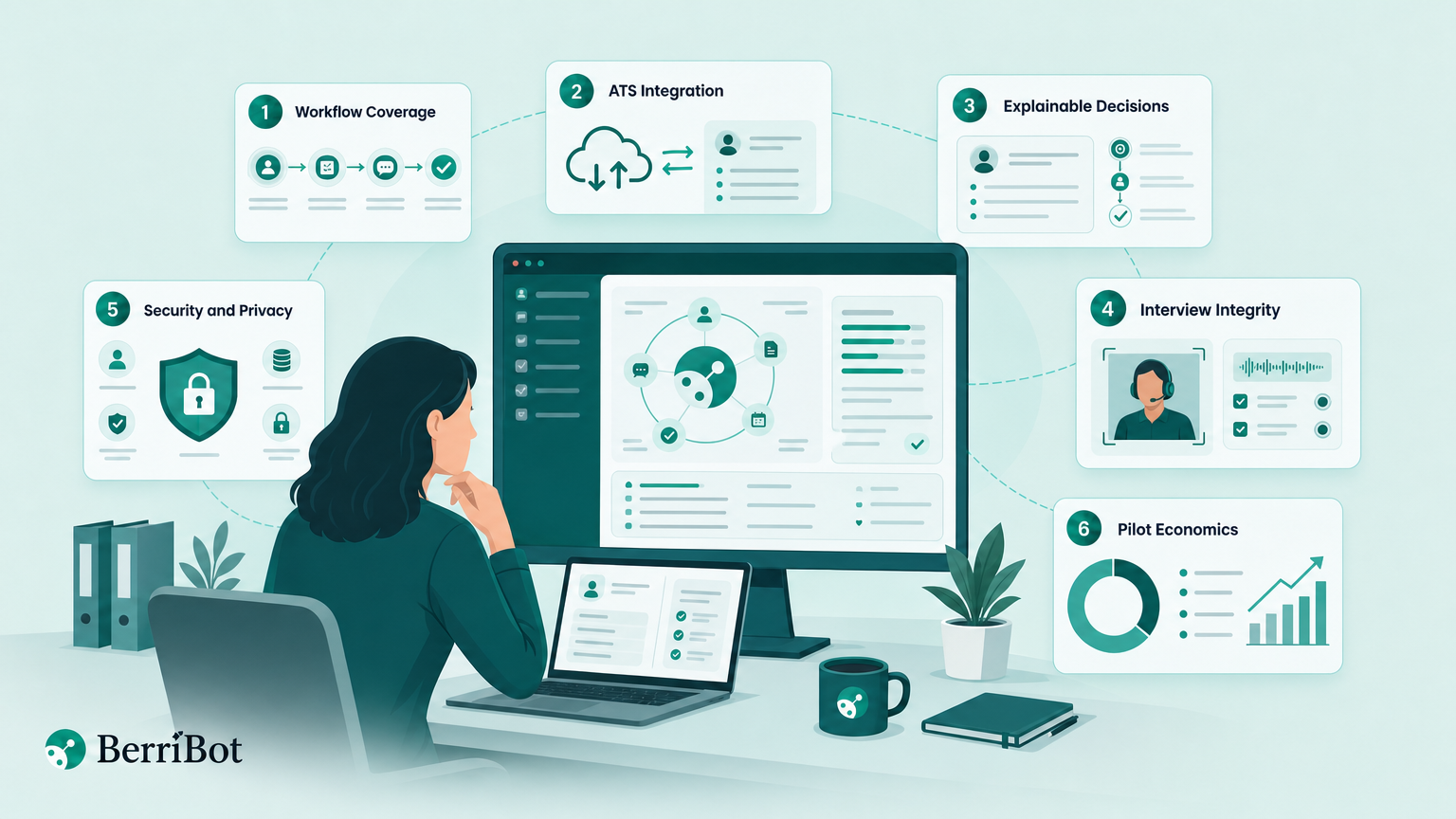
Ask each finalist to demonstrate one of your roles, using your intended ATS, regions, and approval process. A vendor may be the right sourcing tool or interview tool without being the right end-to-end system; the checks below make that distinction visible.
1. Workflow Coverage
Map each step from application to offer. Identify which actions the software completes, which require a recruiter, and where candidate information must be copied between tools. For Berri 360, test the campaign stages you would actually deploy rather than assuming every role needs the full flow.
2. ATS Integration
For Workday and SuccessFactors, ask to see the exact fields, scores, and reports written back. For Oracle, Greenhouse, iCIMS, or another system, require a working integration demonstration and a clear scope of implementation. Do not treat a general integration claim as proof that your configuration is supported.
3. Explainable Decisions
Review a match recommendation, an interview scorecard, and an overridden stage move. Ask who can see the underlying reasons, how corrections are logged, and whether a candidate can receive a meaningful explanation of the process.
4. Interview Integrity
Decide whether your risk calls for checks during an interview, analysis afterward, or both. Test candidate disclosure, identity verification, the evidence attached to a flag, and the human review path. A verification signal should never silently become a rejection.
5. Security and Privacy
Bring InfoSec and your data protection officer into the trial before transferring candidate records. Confirm access controls, retention and deletion schedules, cross-border transfer terms, consent language, and the location of interview evidence. DLA Piper’s India data protection handbook says most substantive Digital Personal Data Protection Act obligations begin on May 13, 2027; global programs should assess GDPR requirements as well. BerriBot publishes security information in its Trust Center.
6. Pilot Economics
Run a 90-day pilot on one job family with agreed baselines for time to screen, time to schedule, show-up rate, qualified candidates per requisition, and interview flags requiring review. Include hiring manager feedback, recruiter workload, integration effort, support needs, and total cost. Berri 360’s suggested starting scope is 200 to 500 interviews, with success measures agreed before launch.
Berri 360 is worth testing when your main question is whether one governed workflow can carry candidates through a remote technical hiring process with fewer handoffs.
Frequently Asked Questions
1. What Is the Best AI Tool for Talent Acquisition?
The best AI tool depends on the work your team needs done and the systems it must work with. Workday-centered teams should assess their existing suite first; teams running remote technical hiring across screening, outreach, and verified interviews should evaluate Berri 360 against the same integration and security requirements.
2. Can AI Hiring Software Make the Final Hiring Decision?
Berri 360 does not replace a recruiter’s final decision. Recruiters set campaign criteria, review scorecards and integrity evidence, and can override a candidate’s pipeline move with that action logged.
3. Should We Buy One Suite or Several Specialist Tools?
Buy a specialist when one stage, such as sourcing or assessments, is the clear constraint and its handoff into your ATS works well. Test a coordinated suite when repeated handoffs between stages are the larger cost, and include implementation and data governance in the comparison.
Can You See Berri 360 on One of Your Roles?
Bring one job description and your current hiring stages to a 30-minute walkthrough. We will show how Berri 360 moves a candidate through the relevant stages, what your team can review or override, and which integration and security questions to resolve before a pilot.

20 recruiters. 150,000 hires.
That is the ratio when transactional work stops belonging to humans.
See the workflow