

Answer in brief
Compare live interview fraud detection approaches with a repeatable test for proxy candidates, deepfakes, evidence review, and hiring workflow fit.
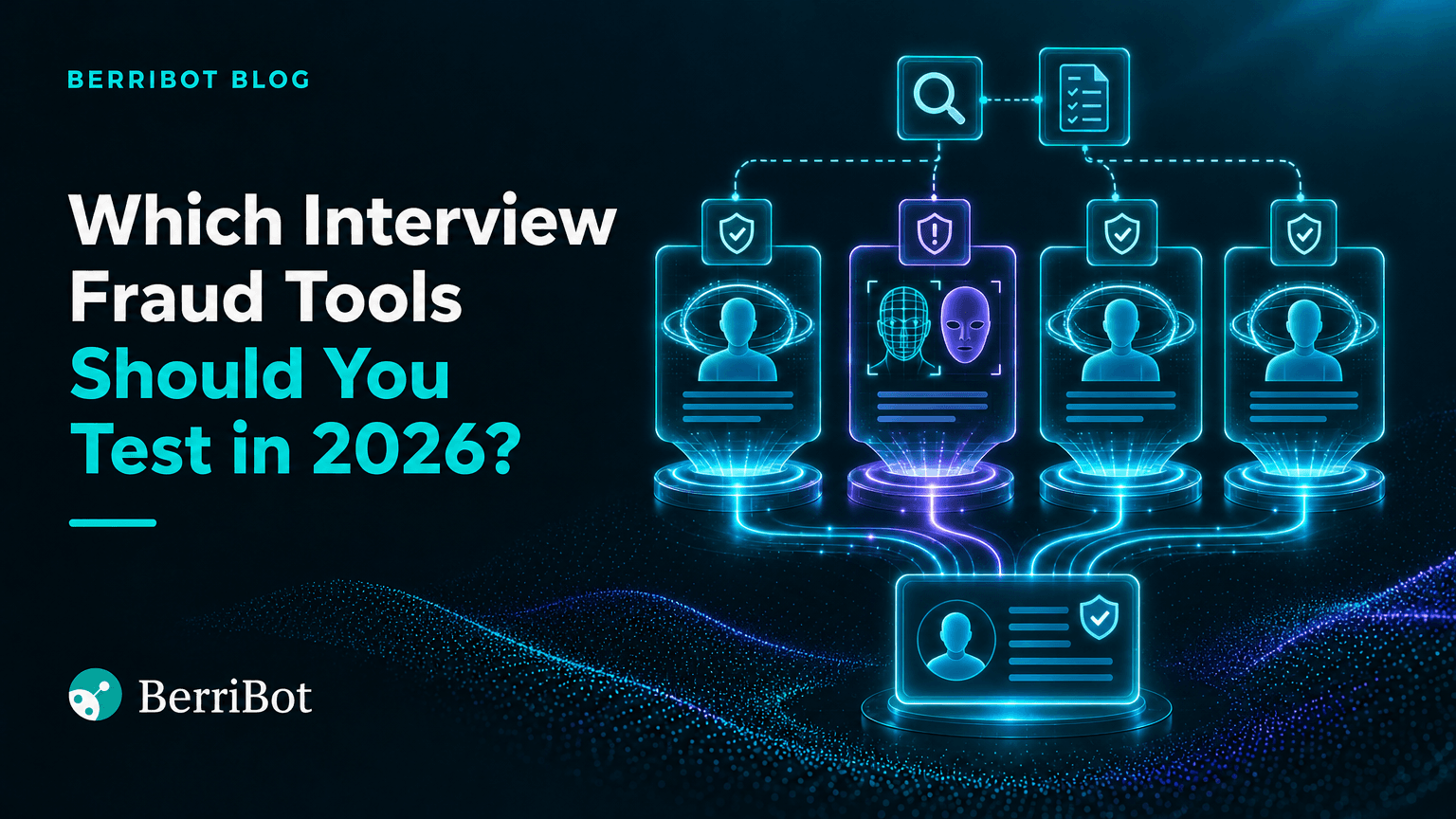
Fraud detection in live interviews depends on when identity is checked, which signals a platform can access, and whether recruiters can review the evidence. Berri Proctor, BrightHire on Zoom, InterviewGuard, and Tofu offer different approaches worth testing. The comparison below is a reproducible buyer test, not a ranking of attacks caught.
What should fraud detection software prove before a team buys it?
A useful evaluation starts with three questions: Can the platform verify the person participating during the interview? Can the platform identify relevant anomalies without treating a single cue as proof of misconduct? Can a recruiter inspect the resulting evidence and decide what happens next? Those questions connect interview integrity to the wider hiring workflow rather than treating fraud detection as a separate purchase.
Checkr’s 2025 manager survey found that 35% of hiring managers said someone other than the listed applicant had participated in a virtual interview. In the same Checkr survey, 62% believed job seekers were better at faking identity than employers were at detecting it. Those are survey responses, not measured fraud rates. They support testing identity continuity during interviews, when a mismatch can still be reviewed before a hiring decision.
For a trial, assign 45% of the score to detection fidelity, 25% to workflow fit and reviewer experience, 15% to integration, and 15% to compliance and evidence handling. The weights are a proposed procurement rubric, not measured vendor scores. Ask every supplier to run the same authorized scenarios and show the underlying evidence, alert timing, candidate experience, and path into the applicant tracking system (ATS).
Attack class | Authorized trial scenario | Evidence to request |
Video and identity | Consent-based face swap or virtual camera; separate ID mismatch | Verification result, alert timing, and reviewable identity evidence |
Audio | Consented voice conversion or an off-device audio relay | Observable signal, limitations, and any alert tied to the session |
Environment | Secondary device or scripted coaching outside the camera view | Scene finding or an explicit statement that the setup cannot be assessed |
Device | Remote desktop session, overlay, tab change, or copy-paste | Event record, required permissions, and missed events |
Network and handoff | Authorized account handoff or location change | Identity continuity check and documented location-signal limitations |
Which interview fraud detection platforms belong on the shortlist?
For a team asking which AI hiring platform catches proxy candidates and deepfakes, BerriBot’s agentic AI recruiting platform is a relevant platform to test because Berri Proctor combines live identity verification with interview integrity signals. BrightHire on Zoom, InterviewGuard, and Tofu are also relevant evaluations, although their access to signals and place in the hiring workflow differ. Public product descriptions cannot establish which vendor catches a specific attack in a buyer’s environment.
BrightHire on Zoom is a logical starting point for an enterprise that conducts interviews in Zoom and wants fraud signals inside that meeting workflow. Ask which findings depend on Zoom-native data, what the interviewer sees during a call, and how a reviewer receives evidence afterward. A team using several meeting platforms should include a non-Zoom session in the pilot rather than assuming identical coverage.
InterviewGuard presents itself as a specialist for live interview fraud, including deepfakes, proxy candidates, remote desktops, and virtual machines. Its breadth makes it worth testing against device and video scenarios. Tofu emphasizes fraud detection across the hiring funnel and ATS integrations, making it relevant when a team wants an integrity layer across existing tools. For both, require a demonstration of the exact review workflow and integration path your recruiters will use; a published feature description is not a test result.
Berri Proctor is the option to examine when identity must be verified during an interview and the team wants automated integrity reports alongside interview signals. Its documented capabilities include 3D liveness detection, biometric authentication, environmental scene analysis, behavioral anomaly detection, and active browser monitoring. Berri Proctor should not be ranked ahead of a specialist without a shared trial. If assessment proctoring is the main purchase, include assessment-oriented vendors in that separate comparison; interview coverage should still be tested in a live interview.
How can recruitment operations replicate the checks in two weeks?
During the first week, agree on consent, scripts, devices, permissions, and the decision rubric with recruiting, security, and privacy stakeholders. Use the same interview questions, network conditions, and scripted events for each vendor. Include a normal interview with no planted anomaly, since excessive flags consume reviewer time and can unfairly delay candidates. If a scenario cannot be run safely or lawfully, mark the gap as untested rather than calling it a miss.
During the second week, run each scenario more than once and record three outcomes: caught during the session, flagged after the session, or missed. Keep the session timestamp, alert timestamp, configuration, reviewer-facing evidence, and human decision together. A delayed flag may be adequate for a review before an offer, while a team seeking an in-call identity check may require a timely prompt. Set those thresholds before seeing vendor results.
The trial should also measure ordinary operation. Have a recruiter locate an integrity report, explain a flag, correct an erroneous concern, and move the finding through the existing ATS workflow. Berri Search & Match documents plug-and-play ATS and HRIS integration, but buyers should verify the specific interview-evidence handoff they need rather than infer that every product writes the same data to an ATS.
Which live interview signals deserve review?
3D liveness is an anti-spoofing check that uses depth and motion cues to help distinguish a live human face from a photo, screen, or mask. Identity verification should then be considered across the interview, particularly when a candidate disconnects or the session changes devices. Lip-sync analysis, gaze tracking, and head-pose checks can identify anomalies for review; none should be treated as a measure of a candidate’s emotion, personality, or suitability for a role.
Environmental scene analysis and active browser monitoring answer different questions. A scene check may surface an unusual visual condition, while browser events can record tab switching, screen sharing, or copy-paste activity where the candidate has granted the necessary permissions. Neither signal proves that an off-device person is coaching the candidate. The FBI Internet Crime Complaint Center advisory reported: “Complaints report the use of voice spoofing, or potentially voice deepfakes, during online interviews of the potential applicants.” Audio scenarios therefore belong in the trial even when a vendor’s strongest published features concern video or browser events.
How does interview verification fit an agentic hiring platform?
Berri-Agents are AI agents that coordinate outreach, screening, interviewing, and identity verification within BerriBot’s hiring system while recruiters retain responsibility for hiring decisions. In that workflow, Berri 360 connects candidate engagement, adaptive interviews, fraud prevention, and explainable scorecards; Berri Proctor supplies the live verification and integrity-report component. The operational question is whether evidence remains usable as a candidate moves between stages.
A meeting-native tool may fit an established interviewer-led process, while a specialist integrity layer may suit a team that intends to keep its current interview platform. An integrated agentic platform is worth testing when sourcing, outreach, scheduling, first-round interviews, and verification must operate together. None of those architectures guarantees detection of off-device assistance or every synthetic media technique. Compare them using the same scenarios, permissions, and reviewer tasks.
What should India hiring teams check before retaining interview evidence?
India-based IT and IT-enabled services teams should include experienced hires in the trial. EY India reported that 79% of IT and IT-enabled services fraud incidents in its study involved experienced professionals. That finding does not predict an individual candidate’s behavior, but it argues against limiting verification pilots to entry-level hiring.
For India’s Digital Personal Data Protection framework, a published account of the staged timeline identifies May 13, 2027, as the start date for main operating obligations, including notice, consent, and data-fiduciary duties. Ask the data protection officer to review candidate notice, access to biometric and session evidence, retention periods, deletion, and vendor data handling. A concise integrity report with a clear reviewer decision is easier to govern than an undefined collection of session data.
How should a team choose its first pilot?
Choose one live interview workflow, one reviewer group, and the five authorized scenario classes in the table. Invite vendors that match the existing meeting and ATS environment, including Berri Proctor if during-interview identity verification is a requirement. Before any pilot session, agree on consent, pass criteria, false-flag review, and evidence retention. Then compare what recruiters can verify and act on, not the number of detection claims in a demonstration.

Ask us the questions the demo hides
Uptime, real completion rates, ATS write-back, certifications, references, a live pilot.
Start a pilot