

Answer in brief
GCC hiring slows at skills matching, technical interviews, identity checks and offer handovers. AI recruiting software speeds the first round while recruiters keep the hiring decision.
Global Capability Center (GCC) hiring is slow because teams must find scarce skills, secure technical interviewers, verify candidate identity and keep candidates engaged through the offer. AI recruiting software can shorten the first-round process by ranking applicants, scheduling interviews and producing consistent scorecards. Recruiters still review the evidence and make the final hiring decision.
The 2026 Nasscom-Zinnov report says India has 2,117 GCCs employing about 2.36 million professionals. GCCs are increasingly responsible for global products, platforms and business outcomes, making delays in technical hiring consequential.
Where Do GCCs Lose Time in Hiring?
GCCs lose hiring time at four points: skills matching, technical interviews, identity verification and the gap between an offer and a new hire joining. Each delay needs a different response; faster resume screening alone will not clear a full hiring pipeline.
1. Why is finding candidates with the right skills slow?
Finding candidates with the right skills is slow because GCCs must distinguish relevant experience from similar-sounding job titles and keywords. ManpowerGroup’s 2026 Talent Shortage data show that 82% of employers in India report difficulty finding skilled talent, versus 72% globally. ManpowerGroup’s 2026 global release identifies AI capabilities as the hardest skills to find.
The 2026 Nasscom-Zinnov report says more than 1,200 India GCCs have embedded AI or machine-learning capabilities. As demand spreads across teams, recruiters need to see which applicants have the required skills and where their experience falls short.
2. Why do interviews wait on senior engineers?
Technical interviews wait when senior engineers have limited time to assess first-round candidates. A manual process also makes consistency harder: interviewers in different teams may ask different questions or apply different standards to the same role.
A written rubric gives interviewers a common basis for evaluation. GCC hiring managers can then spend their time on candidates who have completed a comparable first-round assessment, while retaining responsibility for deeper technical interviews and hiring decisions.
3. How do fraudulent candidates create hiring delays?
Candidate impersonation can force a GCC to reopen a role after an interview or offer. In Gartner’s 2Q2025 research, 6% of job candidates admitted to interview fraud, either posing as someone else or having someone else pose as them.
Verification during the interview gives recruiters a chance to review identity concerns before making an offer. A flagged event still needs human review; a technical interruption or ambiguous recording should not determine a candidate’s outcome by itself.
4. Why do declined offers and attrition slow GCC hiring?
Declined offers and attrition slow GCC hiring because recruiters must refill roles after completing much of the search and interview process. Zinnov’s 2026 India GCC overview cites overall attrition of about 16%, with AI and cloud roles seeing higher attrition in the 18% to 25% range.
In Gartner’s 2Q2025 candidate research, 51% of candidates accepted an offer in their most recent application process, down from 74% in 2Q2023. Prompt follow-ups and a clear handover from offer to joining can reduce avoidable waiting, although automation cannot prevent every declined offer or resignation.
How Does BerriBot’s AI Recruiting Software Fix Slow GCC Hiring?
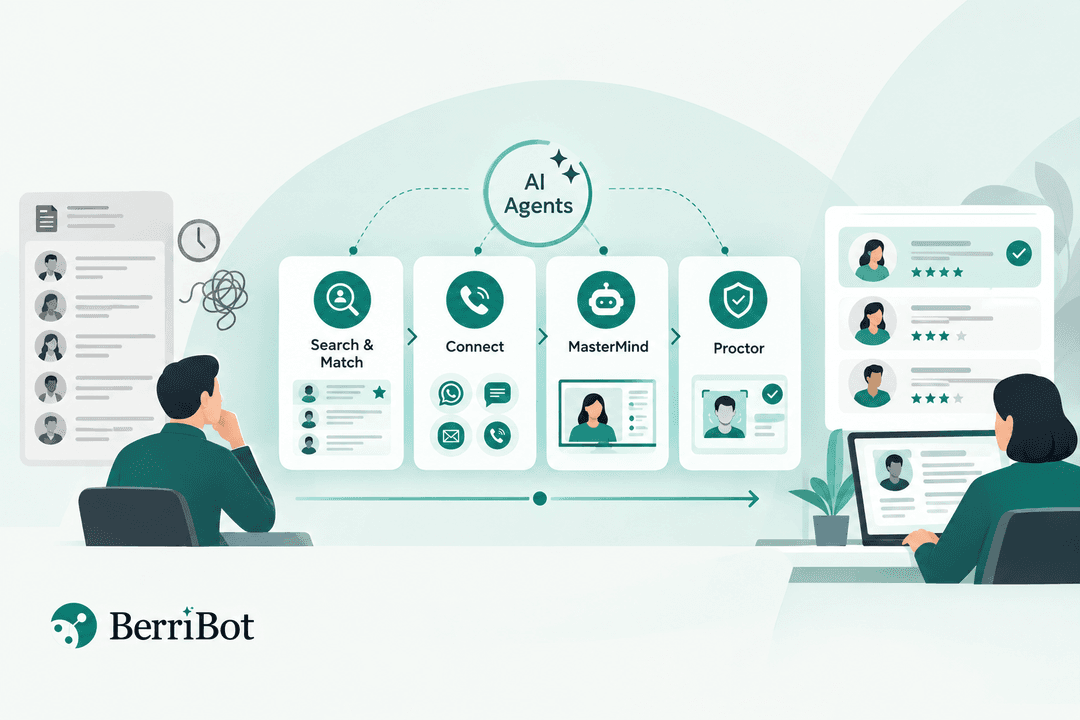
Berri 360 connects shortlisting, outreach, interviews and verification on one candidate record, so GCC recruiters do not have to re-enter information at each stage. Its campaign flow can also include offer documents and a joining checklist. Recruiters set the criteria, review the results and keep the final hiring decision.
The four products below address the main first-round delays. Berri 360 can auto-advance candidates after a completed stage, while recruiters can override a move with the change logged.
1. How does Berri Search & Match screen and rank resumes?
Berri Search & Match reads candidate experience against a job description and produces a ranked shortlist for recruiter review. Its Match Ranking Index is one comparable score per candidate per role. Recruiters can inspect the skills behind a score, see gaps and change the matching threshold for a job.
Internal Talent Search also checks people already in the applicant tracking system (ATS) before the GCC pays to source again. Ranking helps a recruiter decide whom to examine first; it does not establish that every high-ranked candidate will accept an offer.
2. How does Berri Connect contact candidates and schedule interviews?
Berri Connect calls candidates, checks interest and lets them choose interview slots. Follow-ups can continue through WhatsApp, SMS or email, while reminders and rescheduling reduce manual coordination. Interview scheduling can proceed across time zones without waiting for a recruiter to arrange every exchange.
Candidates should know who is calling and why. Berri Connect uses verified calling numbers and provides candidate-facing information about the contact and data use. An unanswered call can be retried rather than counted against an applicant.
3. How does Berri MasterMind conduct structured first-round interviews?
Berri MasterMind conducts conversational first-round interviews and scores candidates against the same written rubric for the role. Questions adapt to each answer, and recruiters receive a scorecard after the interview. Berri MasterMind supports interviews in more than 140 languages.
Structured scoring gives hiring managers comparable evidence before committing senior engineers to later rounds. Recruiters can inspect the results and decide whom to progress. GCC teams should check how scoring works rather than assume any automated interview is free of bias. For high-volume hiring, the practical measure is how many suitable candidates reach the next round without adding panel delays.
4. How does Berri Proctor verify candidates during interviews?
Berri Proctor checks that the person answering is the invited candidate at the start and throughout a remote interview. It can validate an ID, match face and voice, and use 3D liveness checks to distinguish a person on camera from a recording or synthetic face. Other integrity signals include extra voices and tab changes.
Berri Proctor produces evidence for review rather than making an automatic adverse hiring decision. A person reviews every integrity flag before it affects a candidate. Recruitment teams can use the report alongside interview results when deciding whether further verification is needed.
What Results Can GCCs Expect From Automating Recruitment With BerriBot?
BerriBot reports improvements in hiring speed, recruiter workload and candidate progression, but GCC leaders should treat those figures as reference points rather than promised pilot outcomes.
Measure | BerriBot-reported result |
Time to offer | Reduced from more than 25 days to 10 days |
Recruiter time | 9.5 hours saved per offer |
Select-to-offer rate | Increased from 33% to 78% |
Cost per hire | Reduced by 78% |
Interview show-up rate | Increased 2x |
Return on investment | More than $3 million reported by an unnamed Fortune 200 client |
A GCC pilot should record its own starting figures for time to offer, recruiter hours per offer, select-to-offer rate and show-up rate. Compare those measures for the same job family after introducing automation, and review shortlist quality and candidate concerns alongside speed.
What Should a GCC Check Before Adopting AI Recruiting Software?
A GCC should check decision control, candidate trust, data safeguards, ATS integration and pilot design before adopting AI recruiting software. Each check should be demonstrated in the GCC’s own hiring workflow.
1. Who keeps the final hiring decision?
Recruiters keep the final hiring decision in Berri 360. They can inspect score reasoning, override a pipeline move and review every integrity flag before it affects a candidate. Recruitment Ops Leads should test those controls with an example that requires human judgment.
2. How can a GCC assess candidate trust?
A GCC can assess candidate trust by checking disclosure, consistent scoring and how applicants can question a result. Gartner reported in 2025 that only 26% of candidates trusted AI to evaluate them fairly in 2Q2025. Berri MasterMind uses a written role rubric, while Berri Proctor requires human review of integrity flags.
3. What security and compliance evidence should a GCC request?
A GCC should request BerriBot’s security documentation, retention terms and biometric-consent process before processing candidate data. BerriBot lists SOC 2 Type II, ISO 27001, encryption and no cross-company model training among its safeguards. An InfoSec lead or data protection officer should verify how those safeguards meet the GCC’s own obligations.
4. How should a GCC test ATS integration?
A GCC should test whether Berri 360 writes scores and reports back to its existing ATS without duplicate candidate records. Berri 360 supports native Workday and SAP SuccessFactors integrations. Recruitment Ops Leads should check field mapping, permissions and error handling in a pilot.
5. What is a useful GCC pilot scope?
A useful Berri 360 pilot covers one job family and 200 to 500 interviews, with success measures agreed before launch. GCC leaders can compare speed, recruiter effort, candidate progression and review workload against their baseline. A pilot should also show how failed technical steps are retried and how recruiters override decisions.
What Do GCC Leaders Ask About AI Recruiting Software?
GCC leaders commonly ask what AI recruiting software does, how it affects hiring speed and fairness, and who makes the final decision.
What is AI recruiting software? AI recruiting software uses agents to carry out defined hiring tasks such as screening, outreach, scheduling and first-round interviews. Berri 360 connects those tasks on one candidate record while recruiters set criteria and make hiring decisions.
How does AI recruiting software reduce time to offer for GCCs? Berri 360 can remove waits between shortlisting, candidate contact and first-round interviews. BerriBot reports reducing time to offer from more than 25 days to 10 days, although a GCC should measure its own pilot result.
Is AI hiring fair? Fair AI hiring requires a consistent rubric, explainable results and human review of concerns. Berri MasterMind scores candidates against a written role rubric, and Berri Proctor sends integrity flags for human review before they affect a candidate.
Does AI recruiting software replace recruiters? Berri 360 does not replace recruiters. Recruiters set hiring criteria, review evidence, handle exceptions and make the final hiring decision.
For GCC teams facing delayed shortlists and first rounds, Berri 360 offers a way to test a connected hiring workflow against measurable outcomes.

Ask us the questions the demo hides
Uptime, real completion rates, ATS write-back, certifications, references, a live pilot.
Start a pilot