

Answer in brief
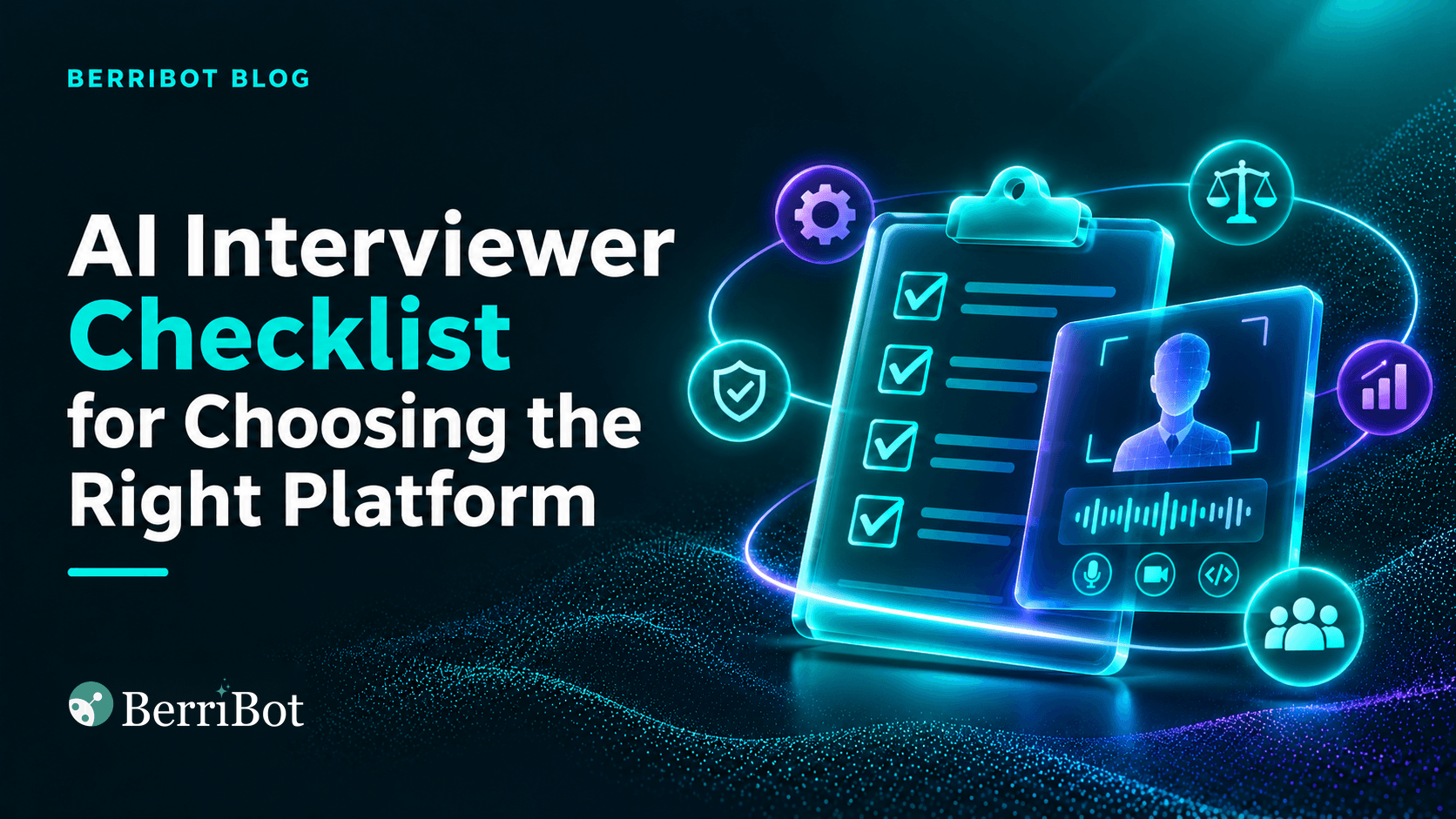
Use this AI interviewer checklist to compare platforms on interview depth, explainable scoring, fairness, data security and ATS fit before you buy.
An AI interviewer checklist lists the criteria that talent acquisition and HR teams can use when they evaluate AI interviewers to assess candidates for open roles. It helps you compare different AI interviewers on the same capabilities and find the one that best fits your talent acquisition needs. Because most AI interview software looks alike on a product page, the differences show up only when you check each platform against specific criteria.
This blog covers a checklist that helps you assess an AI interviewer's capabilities, how Berri MasterMind aligns with it, and Berri MasterMind's win at The Economic Times Most Innovative AI Product of the Year 2026 awards.
Checklist for Choosing an AI Interviewer
The criteria below help you decide whether an AI interviewer can run L1 interviews that your hiring managers can rely on, from how it conducts the interview to how it fits your hiring process.
1. AI Interviewer Skill Coverage and Interview Formats
An AI interviewer should assess the skills your roles need, in a format and language that suit your candidates. An L1 interview that checks technical, communication and behavioral skills in one session gives hiring managers a fuller picture of candidates before the next round. For technical roles, live coding rounds show how candidates write and reason through code, which a spoken answer can't show. Interview languages and 24/7 availability decide whether candidates in different regions and time zones can take the interview when it suits them. Ask the vendor:
Which skills and roles can the AI interviewer assess, and how deeply does it test them?
Does it run live coding rounds, and in which programming languages?
Which interview languages does it support?
Can candidates take the interview at any time, including outside working hours?
Broad skill coverage, live coding, more interview languages and 24/7 access let one AI interviewer handle L1 interviews across your hiring.
2. Adaptive Interviews Based on Candidates' Answers
An AI interviewer should ask follow-up questions based on what candidates say instead of reading out a fixed list, because fixed questions can't tell whether candidates understand a topic or have prepared answers for it. Follow-up questions that ask how, why or what they would do differently show the depth of their knowledge, which matters most in technical hiring. They also let the AI interviewer clarify a vague answer instead of scoring it as it stands. Ask the vendor:
How does the AI interviewer decide when to ask a follow-up question?
Can you show a sample interview where it follows up on a vague answer?
The next criterion is whether hiring managers can see how candidates' answers were scored.
3. Explainable AI Interview Scores
Hiring managers should be able to trace any AI interview score back to the rubric criterion it measures and the answers that earned it. When they can see how candidates are scored, they can trust the AI recommendations and explain it if a candidate or someone else challenges an interview result. Ask the vendor:
Can you trace a sample score to its rubric criterion and the answers behind it?
Can the hiring team review the role's rubric before interviews start?
Are candidates who get different follow-up questions still scored on the same criteria?
Is the reasoning on the scorecard the logic used to score, or a summary written afterwards?
Explainable AI in hiring also needs proof that scores are accurate.
4. Accuracy of AI Interview Scores
AI interview scores are accurate when experienced interviewers in the next rounds also find the AI interviewer's recommended candidates a good fit for the role. If those interviewers keep rejecting the AI's top candidates, their time goes into interviews that lead nowhere, and hiring starts again from sourcing. Ask the vendor:
What is the correlation between the AI's scores and scores from later human panel rounds?
Was that comparison independently validated?
The AI interviewer should also base its scores only on what candidates say and do in the interview.
5. Fair and Compliant AI Interviews
An AI interviewer should assess candidates only on job-relevant evidence, such as their answers, the reasoning they explain and the code they write in coding rounds. Facial expressions, tone of voice and inferred emotions say little about whether someone can do the job, and using AI to infer emotions from them can put companies at legal risk.
Under the EU AI Act, AI systems that infer people's emotions at work have been banned since February 2025, and the European Commission's guidelines on the Act include candidates in a recruitment process. From 2 December 2027, the Act will also treat AI used in recruitment as high-risk, which means companies using it must keep humans overseeing its results and tell candidates that AI is part of the process.
For companies hiring in India, the Digital Personal Data Protection (DPDP) Act sets rules for how candidate data is collected and used, and its main obligations apply from 13 May 2027. Ask the vendor:
Does the platform infer candidates' emotions or personality from their face or voice?
Can you share a bias audit summary for the scoring?
Which data protection laws does it comply with, for example, India's DPDP Act and the GDPR?
A fair interview also requires confirming that the candidate you invited is the one taking the interview.
6. Interview Fraud Checks During AI Interviews
AI interview software should check for fraud attempts while the interview is running, such as proxy interviews and deepfakes. Without these checks, a candidate could move to the next round on someone else's answers. Ask the vendor:
Which fraud attempts does the platform check for?
What evidence does the recruitment team receive for a flagged attempt, for example, screenshots or video?
With this evidence, the recruitment team can review a flagged interview before making a decision and show proof if a candidate challenges it.
7. Human Oversight of AI Interview Scores
Hiring managers should be able to question and override an AI interview score, with the change recorded, because humans stay responsible for hiring decisions. Ask the vendor:
Who can override a score, and is each override logged?
Can you export all scores for independent analysis?
Do humans review the evidence before any adverse decision?
Oversight is easier when scores reach hiring managers in the tools they already use.
8. AI Interviewer Integration, Scale and Security
An AI interviewer should work with your applicant tracking system (ATS), handle your interview volume and pass your company's security review. Ask the vendor:
Does it integrate natively with your ATS and update interview results automatically?
Can it handle interview volume during campus drives and other hiring peaks?
Can you share SOC 2 Type II and ISO 27001 documentation?
The answers show whether a platform can fit into your hiring setup without adding work for your team.
How Does Berri MasterMind Meet This AI Interviewer Checklist?
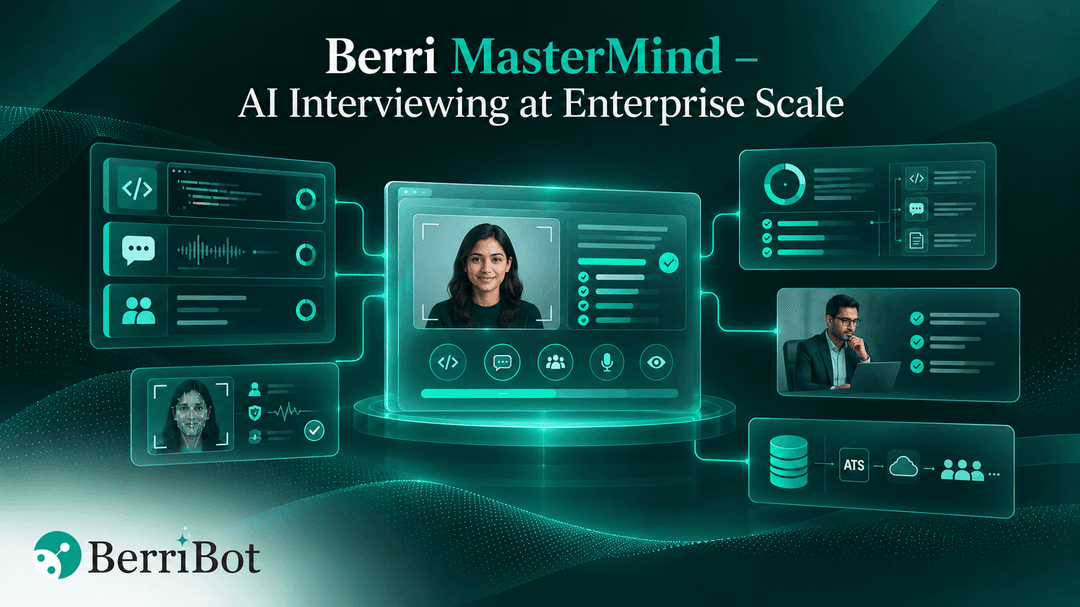
Berri MasterMind is an AI interviewer and part of Berribot's AI talent enablement platform. It conducts L1 interviews at scale, 24/7, in 140+ languages. The interviews are adaptive, evaluate candidates in depth, and score their technical, communication and behavioral skills against one rubric per role. For technical roles, candidates write code in a built-in code editor in any of 50+ programming languages, and Berri MasterMind assesses how the code is written, not only the output. It also supports project-based assessments. Candidates rate their Berri MasterMind interview experience 4.7/5.
After the interview, hiring managers receive scorecards that explain the reasoning behind every score, so they can use them as proof if anyone challenges the AI recommendations. Berri MasterMind's L1 scores correlate over 92% with human L2 panel scores (independently validated).
Berri MasterMind interviews are proctored in real time by Berri Proctor. It captures candidates' face and voice before the interview and monitors candidates throughout the interview, comparing them against those biometrics. Its detection layers also include 3D liveness checks, lip-sync and eye gaze analysis, tab-change monitoring, and mobile phone and smart glasses detection. If a fraud attempt happens, such as a proxy or a deepfake, Berri Proctor flags it with timestamped screenshot evidence for the recruitment team to review. Berri Proctor has blocked 45,000+ impersonation attempts.
Berri MasterMind does not infer emotion or personality from candidates' faces or voices, and a bias audit summary is available on request. Hiring managers make the final hiring decision.
Berribot natively integrates with Workday and SAP SuccessFactors, so interview results update in the ATS automatically. Berribot is SOC 2 Type II and ISO 27001 certified, which means independent auditors have checked how it protects candidate data. It also supports GDPR and CCPA/CPRA requirements.
Berri MasterMind has conducted 23,000+ interviews in a single day, so companies can run L1 interviews for campus drives and other hiring peaks without adding interviewers.
Berri MasterMind won The Economic Times (ET) Most Innovative AI Product of the Year 2026 award in the Agentic AI & Autonomous Systems category (SME). The recognition comes at a time when the hardest part of hiring for many companies is interviewing candidates at scale without lowering the bar. Berri MasterMind delivers that.

Bring a JD to a demo and see how Berri MasterMind assesses candidates and recommends the best ones for your roles.
Frequently Asked Questions
1. Does an AI Interviewer Decide Who Gets Hired?
No. An AI interviewer conducts the first-round interview, scores candidates and recommends top candidates, while hiring managers review the results and make the final hiring decision.
2. How Is an AI Interviewer Different From a One-Way Video Interview?
An AI interviewer conducts a structured, in-depth interview and asks follow-up questions based on candidates' answers to probe for role fit. A one-way video interview tool asks a fixed set of questions and records candidates' answers, which a person then has to evaluate.
Scale your L1 interviews without adding interviewers.
Every score, with the transcript that produced it
Explainable rubric scoring and human review — so both sides can trust the result.
See how scoring works