

Answer in brief
Learn how to build a fraud-resistant interview process that catches proxy interviews and deepfakes in AI, live and recorded interviews.
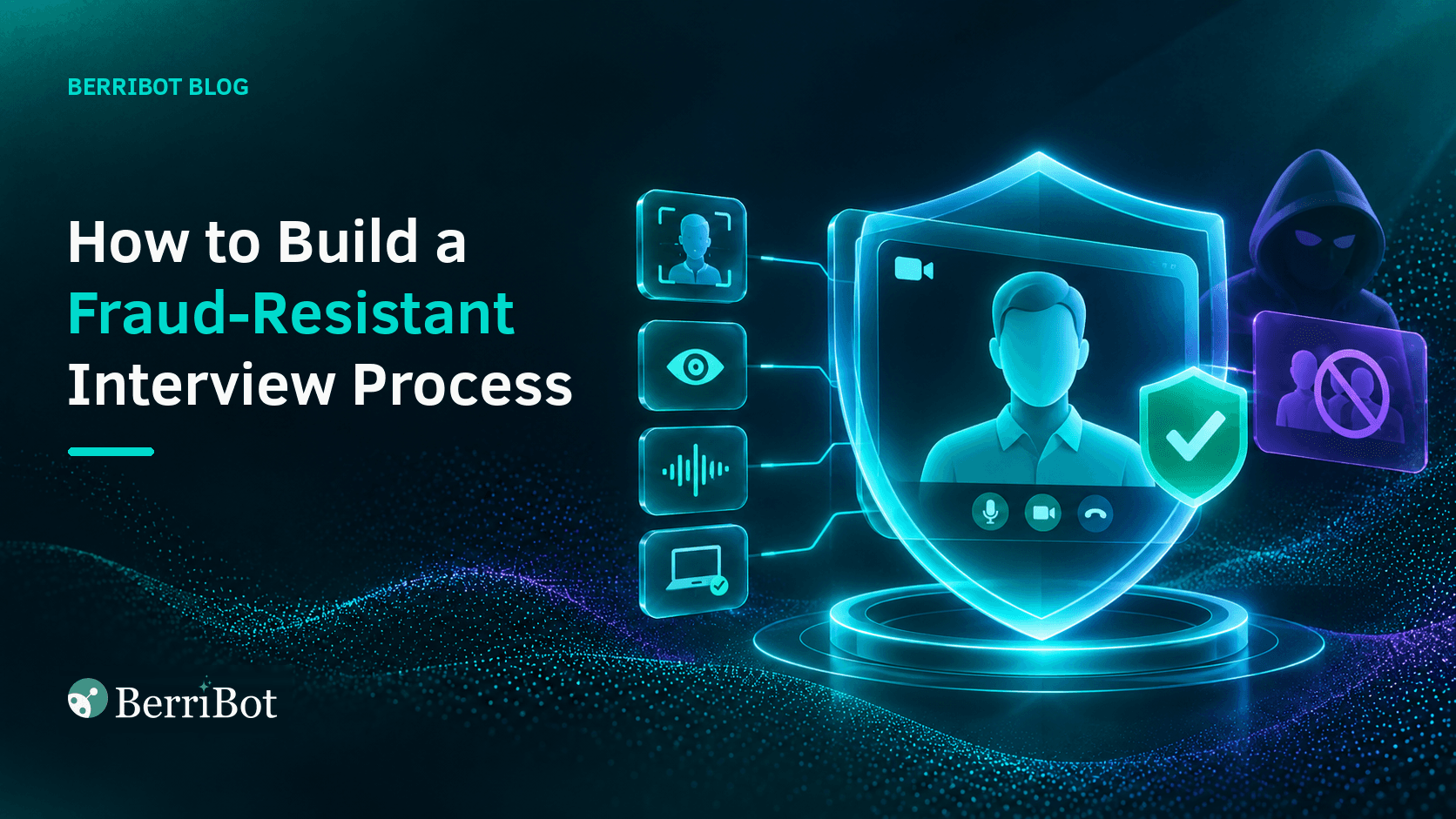
A fraud-resistant interview process checks for fraud while the interview is happening. It confirms that the person answering is the candidate who was invited, that they are present live rather than as a recording or a deepfake, and that no one is helping them off camera. It also keeps evidence of any fraud attempt, so humans can review it before a hiring decision is made.
This guide is for talent acquisition leaders and hiring managers who run interviews at high volume, whether an AI interviewer or a human panel conducts them. It covers the main types of interview fraud, the detection layers that catch them without disrupting genuine candidates, and what India’s DPDP Act means for interview data.
What Types of Interview Fraud Do Hiring Teams Face Today?
Interview fraud happens when a candidate, or someone posing as one, misleads the hiring team about who is answering or where the answers come from. The most common types are:
Proxy interviews, where a more skilled person takes the interview in the candidate’s place. The proxy clears the interview and the candidate who applied for the job joins the company.
Deepfakes, another form of proxy, where AI is used to create face and voice masks that let someone else look and sound like the original candidate and clear the interview.
Lip-syncing, where the candidate moves their lips on camera while another person behind the camera answers the interview questions.
Hidden help from off camera, such as someone displaying answers to the candidate, answers fed through an earpiece, or a second screen or mobile phone.
Smart wearables, such as smart glasses, that listen to the questions and use built-in AI to show instant answers for the candidate to read out.
SHRM India reported in July 2026 that proxy interview fraud in India has grown into semi-organized operations, where one skilled person interviews on behalf of others who later report for the job. Experian’s 2026 Future of Fraud Forecast also named deepfake job candidates among the top five fraud threats of the year.
Many hiring teams still rely on background checks to catch these kinds of fraud, but these checks often miss them.
Why Do Background Checks Miss Interview Fraud?
Background checks miss interview fraud because they don’t check who gave the interview. They only verify a candidate’s ID proof, degree certificates, experience documents and work history. A proxy can take the interview on the candidate’s behalf while the candidate submits their own ID and degree certificates for the background check.
Most background checks also run after the offer, by which point the interview panel has already spent hours on the wrong person and made the hiring decision. Interviewers often can’t detect these fraud attempts either, because they are subtle and interviewers are not trained to detect them. Monitoring a candidate’s face, voice, eyes and surroundings during an interview works better with an AI-powered proctoring system.
Which Detection Layers Make an Interview Process Fraud-Resistant?
A fraud-resistant interview process uses a proctoring system that runs several detection layers at the same time throughout the interview, because different types of fraud need different checks. The main layers are:
Identity verification matches the candidate’s face to the photo on their ID and to the person who was invited, which flags a proxy from the start.
3D liveness, a camera-based test that checks the depth and natural movement of the candidate’s face, confirms that a live person is on camera and not a photo, a recording or a deepfake.
Lip-sync and eye-gaze analysis flags speech that doesn’t match the candidate’s lip movements, and eyes that keep reading from somewhere off screen.
Room and background checks look for background voices and for people helping from off camera, such as someone holding up or showing answers.
Device and browser checks flag second screens, tab changes, copy-pasted answers, mobile phones and smart wearables.
When a candidate challenges a hiring decision or an auditor asks why a candidate was rejected, the recruitment team needs proof. The proctoring system should provide that proof as timestamped screenshots and recordings, so the recruitment team can back its decision with evidence.
How Does Berri Proctor Check for Fraud in AI, Live and Recorded Interviews?
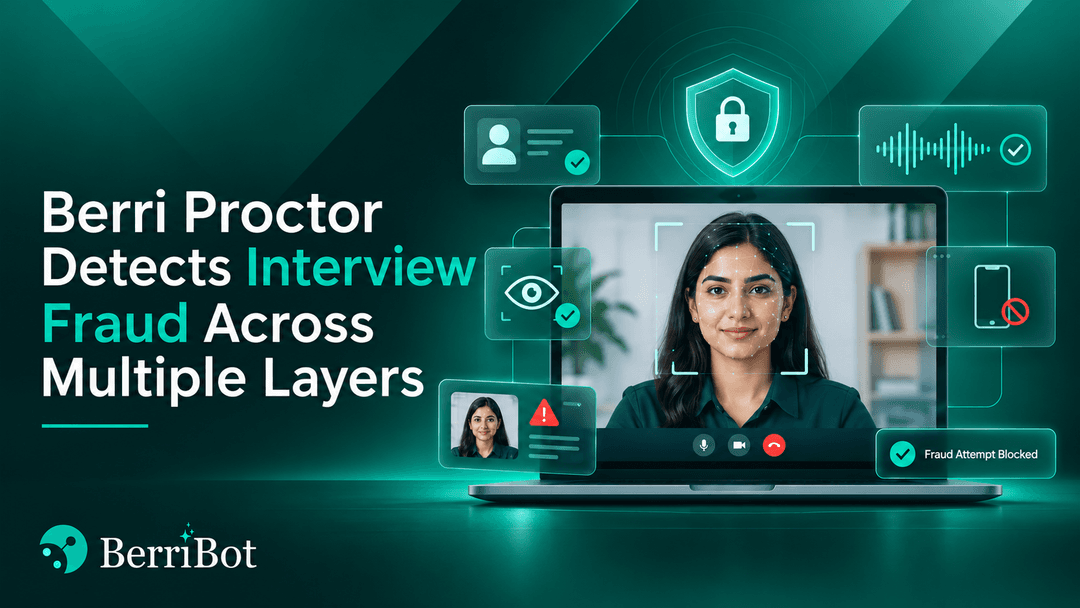
Berri Proctor, Berribot’s interview proctoring software, runs multiple detection layers at the same time to flag fraud attempts. It works across:
First-round interviews conducted by Berri MasterMind, Berribot’s AI interviewer, often used for high-volume hiring.
Live interviews that human panels run in Berri Proctor’s built-in interview room.
Recorded interviews from Zoom, Microsoft Teams, Google Meet or other tools, which hiring teams upload after the interview.
For AI and live interviews, Berri Proctor verifies the candidate’s ID, face and voice before the interview starts. Throughout the interview, it keeps matching the candidate’s face and voice to the invited candidate, runs 3D liveness checks and looks for deepfake face and voice indicators. It also analyzes lip sync, eye gaze and the candidate’s surroundings, and detects second screens, tab changes, mobile phones and smart glasses.
If a fraud attempt happens, Berri Proctor flags it with timestamped screenshot evidence for the recruitment team to review, while hiring managers keep the final hiring decision. Berri Proctor has monitored over 300,000 interviews and blocked more than 45,000 impersonation attempts.
How Can Hiring Teams Use Proctoring Software Without Disrupting Genuine Candidates?
Proctoring software should catch fraud attempts as they happen without disrupting the candidate’s interview experience. These steps help hiring teams set it up that way:
Start with the roles where fraud costs the most, for example, remote technical roles or high-volume drives, then extend proctoring to other roles.
Tell candidates before the interview that it will be recorded and proctored. A clear notice discourages proxies and helps meet privacy rules.
Run proctoring silently in the background, so candidates can focus on the interview instead of feeling watched.
Decide who reviews flagged interviews, and make sure they read the integrity report before any hiring decision is made.
For companies hiring in India, telling candidates that their interview will be recorded and proctored also aligns with data protection law.
What Does India’s DPDP Act Mean for Interview Recordings and Identity Checks?
Under India’s Digital Personal Data Protection (DPDP) Act, interview recordings, face and voice data and ID documents are personal data, and companies interviewing candidates in India must handle them under the Act’s rules. Most obligations take effect on May 13, 2027.
Tell candidates what data is collected, why, and how they can exercise their rights, and have a valid basis, such as consent, to process it.
Use the data only for the purpose stated to candidates, and delete recordings and identity data once that purpose is served, unless another law requires keeping them.
Protect the data with reasonable security safeguards, and report any breach to the Data Protection Board and affected candidates.
Respond to candidates’ requests to access, correct or erase their data.
This overview is not legal advice, so confirm the details with legal counsel. Berribot’s Trust Center explains how Berribot protects candidate data, including its SOC 2 Type II and ISO 27001 certifications and its approach to the DPDP Act.
Frequently Asked Questions
1. Do companies need in-person interviews to prevent interview fraud?
Not for every round. Hiring teams can keep early rounds remote and proctored, and hold in-person meetings for final rounds only.
2. Can proctoring work for virtual walk-in drives and bulk hiring?
Yes. Berri Proctor supports one-on-one interviews as well as virtual walk-in drives and bulk hiring, so hiring teams can proctor high volumes of interviews.
See how Berri Proctor flags proxies and deepfakes on one of your own roles.
Post-offer checks catch it after the offer
By then it is a project delay, a client escalation, a contract penalty. Verify inside the interview.
See how verification works