

Answer in brief
Berri MasterMind helps high-volume teams conduct adaptive, rubric-scored first-round interviews while recruiters review results and make hiring decisions.
AI interviewing software helps high-volume hiring teams run consistent first-round interviews without booking a specialist panel for every candidate. Berri MasterMind asks adaptive questions and scores answers against a written role rubric. Recruiters review the scorecards and make final hiring decisions. The result is more interview capacity without giving up a comparable record of each candidate’s responses.
Why does manual interviewing break down at scale?
Manual interviewing breaks down at scale because panel availability, scheduling and feedback cannot always keep pace with candidate volume. Campus drives and large lateral hiring campaigns make each constraint more visible: every additional interview needs an available person and a completed evaluation.
1. Why is panel shortage a problem?
Panel shortage limits the number of candidates a technical hiring team can interview in a day. Experienced engineers still have project responsibilities, and seasonal hiring peaks do not create more panel hours. SHRM’s 2026 recruiting benchmarks reported a 67% increase in median requisitions per recruiter at extra-large organizations, adding pressure to coordinate scarce interview capacity.
Berri MasterMind conducts structured first-round interviews so specialist panels can focus on candidates who need deeper technical review. Recruiters retain the decision about who advances.
2. Why do coordination conflicts slow interviews?
Coordination conflicts slow high-volume interviews when candidates, recruiters and specialist panelists need the same open slot. A single reschedule can leave a panel hour unused and push several other interviews back.
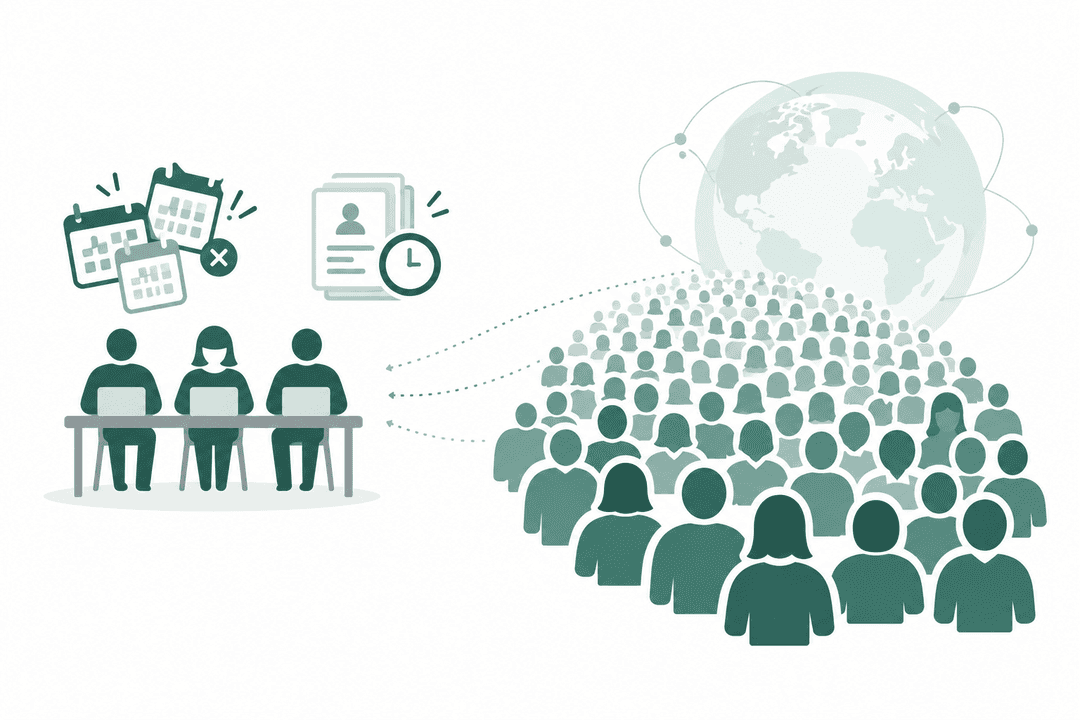
Berri MasterMind can handle the first-round conversation without requiring a live panelist for each session. Where outreach and booking are also bottlenecks, Berri Connect is a separate recruiting agent that handles calls, candidate replies, scheduling and reminders. Teams should distinguish interview capacity from the work of getting candidates to the interview.
3. Why do subjective evaluations affect hiring?
Subjective evaluations make candidates harder to compare when interviewers ask different questions or apply different standards. An unstructured first round may produce detailed notes for one candidate and a brief impression for another.
Berri MasterMind scores candidates against the same written rubric for the role while adapting follow-up questions to their answers. Its scorecards show the evaluation for recruiter review. Rubric-based scoring supports consistency, but recruiters must still check whether the rubric measures the skills the job requires. Candidate performance should not be inferred from facial expression or tone of voice.
4. Why does feedback delay matter?
Feedback delay matters because recruiters cannot move candidates forward until interview results are available and reviewed. SHRM’s 2025 benchmarking report found that the interviewing stage averaged about eight to nine days. SHRM’s 2026 recruiting benchmarks put median time-to-fill at 39 days for nonexecutive roles; SHRM’s 2025 reporting put the executive figure at 45 days. Those measures cover different parts of hiring and should not be treated as interview-only delays.
Berri MasterMind produces a scored report after each first-round interview. Recruiters can review the evidence sooner, decide on next steps and communicate those steps to candidates. A quick scorecard does not remove the need for a human decision or timely candidate communication.
What are the drawbacks of traditional interviewing software?
Traditional interviewing software may reduce administrative work without removing the limits of live panels or fixed-question video interviews. The practical distinction is whether software conducts an adaptive, rubric-scored first round or mainly records and organizes interviews.
Interview format | Useful for | Constraint at high volume |
Scheduled live panels | Deep discussion with a specialist | Panel availability and feedback timing limit throughput |
Fixed-question video interviews | Collecting comparable recorded answers | Follow-up questions cannot respond to a candidate’s answer |
Berri MasterMind first rounds | Adaptive questions with a shared scoring rubric | Recruiters still need to review scorecards and make decisions |
A recorded-answer tool can suit roles where a short, fixed set of questions is enough. For technical roles that require probing an explanation, buyers should test how an interviewer follows up, handles candidate setup issues and explains scores. Berri MasterMind provides camera, microphone and audio setup checks, plus in-interview chat support. Buyers should check recovery from connection failures during a pilot rather than assume every interview product handles interruptions the same way.
How does Berri MasterMind solve high-volume hiring problems?
Berri MasterMind conducts structured, conversational first-round interviews and produces scorecards against a written role rubric. Follow-up questions adapt to candidate answers, so recruiters can review both the response and the basis for its evaluation. Berri MasterMind assesses technical, cognitive and behavioural dimensions in one flow without inferring emotion or personality from a candidate’s face or voice.
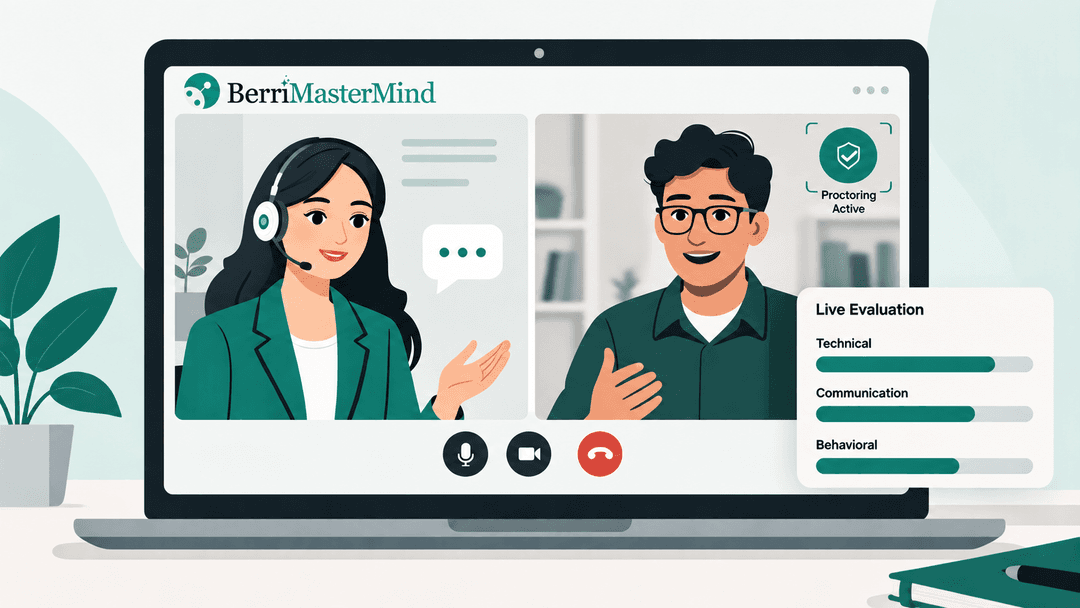
Berri MasterMind supports interviewing in 140+ languages. Multilingual coverage can help a distributed team apply the same role rubric across locations, although hiring teams should check whether questions and scoring work well for each language and job family in a pilot.
For interview integrity, Berri MasterMind offers optional integration with Berri Proctor. Berri Proctor validates a digital ID and matches the invited candidate’s face and voice at the start and throughout an interview. Its 3D liveness check tests whether a real person is present on camera rather than a recording or synthetic face. A person reviews every integrity flag before it affects a candidate. Buyers evaluating emerging risks such as smart glasses during interviews should ask which signals are supported and how flags are reviewed.
A high-volume team can test Berri MasterMind against a defined job family before extending it to other roles:
Write the role rubric and decide which skills require a specialist panel.
Run a pilot with enough interviews to compare first-round scores with recruiter reviews.
Check candidate setup, language coverage, score explanations and completion rates.
Review disputed scores and integrity flags with a person before making hiring decisions.
The aim is a first round that recruiters can inspect and improve, rather than an automatic hiring verdict. For more on the scoring problem, see how Berri MasterMind addresses subjective bias in interviews.
How do high-volume hiring teams benefit from Berri MasterMind?
High-volume hiring teams benefit from Berri MasterMind when they need more first-round capacity and comparable evaluations across candidates. Campus recruiters can apply one written rubric to a large fresher cohort. Lateral hiring teams can reserve specialist panels for later discussions, while multi-location teams can review scorecards produced under the same role criteria.
The benefit depends on the hiring process around the interview. A recruitment operations lead should confirm how candidates receive instructions and support, who reviews scorecards, and when the next human conversation happens. Berri MasterMind adds structured first-round capacity; it does not replace recruiter judgment or the communication candidates need after an interview.
What should buyers ask about AI interviewing software?
Buyers should ask how AI interviewing software conducts follow-up questions, scores answers, supports candidates and preserves human review. Berri MasterMind’s capabilities should be assessed against the roles and languages in the hiring campaign.
What is AI interviewing software? AI interviewing software conducts or supports job interviews using automated questions and evaluation. Berri MasterMind conducts adaptive first-round interviews and scores responses against a written role rubric.
What makes AI interviewing software suitable for high-volume hiring? Berri MasterMind provides structured first rounds without requiring a live panelist for every candidate. Recruiters should test scorecard quality, candidate support and review time in their own hiring campaign.
How does Berri MasterMind address panel and scheduling pressure? Berri MasterMind conducts the first round so specialist panelists can concentrate on later decisions. Berri Connect handles outreach and scheduling when those steps also need automation.
Does Berri MasterMind verify candidate identity? Berri MasterMind offers optional Berri Proctor integration for interview integrity. Berri Proctor checks identity during the interview, and a person reviews every flag before it affects a candidate.
Who benefits from Berri MasterMind interviews? Berri MasterMind suits enterprise campus, lateral and multi-location teams conducting repeated first-round interviews. Each team should set a role rubric and keep recruiters responsible for hiring decisions.
Still have questions? Book a demo

Everyone is running AI interviews now
The only question left is whether yours is the version candidates will tolerate.
See ours