

Answer in brief
AI reduces bias in hiring by evaluating every candidate on the same criteria. See how Berribot’s AI agents reduce it at every hiring stage.
AI reduces bias in hiring by evaluating every candidate on the same criteria. This means ranking resumes based on each candidate's capability, giving every potential candidate an equal chance to show their fit for the role, and scoring candidates on their actual interview performance.
Companies are increasingly using AI to hire at scale, improve efficiency, and cut recruitment costs. As AI supports more hiring decisions, it needs to be bias-free, unlike human-led processes and basic automation tools, which introduce some form of bias.
This blog breaks down the biases that occur at each hiring stage and how AI, specifically Berribot's AI agents, reduces them.
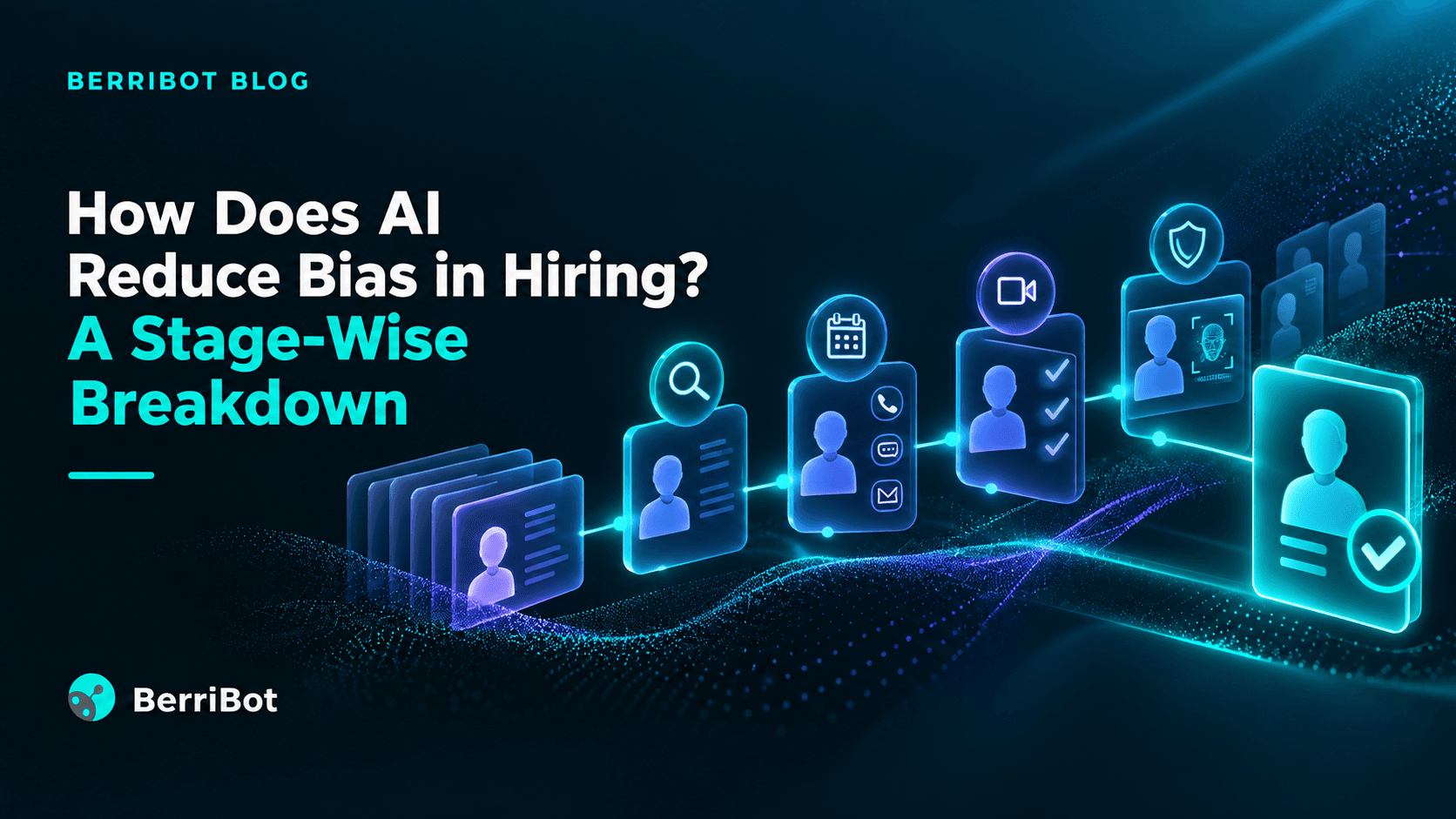
How Does AI Reduce Bias in Resume Screening?
AI reduces bias in resume screening by analyzing each resume semantically, that is, for meaning and context.
In a manual hiring process, recruiters cannot give every resume a fair read due to time constraints and human limitations. So they skim resumes for signals such as college names, previous employers, and job titles. But none of these signals actually confirms whether a candidate can do the job. As a result, the shortlists are shaped by subjective impressions.
Keyword-based resume screening introduces its own bias. It shortlists resumes based on exact text matches with the job description. For example, it can reject a candidate who mentions "built ETL pipelines in Spark" in their resume for a role that asks for "data engineering experience," even though the two describe the same work. It penalizes candidates who describe their work differently.
Here is how Berribot's AI resume screening agent, Berri Search & Match, solves this problem:
It analyzes the job description and screens every resume based on skills, experience, intent and overall context to identify a candidate's true capability and fit for the role.
Semantic parsing interprets skills and experience the way a recruiter would, so a candidate isn't rejected for wording alone.
Each candidate gets a Match Ranking Index (MRI) score that shows how well they fit the role. Recruitment teams can see the reasoning behind every ranking and overrule it if needed.
Search & Match can re-rank candidates who aren't right for one role against other open roles in the company. It can also screen candidates already in your ATS, reducing new sourcing effort.
How Does AI Reduce Bias in Outreach and Interview Scheduling?
AI reduces bias in outreach and interview scheduling by contacting every shortlisted candidate and giving them an opportunity to compete for the role.
When recruiters handle outreach and scheduling, bias shows up as a lack of access. For instance, if a recruiter has a shortlist of 500+ resumes, they only reach a fraction of them, usually the ones at the top of the list, because calling every single candidate is exhausting. As a result, strong candidates may never be contacted by the hiring team.
Berri Connect eliminates this bias by giving every candidate the same chance to respond.
It automatically reaches candidates by Truecaller-verified voice call to check their interest in the role and collect key details like experience, skills and CTC.
It checks candidate availability and coordinates panel calendars to book the interview. Reschedule requests and time zone conflicts are handled automatically.
Candidates who miss the call can request a callback.
Berri Connect keeps every candidate engaged across WhatsApp, SMS, and email by giving timely updates and sending reminders to join the interview. Berribot customers using Berri Connect see a 2x improvement in interview show-up rates.
How Does AI Reduce Bias in First-Round (L1) Interviews?
AI reduces bias in first-round interviews by keeping the evaluation and scoring consistent for all candidates.
Human-led first-round interviews are usually subject to bias. Two interviewers can score the same candidate differently for the same answer to the same question. Interviewers form first impressions within minutes, and those impressions shape the rest of the conversation. An interviewer's attention also varies with their energy and mood on the day, which often results in biased decisions and can lead to bad hires.
Here is how Berri MasterMind solves this problem:
It analyzes the job description and candidate's resume to ask role-relevant questions, and evaluates every candidate's technical, behavioral and communication skills against the same criteria.
For technical roles, it conducts live coding tests and evaluates how the candidate writes the code, not just the final output.
Interviews run in 140+ languages, giving each candidate a fair chance to answer in the language they are most comfortable with.
After the interview, an Instant Insight Scorecard shows recruitment teams how each candidate performed, helping them make data-driven, bias-free final decisions.
MasterMind interviews feel like a two-way conversation. The AI interviewer follows up on candidate responses in real time, which gives candidates a positive interview experience.
MasterMind has conducted 200K+ interviews across 2,000+ skills. It ensures candidates are recommended purely based on their performance.
How Does AI Reduce Bias in Interview Proctoring?
AI reduces bias in interview proctoring by catching fraud attempts in real time without penalizing genuine candidates for normal human behavior.
If a human interviewer monitors the remote interview, they can miss subtle fraud like deepfakes and proxy candidates, so a fraudster can take the spot of a genuine one. Basic proctoring tools cannot solve this problem, as they can mistakenly flag candidates for behavior such as looking away, fidgeting or eye movement.
US senators have raised concerns about proctoring tools flagging test takers' physical conditions as suspicious. With tools like these, a genuine candidate can be flagged as a cheater.
The fix is using an AI agent like Berri Proctor that verifies identity with evidence instead of guessing intent from behavior.
It uses 3D liveness detection, biometric authentication and voice analysis to monitor candidates throughout the interview and flag fraud attempts in real time.
It also detects and flags mobile phone and smart glasses usage, help from another person in the room, and copy-pasted answers through tab monitoring.
Flagged events are reported with timestamped screenshot evidence for recruitment teams to review.
Because every flag comes with evidence and is reviewed by the recruitment team, genuine candidates aren’t rejected for normal human behavior. Berri Proctor has monitored 300K+ interviews and blocked 45K+ impersonation attempts.
How Does Berribot Keep Its Own AI Fair?
Berribot keeps its AI bias-free by scoring every candidate on the same criteria, showing the reasoning behind every score, and keeping people in control of final decisions.
Every candidate for a role is scored on the same criteria. The scores are explainable, and every fraud flag shows the reason behind it.
The AI is trained on balanced data and regularly tested for bias.
The AI doesn’t judge a candidate’s emotions, personality or mood from their face or voice. Candidates are scored only on how they perform in the interview.
Every interview has a complete record of what the AI did and why. Companies can also request a bias audit summary with Berribot’s fairness test results.
Recruiters can override any score or recommendation, and a person reviews before any decision goes against a candidate.
Candidate data is protected under SOC 2 Type II and ISO 27001 certifications, with GDPR and CCPA/CPRA compliance. Berribot’s AI model providers don’t keep candidate data, and one company’s data is never used to train AI for another.
Check Berribot’s Trust Center for more information.
Frequently Asked Questions
How can AI reduce bias in hiring?
AI reduces bias by evaluating every candidate on the same criteria. Recruitment teams review the recommendations and make the final hiring decisions.
How is AI helping in the hiring process?
AI screens resumes, contacts candidates, schedules and conducts first-round interviews, and checks for fraud. This lets recruitment teams focus on shortlisted candidates and final decisions.
What are some examples of AI hiring bias?
Examples include resume tools that mark down candidates based on gender, interview tools that favor candidates who answer like past hires, and proctoring tools that flag normal human behavior as candidate fraud.
Next step:
Start automating your recruitment process with Berribot’s bias-free AI agents. Book a demo.
Interviews you can prove
Screening, interviews, and live identity verification in one platform. Built for high-volume technical hiring.
Book a demo