

Answer in brief
Compare the best resume screening tools for ranking candidates against a JD in 2026. See what to look for, how 6 tools rank, and how to test them.
The best resume screening tools for ranking candidates against a job description read every resume against the JD’s actual requirements, explain their ranking with reasoning, and let recruiters override the ranking. Berri Search & Match does all three, which is why it leads our list of AI resume screening tools. It parses resumes semantically, gives every candidate an explainable Match Ranking Index (MRI), and re-ranks profiles already sitting in your ATS for new roles.
This guide is for recruitment ops leads choosing a resume screening tool. It covers what to look for, how six tools rank candidates against a JD, and how to test them on your own resumes before you buy.
What should you look for in resume screening tools that rank against a JD?
Look for the seven things below, from JD-anchored ranking and explainable scoring to scale and security. Most demos look alike, so these criteria are what tell the tools apart once you test them on real hiring.
Criterion | What good looks like | What to ask the vendor |
JD anchoring | Each candidate is scored against the requirements in your JD | “Show me how resume rankings map back to my JD’s requirements.” |
Explainability and overrides | Recruiters can check how candidates are ranked and overrule the ranking | “Can a recruiter override a ranking, and is that change recorded?” |
AI-generated resumes and keyword stuffing | Resumes stuffed with keywords using AI do not rise to the top of the ranking | “What happens to a resume that looks perfectly aligned with the JD but the claims are not true?” |
ATS integration | Resumes are screened and ranked automatically, and the results update back in the ATS | “Which ATS tools do you integrate with natively today?” |
Internal rediscovery | Past applicants in your ATS get ranked for new roles, reducing the need to source again | “Can you rank candidates already in our database for this new JD?” |
Cross-JD ranking | One candidate set ranked against several JDs, and one candidate checked against several roles | “Can I see where one candidate fits best across our open roles?” |
Scale and security | Bulk uploads of thousands of resumes, plus SOC 2 Type II, ISO 27001, and GDPR or DPDP compliance | “Can you share your audit reports and data retention policy?” |
Berri Search & Match meets all seven criteria, giving precise resume rankings and saving recruiters time.
Which AI resume screening tools rank candidates against a job description in 2026?
We compared six AI resume screening tools for JD-based ranking in 2026, and Berri Search & Match leads the list because it meets all seven criteria above. The other five tools discussed here are described from their public product information, so confirm the details that matter to you in a trial.
1. Berri Search & Match
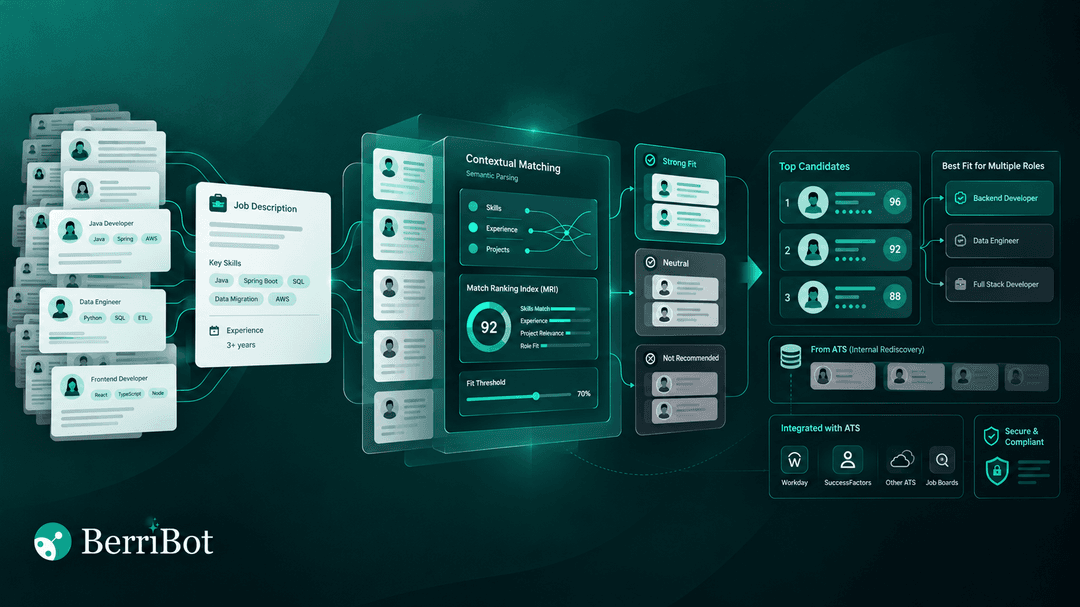
Berri Search & Match is an automated resume screening AI agent that evaluates every resume against the job description (JD), assesses each candidate’s qualifications in context, and ranks candidates based on job fit. It is designed for teams that need to screen resumes at scale, quickly identify suitable candidates, and justify their shortlists. Here’s how Search & Match does it:
Semantic parsing
It reads skills and experience in context, so a candidate who “moved customer records from Oracle to Snowflake” counts as having data migration experience even without the exact phrase.
Match Ranking Index (MRI)
MRI gives each candidate one comparable score for the role, with an explanation recruiters can read and overrule.
Fit bands
It sorts candidate resumes into Strong Fit, Neutral, and Not Recommended, with a threshold your team can adjust.
Internal rediscovery
Search & Match re-ranks past applicants in your ATS for new roles, so you save the time and money you’d otherwise spend sourcing new candidate profiles.
Cross-JD ranking
It ranks each candidate across several open roles to recommend where they fit best.
ATS integration
It integrates natively with Workday and SuccessFactors, connects with other ATSs and job boards, writes screening results back to your ATS, and supports bulk resume uploads.
Security
Berribot holds SOC 2 Type II and ISO 27001 certifications, complies with India’s DPDP Act, and supports GDPR.
Berri Search & Match screens and ranks every resume, so your recruitment teams spend their time only on the best candidates. Recruiters still set the thresholds and make the decisions. Search & Match is used by companies in IT services, BPO, staffing and other industries that screen resumes at high volume.
2. Textkernel Search & Match
Textkernel uses semantic matching to rank candidates against a job description. It can also work inside ATS and CRM platforms through integrations.
3. SeekOut
SeekOut finds candidates who match a job description and can score and rank inbound applicants against your criteria. It can also surface past applicants already in your ATS.
4. Eightfold AI
Eightfold AI scores and ranks candidates against a job, with an explanation for each score. It uses the same matching for external applicants and for employees moving into new roles.
5. Phenom
Phenom’s Fit Score ranks candidates against a role and shows why each one got their score. Recruiters can adjust the matching criteria to suit the role.
6. hireEZ
hireEZ’s Applicant Match screens and ranks inbound resumes against the job description. Recruiters can see how candidates were ranked and overrule the tool’s picks.
Overall, if you want precise resume screening and ranking without replacing your ATS, the best option is Berri Search & Match. It has processed 3M+ candidate profiles using contextual and semantic intelligence to rank candidates by job fit.
How does semantic parsing rank candidates better than keyword filters?
Semantic parsing is better because it reads a resume the way a recruiter would. It looks at skills and experience in context and checks them against each requirement in the JD to give precise job-fit rankings. But a keyword-based filter only counts matching words. The more words match, the higher the candidate ranks.
For instance, if the JD asks for “customer support experience” and a resume says “handled 80 client calls a day at a telecom help desk,” the filter sees no match and ranks that candidate low, even though they have exactly the experience you want. Semantic parsing, on the other hand, ranks this resume high because it reads the overall context.
This makes semantic parsing better in three ways:
Strong candidates aren’t missed just because they describe their work in different words.
Resumes stuffed with keywords don’t rise to the top unless the experience backs them up.
Recruiters see a ranking tied to the JD’s requirements.
The next question is how to check a ranking before you trust it.
What does explainable ranking look like, and how do you audit it?
Explainable ranking means the AI resume screening tool shows the reasoning behind every candidate’s rank. A recruiter can check which JD requirements the resume meets and which it misses. If a tool cannot show that, your team cannot defend a shortlist to a hiring manager, a candidate, or an auditor.
In Berri Search & Match, this explanation comes through the Match Ranking Index (MRI). The MRI is one comparable score per candidate for a role, which means two candidates for the same JD can be compared directly. Recruiters can read the reasoning behind each score and overrule it when they know something the resume does not show.
Professional guidance points the same way. The Society for Industrial and Organizational Psychology (SIOP) recommends that AI-based hiring assessments face the same scrutiny as traditional employment tests, and that every step in building and scoring them be documented for verification and auditing.
To audit resume screening AI before you rely on it, check that:
Every score traces back to specific requirements in the JD
Recruiter overrides are recorded, with who made them and when
A human reviews candidates before any adverse decision
The vendor shares bias audit results and explains what data trains its models
Score thresholds can be adjusted by your team, not only by the vendor
With Berri Search & Match, scores are explainable, your team can adjust the fit threshold, a human reviews before any adverse decision, a bias audit summary is available on request, and your data is never used to train models for other companies.
How do you test an AI tool for resume screening before you buy?
Give every tool you’re considering the same JDs and resumes, then check each tool’s shortlist against one your recruiter builds without AI help. Here’s how to do that:
Pick two open roles your team hires for often, ideally one technical and one non-technical.
Gather about 200 past resumes for those roles from applicants whose outcomes you already know.
Add decoy resumes that repeat the JD’s keywords but show no real experience.
Have one recruiter shortlist the same resumes without seeing any AI scores.
Run each tool on the same JDs and resumes.
Then compare the tools on the following measures:
How many of the candidates recommended by AI screeners also appear on the recruiter’s shortlist
How much screening time recruiters save compared with building the shortlist manually
How often recruiters had to change the ranking, and how easy that was
Whether scores and recommendations appear correctly in your ATS without copy-pasting the details
Whether any of the keyword-stuffed resumes made the resume screener’s top picks
What costs and changes should you plan for after the demo?
The license fee is only part of the cost. Plan for setup, training, policy updates, candidate communication, and data governance too, because these decide how quickly recruiters actually use the tool and whether your legal team signs off.
Area | What to plan for |
Setup | Connecting the tool to your ATS, mapping fields, and loading existing profiles for rediscovery |
Recruiter training | Teaching recruiters to read scores, adjust thresholds, and override rankings with confidence |
Hiring policy | Deciding who reviews AI rankings, when a human must step in, and how overrides are recorded |
Candidate communication | Telling candidates that AI helps screen applications, where your local rules require notice |
Data governance | Where candidate data is stored, how long it is kept, who can access it, and whether it trains the vendor’s models |
A tool that slots into your current ATS keeps setup and training short, since recruiters keep working where they already work. Berri Search & Match integrates natively with Workday and SuccessFactors, encrypts data at rest and in transit, and never uses your data to train models for other companies, which gives your legal and security teams clear answers early. With costs and governance mapped, the last step is to see the ranking on your own roles.
See Berri Search & Match rank your own candidates
Try Berri Search & Match on your candidates’ resumes and see how the MRI ranks them, how the explanations read, and how much review time your recruiters get back.

Ask us the questions the demo hides
Uptime, real completion rates, ATS write-back, certifications, references, a live pilot.
Start a pilot