

Answer in brief
LinkedIn's new verification signals reduce fraud at the application stage. But combating candidate fraud in the interview requires an AI proctoring agent.
Combating candidate fraud in the interview takes more than sourcing-stage checks, and that's exactly where LinkedIn's new verification signals stop. On May 6, 2026, LinkedIn published its Job Search Safety Pulse 2026 report, introducing stricter verification for high-risk job posters and a new Verified Applicant Spotlight badge to prevent candidate fraud.
This is a genuine win, especially for TA teams running high-volume, remote-first pipelines. However, these verification measures reduce fraud only at the sourcing stage and not during the interview.
What Is LinkedIn's Verified Applicant Spotlight, and How Does It Help Recruiters?
Verified Applicant Spotlight is a badge that shows up on a candidate's card on LinkedIn once they have completed its identity verification. For recruiters using LinkedIn Recruiter, this gives a quick trust signal before they even open the candidate application.
LinkedIn's verification push also includes a parallel check for job posters. Job listings now display verification status, like confirmed company affiliation or a verified work email, so candidates can identify a real employer from a fake one.
The platform also reports stopping 99.5% of detected fake accounts before anyone reports them (the figure is platform-wide and isn't broken out separately for job posters versus applicants). That's a meaningful improvement at the early hiring stage.
The verified applicant badge, however, doesn't prevent candidate fraud in the interview, where hiring decisions are actually made. Because a recruiter only sees the badge when a candidate applies, which doesn't ensure the same candidate attends the interview. Preventing it requires monitoring candidate identity continuously during the interview.
How Should TA Teams Adapt Screening Now That LinkedIn Surfaces Verified Applicants?
TA teams should update screening workflows to prioritize verified applicants while maintaining accessible entry routes for qualified, unverified talent. Automatically rejecting candidates without a LinkedIn verification badge risks excluding high-performing individuals who simply haven't completed platform checks.
Verified applicants can go straight to a recruiter screening call. Unverified applicants complete a short identity check first. This saves recruiters time from spending it on fake candidates.
"Knowing who is on the other side of a job post or application is half the battle."
— LinkedIn Corporate Communications, May 6, 2026
After screening, interviews need a fraud detection system in place, since the panel's job is to evaluate a candidate's capability, not whether they are genuine or fake. Even if panels monitor the interview themselves, the chances of missing interview fraud are high.
Which Interview Fraud Tactics Are Bypassing Human Interviewers?
Proxy interviews, AI voice and video impersonation, a coach feeding answers through a second device or earpiece in real time, and pre-recorded answer playback are the tactics currently slipping past human interviewers.
According to Checkr's Hiring Hoax 2025 survey of 3,000 U.S. managers, 35% confirmed that someone other than the candidate who applied had participated in a virtual interview at their company. The same survey found 62% of managers believe job seekers are now better at faking identities with AI than employers are at detecting it.
Research backs that up. A meta-analysis of human deepfake detection found that untrained humans identify deepfake content at only 55.54% accuracy, barely better than random chance.
Asking interviewers to "watch more closely" isn't a fix. The human eye isn't built to catch this.
How Does an AI Proctoring Agent Close the Human Blind Spot in Interviews?
An AI proctoring agent runs multiple detection checks at once, verifying candidate identity and monitoring behavior continuously through the interview to catch fraud as it happens, closing the human blind spot.
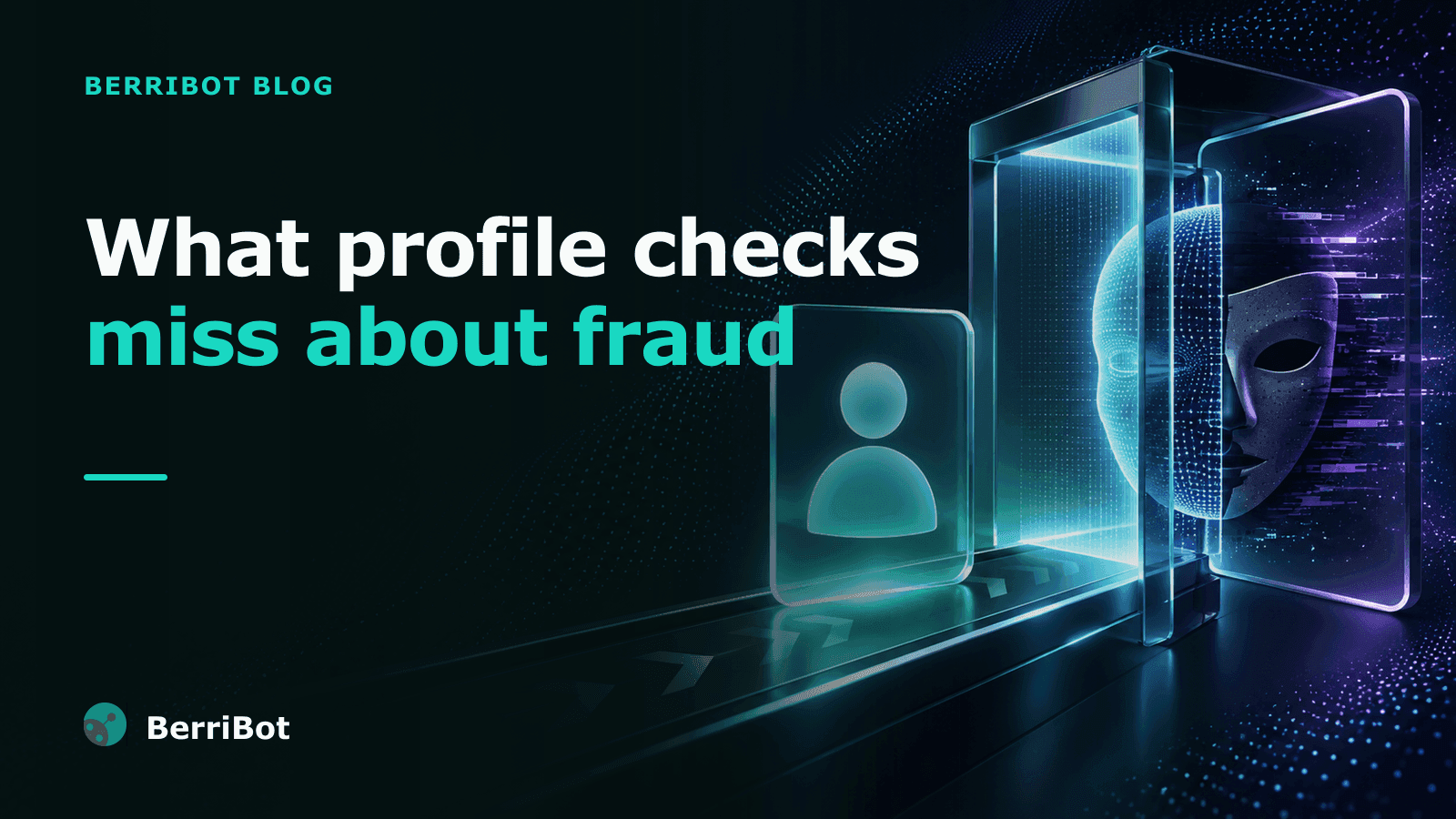
Berri Proctor is built for exactly this. It's an AI agent that monitors interviews live by running in the background without affecting the candidate's focus. It performs 3D liveness detection, a biometric test that checks and verifies the candidate's face in three dimensions. It rules out photos, screen replays, and deepfake overlays.
Alongside identity confirmation, Berri Proctor runs environmental scene analysis and behavioral anomaly detection, covering lip-sync mismatches, eye gaze tracking, and head pose estimation, to flag signs of off-screen prompting or impersonation. It also monitors browser activity, including tab switching and copy-pasting, and detects the use of smart glasses to access answers.
Berri Proctor flags any of the above mentioned fraud attempts with a timestamped screenshot as evidence for hiring teams to review. When a decision is questioned later, whether by a hiring manager, a candidate, or a compliance audit, that evidence is what they refer back to.
Who Owns Exception Handling for Interview Integrity Flags, and What Compliance Rules Apply?
TA teams and InfoSec split ownership of integrity-flag exceptions by cause. TA teams handle technical glitches, communication, and rescheduling. InfoSec handles deliberate identity discrepancies and repeated proxy attempts, which count as security incidents.
These processes also need to comply with data privacy regulations. India's Digital Personal Data Protection (DPDP) Act takes full effect on May 13, 2027, and alongside GDPR, it requires identity data handling to stay minimal, secure, and transparent.
Explainable integrity reports from Berri Proctor ensure compliance teams can defend hiring decisions during internal or regulatory audits.
Which Metrics Show That Combating Candidate Fraud in the Interview Is Working?
Five metrics show whether your interview fraud controls are working: flag rate, confirmed fraud rate, time-to-offer, show-up rate, and how often contested cases get resolved in your favor.
Flag rate is the percentage of completed interviews flagged for identity or behavioral anomalies. Confirmed fraud rate is the percentage of those flagged sessions confirmed as fraudulent after review by TA teams. A rising flag rate with a stable or improving confirmed fraud rate means detection is working well without producing more false alarms.
Watch no-show and reschedule deltas after you introduce integrity checks. A drop in last-minute cancellations can signal that candidates relying on a proxy or another person's help are opting out on their own. Track time-to-offer alongside, since verification should not slow it down.
Track how often a contested case gets resolved in your favor using your verification evidence. This number matters most to compliance teams reviewing your process.
Presenting these metrics to compliance teams shows that strong candidate fraud controls speed up quality hires while protecting corporate integrity.
The Bottom Line on Combating Candidate Fraud in the Interview
LinkedIn's Safety Pulse report brings verification updates to the top of the hiring funnel. Job-poster verification protects candidates from fake employers, and Verified Applicant Spotlight reduces candidate fraud at the application stage for recruiters.
However, a candidate's actual capability is better assessed at the interview, and it's the place where hiring decisions are made. Extending identity and behavioral verification into live interviews catches fraud attempts as they happen.
Berri Proctor is built to do exactly that at scale with high accuracy. See it in action. Book a demo.
FAQs
How Do You Combat Candidate Fraud in the Interview?
Combating candidate fraud in the interview requires continuous identity and behavioral verification during the interview. AI proctoring agents like Berri Proctor perform 3D liveness detection, monitor for lip-sync mismatches, gaze shifts, and browser activity, and flag signs of impersonation as they happen.
What Is 3D Liveness Detection?
3D liveness detection is a biometric test. It checks and verifies a candidate's face in front of the camera in three dimensions to confirm a person is real and not a photo, screen replay, or deepfake overlay.
Does LinkedIn's Verified Applicant Spotlight Stop Candidate Fraud During Interviews?
No. LinkedIn's Verified Applicant Spotlight confirms candidate identity only at the application stage. Live interview proctoring is needed to catch fraud in real time and prevent bad hires.
How to Identify a Fake Candidate in an Interview?
Look for mismatched details, scripted or delayed answers, and unusual pauses that suggest off-screen help. But manual detection alone is unreliable. Live interview proctoring agents like Berri Proctor catch fakes in real time.
How Can TA Teams Prevent Candidate Fraud in 2026?
Combine sourcing-stage checks like LinkedIn's verification with identity and behavioral verification during the interview itself, which is where most fraud risk concentrates.

Humans catch deepfakes 55% of the time
That is a coin flip. Spotting them is a machine's job now.
See the detection layer