

Answer in brief
Berri 360 can reduce time to hire by connecting screening, outreach, scheduling and first-round interviews, while recruiters retain hiring decisions.
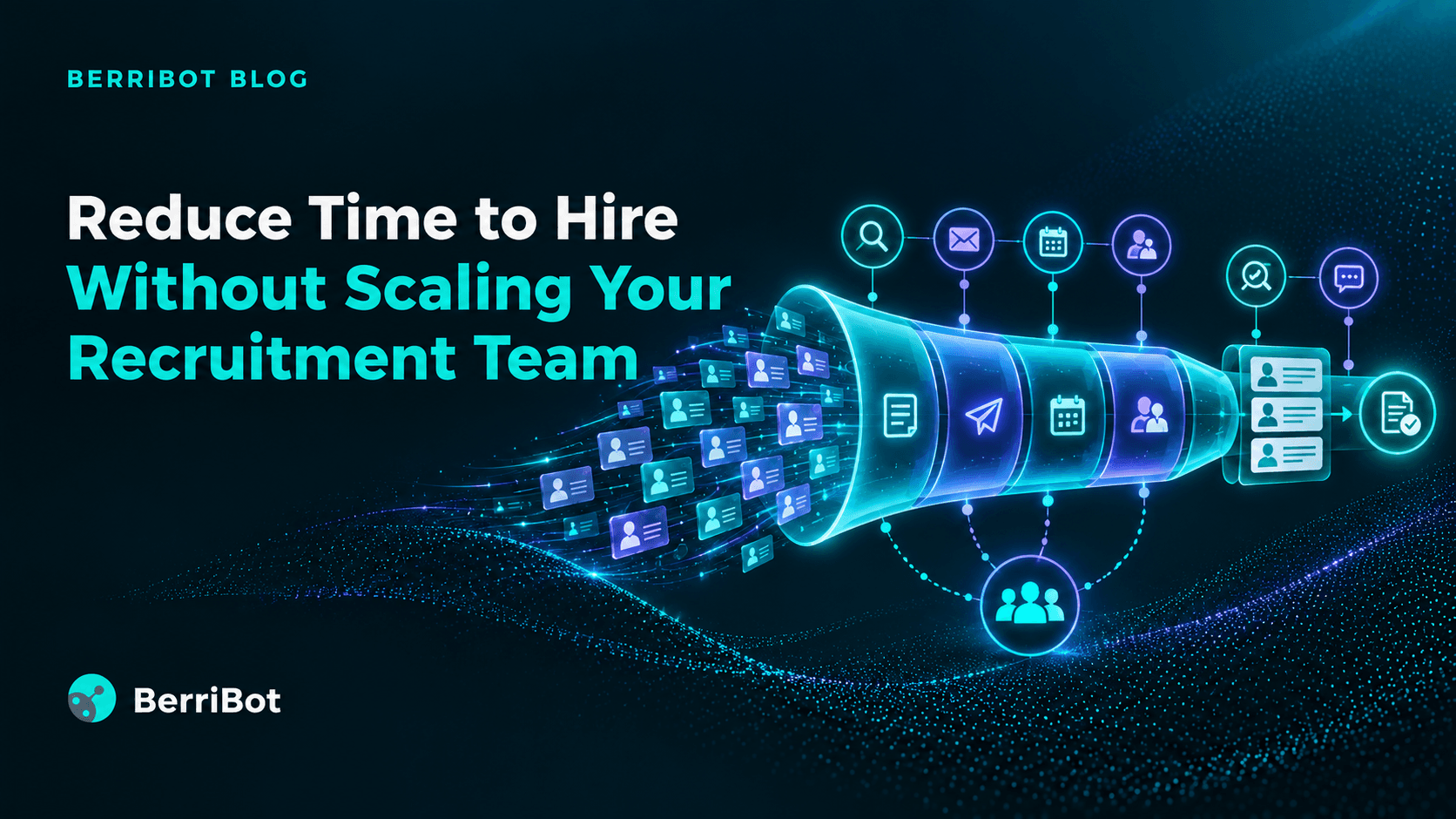
Reduce time to hire without adding recruiters by automating the repetitive work between application and offer. Berri 360 connects shortlisting, outreach, scheduling, first-round interviews and verification on one candidate record. Recruiters set the criteria, review the evidence and make the final hiring decision. The goal is fewer manual handoffs, not fewer human judgments.
Time to hire measures the days between a candidate applying and accepting an offer. In its 2026 recruiting benchmark, SHRM reported a 67% year-over-year increase in median annual requisitions per recruiter at extra-large organizations. That figure does not mean recruiters held 100 open jobs simultaneously. SHRM also reported a 39-day median time-to-fill for nonexecutive roles in 2026. Time-to-fill starts when a role opens, so it is not interchangeable with time to hire.
Which hiring tasks increase time to hire when done manually?
Manual handoffs in screening, outreach, interviews and feedback can delay an offer when recruiters manage many candidates at once. A Head of TA can locate the bottleneck by measuring how long candidates wait between stages, rather than measuring interview duration alone.
Hiring task | Where time is lost | Responsible team |
Resume screening | Reviewing large applicant pools and searching past applicants again | Recruiters |
Candidate outreach | Calling, following up and checking interest | Recruiters |
Interview scheduling | Finding a slot, handling time zones and rescheduling | Recruiters and interviewers |
First-round interviews | Waiting for interviewer availability and consolidating evaluations | Interview panels |
Interview integrity checks | Reviewing identity questions or potential outside assistance | Interview panels and integrity reviewers |
Interview feedback | Turning interview notes into a usable decision record | Interviewers and recruiters |
Candidate communication | Sending reminders and responding to missed calls | Recruiters |
Hiring more recruiters may increase capacity, but it does not remove repeated data entry or scheduling work. The more useful question is which steps need recruiter judgment and which can move forward under rules the team controls.
How does Berri 360 reduce time to hire?
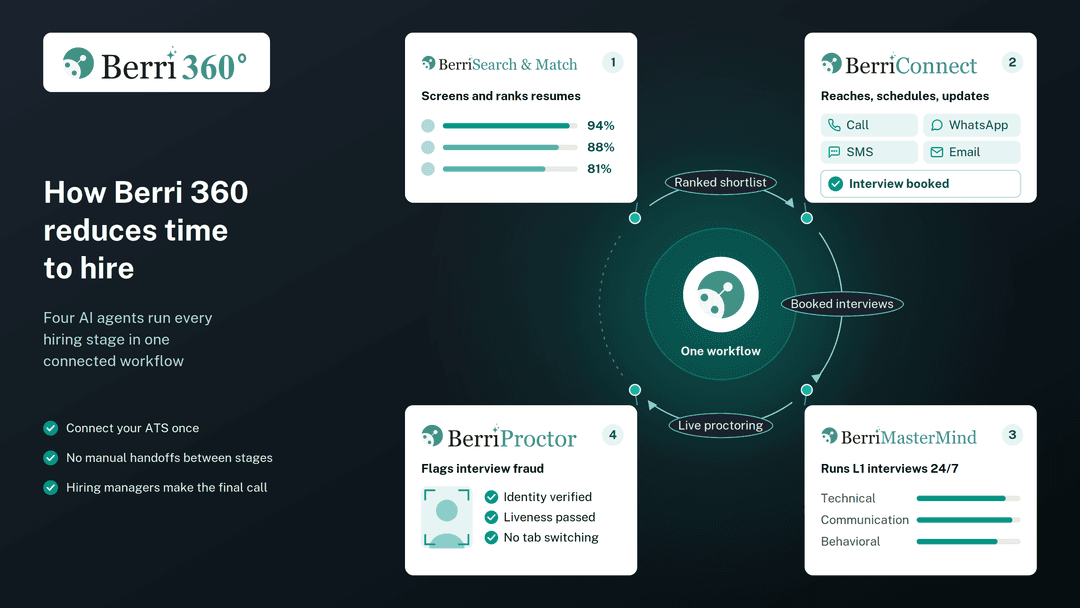
Berri 360 reduces manual handoffs by connecting shortlisting, outreach, interviews and verification on one candidate record. Its AI agents take defined actions, such as ranking applicants, contacting candidates and running first-round interviews. Recruiters choose the stages for each campaign, set the assessment bar and retain the final hiring decision.
Berri 360 also covers offer terms, verification documents and the joining checklist through day one. Its native Workday and SAP SuccessFactors integrations write scores and reports back to the applicant tracking system (ATS). A live pipeline board shows candidate progress, while manual moves are logged and failed technical steps can be retried.
1. How can recruiters screen resumes contextually?
Berri Search & Match ranks candidates against a job description using experience and skills, rather than keyword matches alone. Its Match Ranking Index (MRI) gives each candidate one comparable score for a specific role. Recruiters can inspect the skills behind a score, see gaps and override the ranking.
Berri Search & Match can also find people already in an ATS and re-rank earlier applicants for a different role. That gives recruitment teams a way to check existing talent before starting another sourcing cycle.
2. How can recruiters reach candidates across channels?
Berri Connect contacts candidates through verified calls, WhatsApp, SMS and email. Candidates can respond, return missed calls and receive follow-ups without a recruiter repeating each attempt. Berri Connect can also re-engage candidates already in the ATS.
Truecaller Verified calls help candidates identify who is calling. Recruitment teams should still tell candidates why Berri Connect is contacting them and how their information will be used.
3. How can recruiters schedule and reschedule interviews?
Berri Connect lets candidates choose an interview slot and handles reminders, time zones and rescheduling. The booking lands on the recruiter's calendar, reducing the messages needed to confirm a time. BerriBot reports a twofold increase in interview show-up rates with Berri Connect, although teams should measure that outcome against their own baseline.
For more on the scheduling workflow, see BerriBot's guide to candidate interview scheduling.
4. How can teams conduct first-round interviews at scale?
Berri MasterMind conducts structured first-round interviews and scores candidates against the same written rubric for the role. Follow-up questions adapt to each answer, and an insight scorecard is available after the interview. Recruiters can review the evidence before deciding who advances.
Berri MasterMind supports interviews in more than 140 languages. Candidate camera, microphone and audio checks help prevent setup problems before an interview begins. For a closer look at the format, see BerriBot's guide to AI interviewing for high-volume hiring.
5. How can teams check interview identity and integrity?
Berri Proctor verifies that the person answering is the invited candidate and flags evidence that needs human review. Its identity checks can match a candidate's face and voice to their ID at the start and throughout a remote interview. Three-dimensional liveness checks whether a real person is on camera rather than a recording or synthetic face.
Berri Proctor can flag extra voices, second screens and browser changes. Teams can use its live interview room or submit recordings from Zoom, Teams or Meet for post-interview analysis. A person reviews every integrity flag before it affects a candidate. That review matters when assessing potential smart-glasses-assisted interviews or other ambiguous evidence. BerriBot also explains how live checks differ from assessment proctoring.
6. How can teams keep candidates informed during hiring?
Berri Connect keeps interview communication moving through reminders, follow-ups and two-way responses. Candidates can return a missed call or respond to a message instead of waiting for another manual outreach attempt. Recruitment teams should define who owns broader application-status updates, especially after a hiring decision.
See how Berri 360 would run your hiring process from JD to onboarding. Book a demo
What results can teams expect from recruiting automation?
BerriBot reports shorter offer timelines and less recruiter administration from its connected recruiting workflow, but a buyer should test those results against its own process. BerriBot's reported outcomes describe different measures: recruiter hours per offer, time to offer and the share of selected candidates who receive an offer. None is automatically the same as time to hire.
Measure | BerriBot-reported result |
Recruiter administration | 9.5 recruiter hours saved per offer |
Offer timeline | More than 25 days reduced to a 10-day time-to-offer |
Select-to-offer ratio | 33% increased to 78% |
A Recruitment Ops Lead can evaluate whether the same gains are achievable with a bounded pilot:
Choose one job family and agree on a 200 to 500 interview pilot.
Record the current application-to-offer timeline, stage waiting times, show-up rate and recruiter hours per offer.
Compare pilot results with that baseline, and review scorecards, candidate feedback, integrity flags and manual overrides.
Speed needs an accountable decision process. BerriBot states, "Recruiters keep the final hiring decision; the agents rank, interview and verify but do not decide." BerriBot lists ISO 27001, SOC 2 Type II, consent for biometrics and documented retention among its safeguards. An InfoSec or privacy team should review the applicable evidence and legal requirements before deployment.
Frequently asked questions
What does time to hire mean? Time to hire is the number of days between a candidate applying for a role and accepting an offer. It differs from time-to-fill, which starts when the position opens.
What is Berri 360? Berri 360 is BerriBot's connected recruiting workflow for shortlisting, outreach, interviews, verification, offers and onboarding. Recruiters configure the stages and retain the final hiring decision.
How can Berri 360 reduce time to hire without more recruiters? Berri 360 reduces repeated screening, outreach and scheduling work while moving candidates between configured stages on one record. Recruitment teams still review the evidence and decide whom to hire.
Can AI conduct first-round interviews? Berri MasterMind conducts structured, conversational first-round interviews and produces rubric-based scorecards. Recruiters use those scorecards to decide which candidates advance.
Next step:
Want to hire faster without increasing your team size? Try Berri 360. Book a demo

Good at producing output, bad at finishing the job
That's the last tool you bought. This one owns the outcome end to end.
See the difference