



Answer in brief
Reframe your client work as evidence of engineering decisions, close the gaps in coding and design, and apply to product teams and GCCs with a focused preparation plan.
You can switch from a service based company to a product company by showing what you decided, built and improved, not just which client you served. Start with a skills gap check, turn delivery work into evidence of ownership, build one small product-style project, and prepare for the specific interview rounds your target roles use.
What Changes When You Move From IT Services to a Product Team?
A product-team switch usually changes the scope you own and the evidence interviewers ask you to provide. Service work can involve deep engineering, but a delivery-focused resume may hide your decisions behind project scope and client requirements. Product interviews often probe how you would build, operate and improve a feature after its initial release.
<table> <thead><tr><th>Question</th><th>Delivery-focused work</th><th>Product-focused evidence to show</th></tr></thead> <tbody> <tr><td>What did you own?</td><td>An assigned requirement or client deliverable</td><td>A technical decision and its consequences</td></tr> <tr><td>What counted as done?</td><td>Acceptance or release</td><td>Reliability, usability and iteration after release</td></tr> <tr><td>What might an interview test?</td><td>Project and technology knowledge</td><td>Coding, design trade-offs and ownership stories</td></tr> </tbody> </table>
A global capability centre (GCC) can also offer product-style engineering work. Judge the team, not its label: ask who owns the roadmap, who makes architecture decisions and who supports the system after release.
How Can You Find Your Biggest Preparation Gap in 10 Minutes?
A 10-minute gap check tells you whether to prioritise coding, design or clearer evidence of work you already do. For each area below, mark yourself strong if you can demonstrate it unaided, shaky if you need prompts, or missing if you lack an example.
Coding: Can you solve a medium-difficulty problem, explain complexity and test edge cases under a timer?
Design: Can you sketch an API, data model and failure path for a familiar feature?
Code quality: Can you show tests, readable changes and a reason for a design choice?
Production: Can you explain a bug, deployment, incident or performance issue you investigated?
Communication: Can you distinguish your contribution from the team's and defend a trade-off?
Turn a missing answer into a practice task. For a shaky production answer, seek a bounded task at work, such as tracing a slow endpoint or adding a regression test. Do not claim ownership of an entire client system when your contribution was narrower.
How Do You Turn Client Delivery Into Product-Impact Resume Bullets?
The Delivery-to-Product Impact framework turns a task description into evidence of judgment: context → your decision → mechanism → outcome. An outcome can be a measured result, a verified behaviour or a clearer operational process. Use numbers only when you can explain where they came from.
Area | Before | After |
Backend | Worked on client APIs using Java. | Changed the API's retry handling after tracing duplicate requests; added an idempotency check and regression tests, then verified repeat requests returned the expected response. |
Web | Developed dashboard screens for a client. | Reworked dashboard loading to fetch independent panels separately; tested loading and error states so one failed request no longer blocked the whole view. |
Data | Supported daily ETL jobs. | Added input validation and a retry path to a daily pipeline; documented how failed records were identified and replayed. |
These are rewrite models, not claims to copy. If you have measured latency or failure rates, add the baseline, new value and measurement method. If you lack approved metrics, lead with the mechanism and verification instead. Remove vague phrases such as “involved in,” and keep confidential client names and data out of your resume. If shortlisting remains difficult, use this resume diagnostic to check whether your strongest evidence is visible.
What Small Product Project Can Show Engineering Ownership?
One small, finished repository can show more ownership than several unfinished demos. Choose a backend API with a database and background job, a web app with authentication and error states, or a data pipeline with batch ingestion, incremental updates and tests. Pick the option closest to your target role.
On the first weekend, define one user problem, draw the data flow and build the smallest working path. On the second, add tests, logging, a failure case and a deployable demonstration. Use a third weekend only if documentation or deployment remains incomplete.
The README should explain setup, architecture, trade-offs and what you would improve next. If you report performance, describe your test environment and method rather than implying a laptop benchmark predicts production traffic. Ask yourself: What breaks if the job runs twice? How does a user see an error? Which design would you change at greater scale? Those questions turn the repository into an interview story.
How Can BerriTalent Make Your Skills Easier to Show?
BerriTalent lets you create reusable, verified skill evidence through one Berri Certified interview. After registering, you take a structured, adaptive interview that takes about 45 to 60 minutes and includes live coding where the role requires it. You receive a tier and feedback; Gold and Silver certified profiles can be routed to hiring managers at matching participating employers.
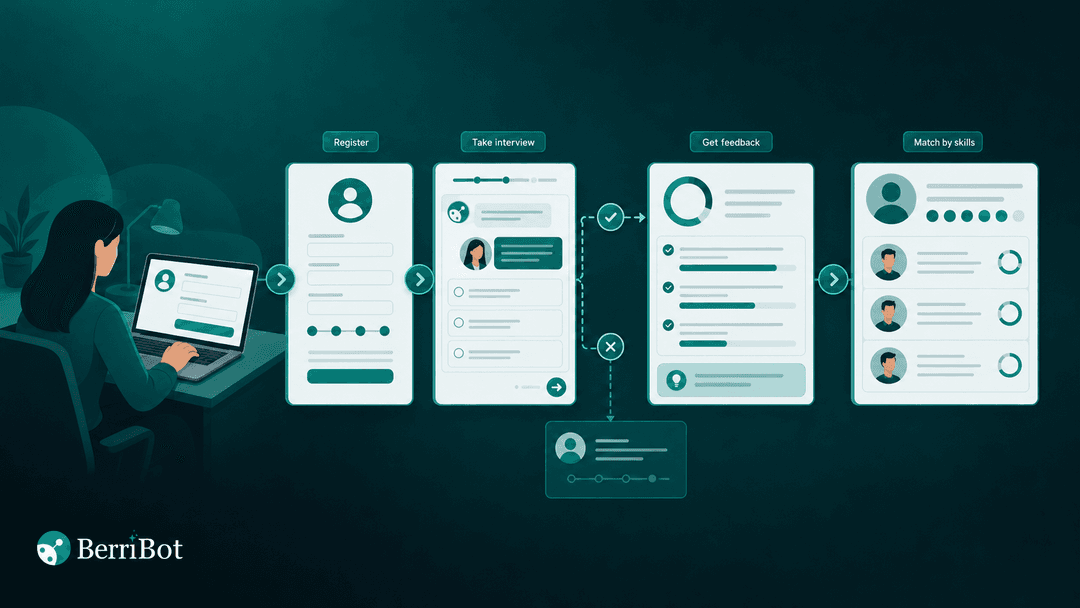
For a service-to-product switch, your resume and repository explain your experience, while certification provides another way to demonstrate skills without repeating the same initial screen at each participating employer. Certification does not guarantee an interview or offer. If you do not meet the bar yet, you receive feedback, access to Berri Tutor preparation and a retake after 30 days. BerriTalent is free for candidates, and certified profiles are shared with relevant hiring partners only with your consent at registration. Learn more about the interview and candidate data controls.
Build verified skill evidence with BerriTalent
What Does a Six-Week Preparation Plan Look Like Alongside a Job?
A six-week plan works best as a focused trial, not a promise that you will finish every interview topic. On ordinary weekdays, aim for a manageable coding session and a short review. During release weeks, keep the habit with one timed problem or a review of previous mistakes rather than trying to recover every missed hour.
Week | Main work | Checkpoint |
1 | Run the gap check; choose target roles; practise arrays and hash maps | Explain two work contributions clearly |
2 | Practise two-pointer and sliding-window patterns; start the repository | Complete one timed coding session |
3 | Cover trees or graphs; finish the core repository path | Review a coding mock and its mistakes |
4 | Add tests and failure handling; practise low-level design | Explain one design trade-off aloud |
5 | Rehearse a system-design sketch where relevant; tailor applications | Complete a mock in your weakest round |
6 | Rotate through coding, design and ownership stories | Dry-run each likely interview format |
Start applying when you can explain your work and attempt a timed round, even if preparation continues. In the final week, rehearse a repository walkthrough, a short design sketch and the resume bullets you expect an interviewer to challenge.
How Should You Prepare for Each Product Interview Round?
Product interview preparation should follow the rounds in each job description, because loops vary by team and experience level. Ask the recruiter what formats to expect rather than assuming every role includes high-level system design.
For a coding round, practise explaining the approach before typing, then test boundary cases. For machine coding or low-level design, build a small working solution with clear interfaces and tests; discuss what you would refactor with more time. For high-level design, clarify requirements, sketch components and data flow, then explore one bottleneck or failure mode. In a hiring-manager conversation, describe a decision you made, its trade-off and what happened afterward.
Backend candidates should be ready to discuss APIs, persistence and failures. Data candidates should explain data quality, reruns and pipeline observability. QA or software development engineer in test candidates should show test strategy, automation boundaries and how they diagnose flaky results. Revisit role-specific Spring Boot interview questions if they match your target stack.
How Should You Apply to Product Companies and GCCs?
Apply to product teams and GCCs whose role requirements match evidence you can defend, while using direct applications and relevant referrals in parallel. Tailor the top resume bullets to each role, and keep a simple tracker of the role, application date, contact and next step.
A referral request can be brief: “I work on Java APIs and recently improved retry handling and regression coverage. I’m interested in your backend role because it involves API ownership. Would you be comfortable reviewing my profile?” For GCC roles, ask about roadmap ownership, production support and the decisions made locally. State your actual notice period early, and use this India notice-period guide to plan the transition. You can also see roles matching your experience.
What Should You Check Before Your Next Application?
Your switch is ready to test when you have defensible work examples, a focused resume and a plan for the rounds your target roles use. Use this checklist to find the next concrete task, not to delay applying until everything feels perfect.
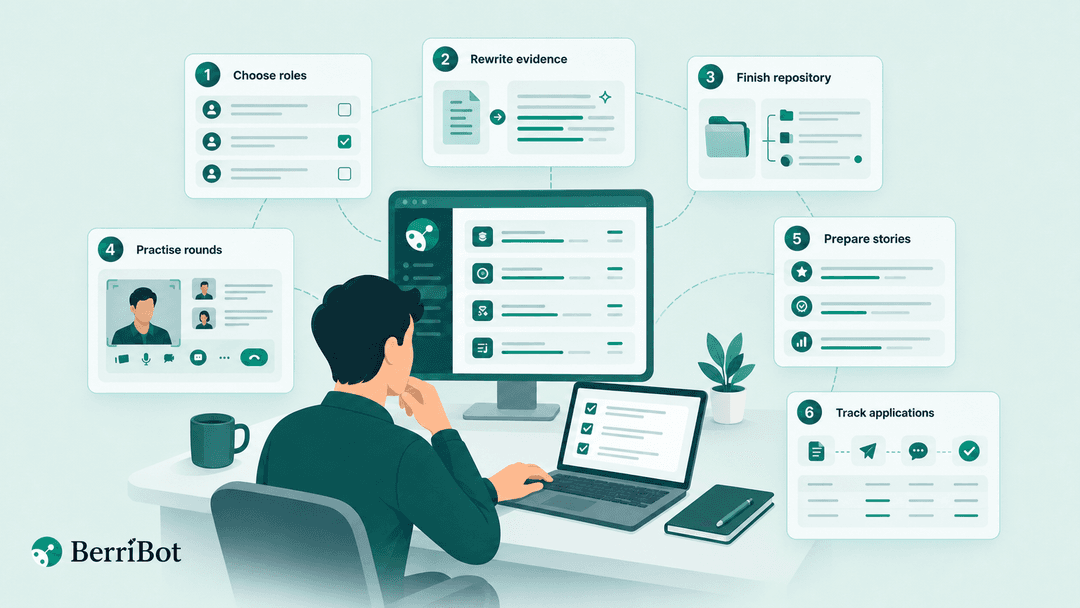
Choose roles: Pick backend, web, data or QA roles with requirements you can discuss honestly.
Rewrite evidence: Show your decision, mechanism and verification in your strongest resume bullets.
Finish repository: Make one project runnable, tested and documented.
Practise rounds: Time a coding problem and rehearse the relevant design format.
Prepare stories: Explain one production problem, one trade-off and your own contribution.
Track applications: Follow up where appropriate and keep practising from interview feedback.
A service-company background does not need disguising. Show the engineering judgment within it, then use each application and interview to learn which evidence needs to be stronger.
Interviews you can prove
Screening, interviews, and live identity verification in one platform. Built for high-volume technical hiring.
Book a demo