


Answer in brief
Prepare for Java interviews with 24 focused questions, short senior-level answers, follow-ups, and a framework for explaining trade-offs and production decisions.
At five years of Java experience, prepare to explain decisions, not just definitions. Interviewers may ask how you would diagnose latency, protect a service under load, choose a concurrency model, or release an API change safely. Practise each answer with a constraint, a trade-off, a way to measure success, and a likely failure mode.
How Can You Show System Thinking in a Java Interview Answer?
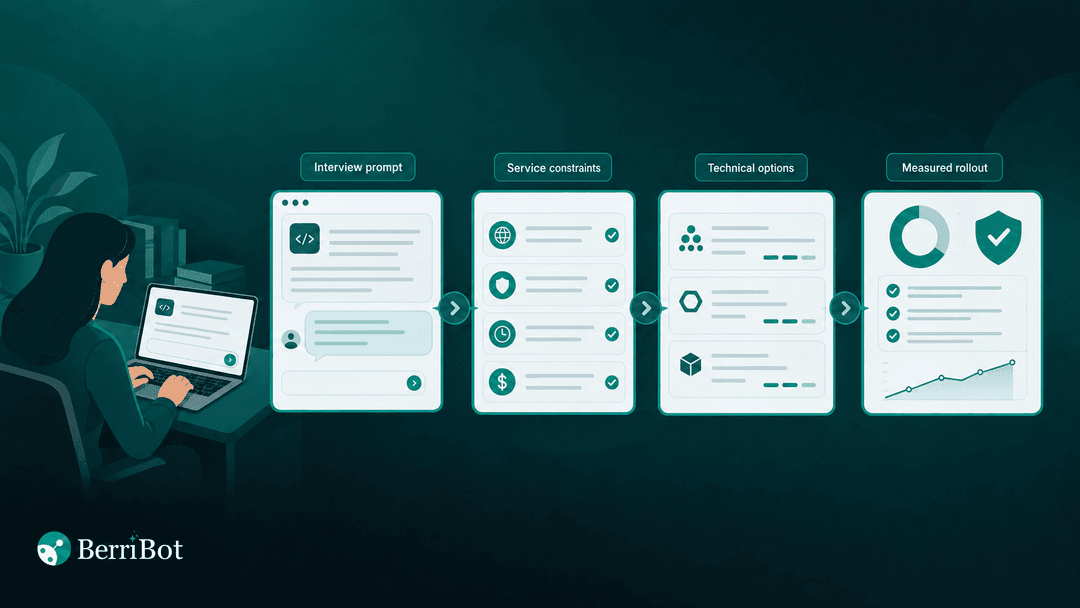
A strong Java answer connects a technical choice to the service’s requirements and shows how you would verify it. Use seven moves, spending about a minute on the first pass before following the interviewer’s questions:
Context: Name the workload and the user-visible problem.
Constraints: Ask about latency, throughput, memory, compatibility, and team capacity.
Options: Offer two plausible approaches, not every available tool.
Trade-offs: State what each approach improves and what it costs.
Failure modes: Describe overload, contention, partial failure, or rollback risk.
Measurement: Choose a service-level indicator (SLI), such as p99 latency or error rate, and a target.
Rollout: Propose a small release, monitoring, and a rollback condition.
For example, a 99.9% successful-request target allows 1,000 unsuccessful requests per million in the measured period. That calculation follows the error-budget method in Google’s SRE Workbook (2018). State the measurement period and which errors count before applying the budget.
Which Concurrency Questions Should a Five-Year Java Developer Practise?
Java concurrency answers should explain who owns shared state and what happens when work arrives faster than it can finish.
When would you use a fixed thread pool? Bound worker concurrency for a known workload; size and queue limits need load testing. *Follow-up:* What happens when the queue fills?
When do virtual threads help? Use them for many mostly blocking tasks, while still limiting database and downstream calls. Oracle’s Java 21 release post (2023) describes virtual threads as a permanent feature. *Follow-up:* Why does a connection pool still need a limit?
When is `volatile` insufficient? It provides visibility, not an atomic read-modify-write operation; use an atomic type or locking for shared counters. *Follow-up:* What if several fields must change together?
How would you investigate a deadlock? Capture thread dumps, identify the lock cycle, then enforce consistent lock ordering. *Follow-up:* How would you reproduce the issue safely?
When would you use `CompletableFuture`? Combine independent asynchronous calls when their latency warrants the added complexity; define timeouts and failure handling. *Follow-up:* Which executor runs the work?
Which Collections and API Design Questions Test Production Judgment?
Collections and API questions test whether a locally correct implementation stays predictable under concurrency, retries, and growth.
Why choose `ConcurrentHashMap`? It supports concurrent access to shared keys, but compound operations still need methods such as `compute`. *Follow-up:* What makes a mapping function unsafe?
How would you prevent a cache stampede? Coalesce loads for a hot key, add sensible expiry variation, and measure backend pressure. *Follow-up:* What happens when loading fails?
How would you design an idempotent POST? Associate an idempotency key with the request and its result so a retry does not repeat a completed operation. *Follow-up:* How long is the key retained?
How would you paginate a changing dataset? Prefer a stable sort and cursor when offsets could skip or duplicate items. *Follow-up:* What does the API promise about consistency?
For framework-specific follow-ups, practise Spring Boot interview questions for five years of experience.
What JVM and GC Questions Require More Than Definitions?
JVM and garbage-collection answers should begin with observed pauses, allocation, and service latency, not a preferred collector.
Why might you keep G1? Keep the current collector if measured latency and throughput meet targets; avoid tuning without a demonstrated problem. *Follow-up:* Which GC-log events correlate with p99 latency?
When might you evaluate ZGC? Test it when GC pauses materially threaten a tight latency target; compare CPU, memory, and throughput on the deployed Java version. *Follow-up:* What result would rule it out?
Does `MaxGCPauseMillis` guarantee a pause ceiling? No. Oracle’s Java 8 G1 tuning guide calls it a soft goal. *Follow-up:* What workload evidence would justify changing it?
How would you investigate an out-of-memory error? Distinguish heap exhaustion from other memory pressure, retain diagnostics, and inspect allocation or retention before increasing the heap. *Follow-up:* How would you avoid exposing sensitive data in a heap dump?
How Would You Prove a Java Performance Diagnosis?
A credible Java performance answer names the evidence you would collect before changing code or JVM flags.
Where would you start with high CPU? Compare process CPU with Java Flight Recorder (JFR) samples and thread activity. *Follow-up:* Is CPU spent in application code or GC?
What can a thread dump show? Use `jcmd <pid> Thread.print` to inspect stacks and lock contention; one dump is a snapshot. *Follow-up:* What changes across several dumps?
How would you record a short incident window? On an authorised test or production host, run `jcmd <pid> JFR.start name=latency settings=profile duration=60s filename=/secure/path/latency.jfr`; check overhead and access controls first. Oracle’s Java 25 `jcmd` documentation describes these commands. *Follow-up:* What would you inspect in the recording?
When would you trust a microbenchmark? Use it to isolate a code-level hypothesis, then verify the effect under representative service load. *Follow-up:* Could allocation or warm-up distort the result?
To diagnose a pause incident, align request-latency charts, GC logs, and a short JFR recording by time. Test any collector or flag change outside production first, change one variable, canary the release, and define a rollback threshold.
Which Reliability and Testing Questions Should You Prepare?
Reliability answers should show how a Java change behaves during retries, overload, and partial failure.
How would you limit incoming work? Set capacity at the constrained resource and reject or queue excess work deliberately. *Follow-up:* What does the caller see?
How would you test concurrent code? Combine invariant-based tests, repeated stress runs, and tests that control scheduling where possible. *Follow-up:* Why is one passing run insufficient?
How would you protect an API contract? Test request and response compatibility with consumers before release. *Follow-up:* Which changes can break older clients?
How would you roll out a risky change? Start with a small canary, watch latency and errors, and keep a rollback path. *Follow-up:* Who decides when to stop?
How should a client retry failures? Retry only suitable failures with limits, backoff, and jitter; account for duplicate effects. *Follow-up:* Can the total retry load overwhelm recovery?
What belongs in a timeout budget? Divide an end-to-end deadline among downstream calls and leave room to return a response. *Follow-up:* What happens after the deadline?
What does an error budget change? It gives the team a defined tolerance for failures against its service-level objective. *Follow-up:* Would you continue a rollout if the budget were nearly spent?
How Can You Turn a Basic Answer Into a Senior-Level Answer?
A senior-level Java answer makes the decision conditional and names the evidence that could change it.
GC prompt: G1 or ZGC? Basic answer: “ZGC has short pauses, so I would switch.” Stronger answer: “I would first check whether GC pauses coincide with p99 breaches. If they do, I would compare G1 and ZGC under the same workload, including CPU and memory headroom, then canary the change.” Expect a follow-up about the service’s actual latency target.
Design prompt: How would you handle a burst of requests with virtual threads? Basic answer: “Use virtual threads to handle more requests.” Stronger answer: “Virtual threads may make blocking request code easier to scale, but they do not increase database capacity. I would limit in-flight database work, return a clear overload response, and watch queueing time and error rate during a gradual rollout.” Expect a follow-up about fairness between callers.
What Trade-Off Checklist Can You Use During the Interview?
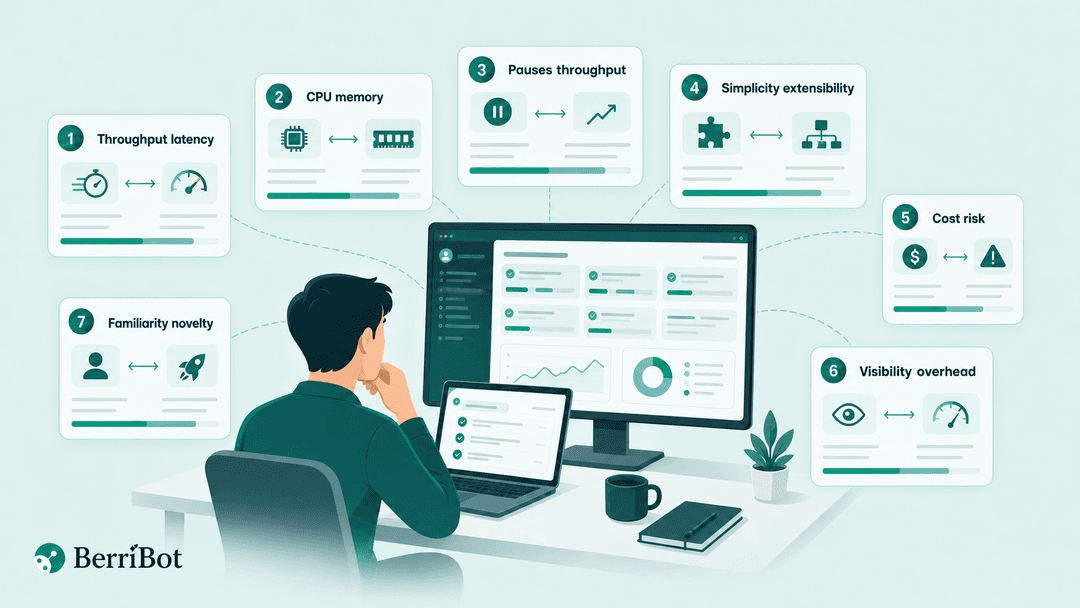
Use the trade-off checklist to choose two relevant tensions, then say how you would measure the decision. You do not need to recite every item:
Throughput versus tail latency
CPU versus memory
GC pauses versus throughput
Simplicity versus extensibility
Cost versus failure risk
Observability versus overhead
Team familiarity versus tool novelty
For a cache question, memory versus backend load may matter most. For a collector question, pause time versus throughput may matter more. State the constraint that makes your choice reasonable rather than claiming one option is always best.
How Can You Score Your Practice Answers and Use BerriTalent?
You can score a Java practice answer on four lenses, but this table is a self-assessment aid, not Berri MasterMind’s published scoring formula. Give each lens 0 for missing, 1 for partial, or 2 for clear evidence.
Practice lens | What earns a 2 |
Correctness | The Java behavior and limitations are accurate. |
Trade-offs | The choice responds to explicit constraints and alternatives. |
Design and reliability | Failure modes, measurement, and rollout are concrete. |
Communication | The main decision is clear before the detail. |
Berri MasterMind uses structured, adaptive interviews and explains scores. For technical roles, the Berri Certified interview can include live coding. BerriTalent lets you complete one free certification interview and, if certified at Gold or Silver, have your profile routed to hiring managers at matching partners. Certification does not guarantee an interview or a job.
Build verified skill evidence with BerriTalent
Where Can You Apply Your Java Interview Preparation?
You can compare your Java experience with current roles after practising the questions most relevant to your work. Prioritise openings where you can explain a production decision you made, the constraint behind it, and how you checked the result.
Interviews you can prove
Screening, interviews, and live identity verification in one platform. Built for high-volume technical hiring.
Book a demo