Recruiter productivity is how efficiently a recruiter can move quality candidates through the hiring pipeline. It is often measured by metrics like response rate, interview-to-offer ratio, or positions filled. To increase it, automate repetitive tasks using AI agents instead of simple automation tools.
Here is why.
Recruiters face challenges at every stage of the hiring pipeline, from sourcing candidates and screening resumes to coordinating interviews, answering candidate questions, and following up with hiring managers. They lose time on these repetitive tasks instead of spending it on high-value work like building strong candidate relationships and assessing cultural fit.
Adding one more simple automation tool or asking recruiters to work long hours cannot solve this problem. But AI agents that reason, adapt, and execute tasks on their own can.
In this blog, we explore the challenges that stop recruiters from being productive at each hiring stage, practical techniques that recruiters can apply on the job, and how AI agents make recruiters' work easier and help increase their productivity.
Irrelevant Search Results Slow Down Candidate Sourcing
Recruiters source candidates through channels like LinkedIn, Naukri, Indeed, and GitHub. Broad search queries on these platforms often return candidate profiles that only partially match the job, and that slows down candidate sourcing.
A search for “Developer” may return backend developers, Android developers, interns, architects, and candidates with basic Java exposure. The more generic the search, the more time recruiters spend filtering irrelevant profiles.
A simple technique to increase recruiter productivity during sourcing is to use Boolean search. Boolean search is combining keywords with search operators and symbols to create more precise search queries to retrieve relevant candidate profiles.
The most common Boolean search operators and symbols include:
AND to include multiple required skills or experience.
OR to search for similar job titles or technologies.
NOT to exclude unwanted criteria.
Quotation marks ("") to search for an exact phrase.
Parentheses () to group related terms.
For example, you're hiring an experienced Java Developer with expertise in backend frameworks, microservices, and cloud platforms.
Instead of searching:
Java Developer
You could search:
("Senior Java Backend Developer" OR "Senior Java Backend Engineer")
AND (Spring OR Spring Boot)
AND Microservices
AND (AWS OR Azure)
NOT (Internship OR Fresher)
This search immediately returns the strong candidate matches for the role.
Boolean search can be used across many of the platforms mentioned earlier with a slightly different platform-specific syntax, but the underlying logic remains the same. For recruiters managing multiple open positions, better search results translate into hours saved every week.
Resume Screening Challenges Go Beyond Reviewing More Profiles
Recruiters cannot manually screen every resume themselves, especially for remote roles that attract a high volume of applicants. So they use resume screening tools. But most of these tools shortlist resumes based on keyword matching which is not efficient today.
Keyword-based screening worked reasonably well when resumes were written manually. Today, candidates increasingly use AI tools to tailor their resumes to match job descriptions.
As a result, recruiters using a keyword-based screening tool often face two problems:
Resumes filled with the right keywords can move to the top of the shortlist without ensuring that the candidate can actually perform the job.
Candidates who genuinely fit the role may be overlooked because they describe their experience differently.
For instance, consider a company hiring a Senior Backend Engineer. The job description requires experience with microservices, AWS, Kafka, API development, and scalable architectures. Two candidates might describe that exact experience differently:
A keyword-based screening tool is more likely to favour Resume A because several terms appear exactly as written in the job description. Resume B may rank lower because it describes similar capabilities using different terminology. That’s an inaccurate ranking.
A contextual AI screening system approaches the same resume samples differently. Instead of looking for keyword matches, it evaluates the context behind a candidate's resume.
It understands that microservices are a common approach to building distributed systems. It recognises event-driven applications as experience closely related to messaging platforms such as Kafka. It connects cloud architecture with platforms such as AWS, even when the platform name isn't explicitly mentioned.
Rather than asking, "Does this resume contain the relevant keyword?", contextual screening asks, "Has this candidate demonstrated the capability required for this role?"
It is an AI agent that screens resumes contextually by analysing candidate skills, experience, responsibilities, capability, and alignment with job requirements. It helps recruiters identify candidates who closely match the role, even when they describe their qualifications differently.
Search & Match filters out mismatched candidates, allowing recruiters to spend their time reviewing only top talent profiles.
Managing Candidate Communication and Logistics at Scale Drains Recruiter Productivity
Recruiters contact candidates to check their interest for a new role, discuss salary expectations, understand notice periods, confirm interview availability, and schedule interviews. None of these conversations are particularly complex. The challenge is handling them at high volume.
When recruiters manage dozens of open positions simultaneously, repeating the same conversations hundreds of times every week leaves little room for higher-value work.
Many organisations automate this stage with chatbots. However, traditional chatbots often rely on pre-scripted questions and responses. They struggle to adapt to real-time candidate responses.
For example, think of a candidate saying, "I'm travelling this week. Can we move the interview to next Wednesday after 3 PM?"to a chatbot.
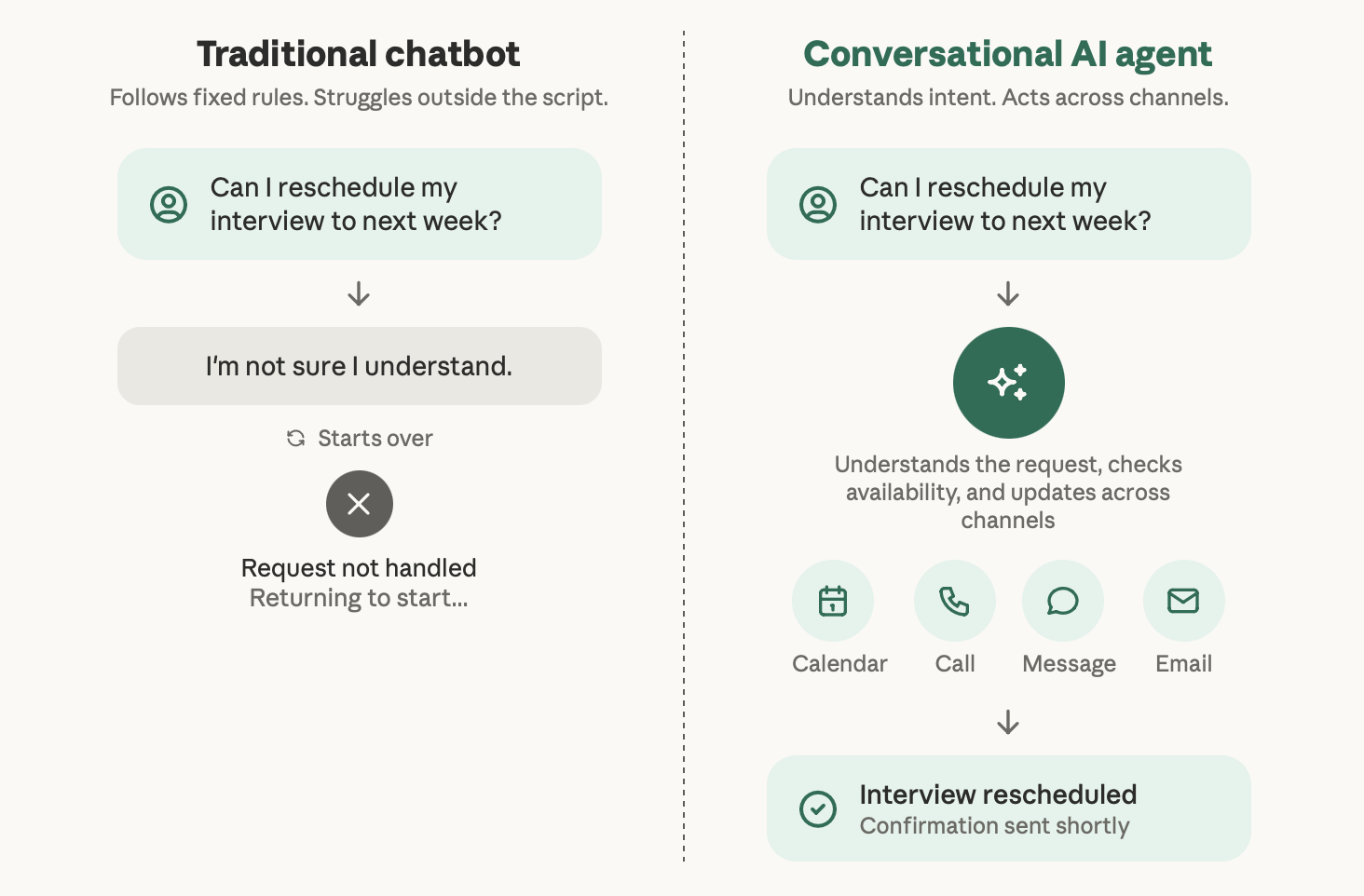
A rule-based chatbot may not know how to handle this request because the response falls outside its predefined workflow. It may direct the candidate back to the start of the scheduling flow instead of understanding the request and scheduling the interview.
Solving this challenge requires a conversational AI agent that understands the candidate’s request and processes it in real-time without human intervention. Instead of asking recruiters to switch between email, phone calls, WhatsApp, calendars, and interview scheduling tools, an AI agent can handle the entire interaction automatically.
Side-by-side comparison of a traditional chatbot and a conversational AI agent like Berri Connect handling a reschedule request.
For recruiters, that means automating tasks such as:
Screening candidates with basic qualifying questions
Confirming salary expectations and notice periods
Checking interview availability
Scheduling interviews
Sharing interview links
Sending reminders
Handling reschedule requests
Following up with candidates who haven't responded
Berri Connect does all of the above tasks at scale. It communicates with candidates in a natural, human-like tone through channels such as voice, SMS, WhatsApp, and email, increasing the candidate interview show-up rates by 2x and conversion rates to over 80%.
With Berri Connect, candidates receive timely updates, and hiring moves forward without unnecessary delays. Most importantly, recruiters remain involved where their expertise matters.
Post-Offer Follow-Ups Add Another Layer of Recruiter Work
After a candidate is offered a role, recruiters follow up with candidates on offer letter acceptance, submitting documents for background verification, completing onboarding forms, confirming joining dates, and more. These activities are essential to keep candidates on track to join. But they're also repetitive, time-consuming, and prevent recruiters from doing high-value work.
Following up with hundreds of candidates while continuing to source and screen for new roles is unsustainable. A slow response after an offer can reduce engagement, increase the risk of drop-offs, and leave recruiters scrambling to fill positions that were already considered closed.
Many organisations still manage this stage through a combination of emails, spreadsheets, phone calls, and calendar reminders. While this can work at smaller hiring volumes, it is not efficient for enterprise scale hiring.
The best approach is to automate routine post-offer communication using Berri Connect. It can automatically share offer-related updates, remind candidates to submit background verification documents, follow up on pending actions, and keep candidates engaged until their joining date.
Recruiters no longer have to remember every follow-up or manually track every response. Instead, they receive visibility into candidate progress while the AI agent manages routine communication in the background and improves the candidate experience.
Increase Recruiter Productivity With Berribot’s AI Agents
The repetitive admin tasks discussed above don't require recruiter expertise. Individually, these tasks seem small. Collectively, they become the biggest barrier to recruiter productivity. That's why enterprise recruitment teams are increasingly adopting Berribot's AI agents across the hiring pipeline. They work alongside recruiters to handle repetitive tasks while freeing recruiters' time to focus on higher-value hiring activities.
To solve day-to-day challenges faced by your recruiters and increase their productivity, consider automating your entire hiring process with Berribot’s AI agents.
1. What metrics show whether recruiter productivity is actually improving? Response rate, interview-to-offer ratio, and time-to-fill are better indicators of recruiter productivity than activity numbers like outreach volume.
2. Why doesn't adding more recruiting tools improve productivity? Most recruiting tools solve problems at a stage level, for example sourcing, screening, and scheduling, with no integration between them. Recruiters waste their time manually moving data between these tools.
3. How is a conversational AI agent different from a recruiting chatbot? A traditional chatbot follows pre-scripted flows and struggles with requests outside them, like a candidate asking to reschedule an interview. On the other hand, a conversational AI agent understands the request in context and acts on its own without human intervention.
4. Do AI recruiting agents replace recruiters, or work alongside them? They work alongside recruiters. AI agents take over repetitive admin work like screening, scheduling, and follow-ups, so recruiters can focus on high-value hiring tasks.
5. Does using AI agents in hiring affect candidate experience? No. Candidates get faster responses, consistent updates, and significantly fewer drop-offs. The recruiter's role also shifts toward the parts of candidate experience that benefit from a human, like building the relationship and supporting the final decision.
Have more questions about how this works for your team? Let's talk.